

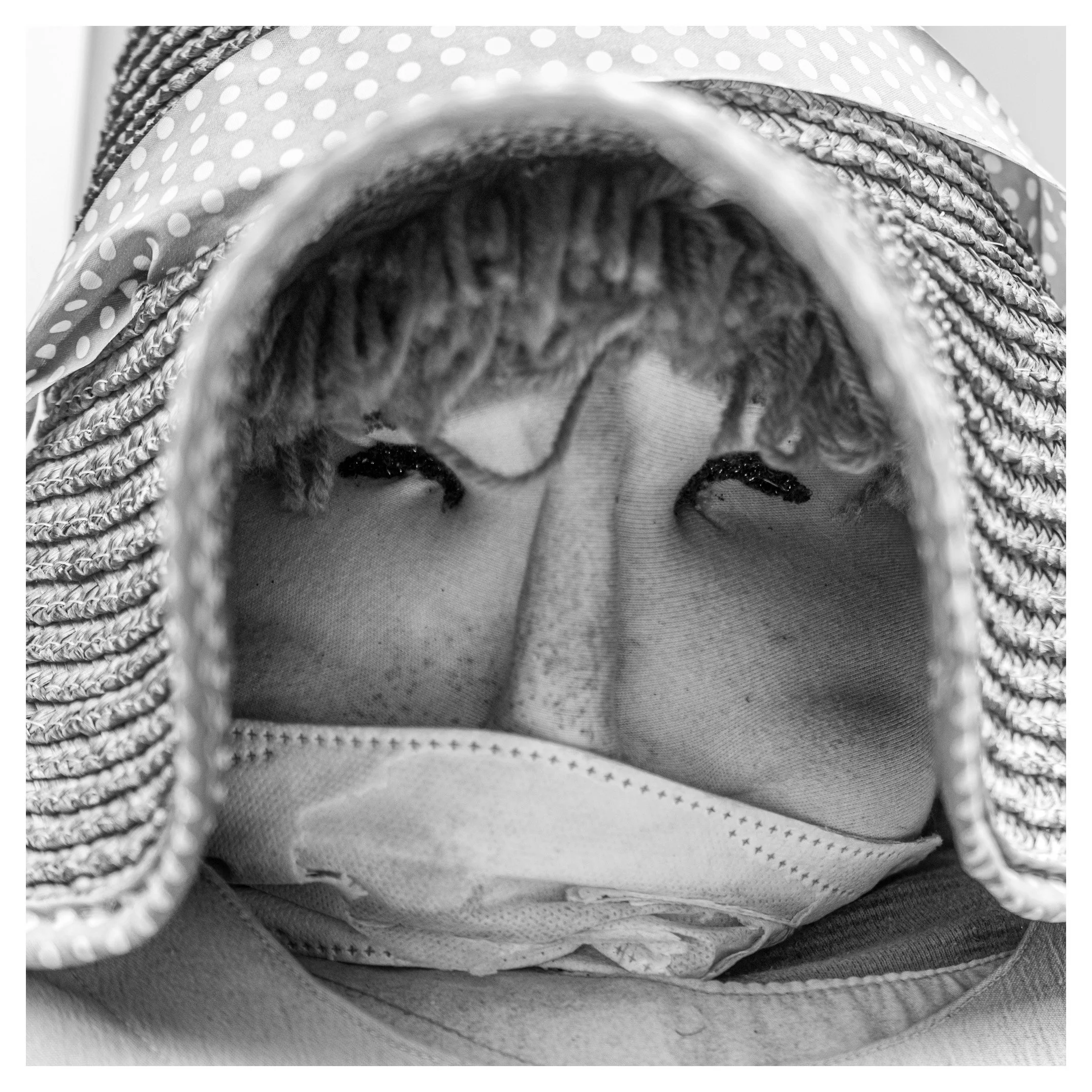
There is a quiet, profound discomfort that sits within the deep shadows of Shikoku Island. In the remote village of Nagoro, where the living population has dwindled to single digits, the empty spaces have been systematically populated by inanimate lookalikes. The image under review today, peers directly into this uncanny valley, offering a tightly framed, monochromatic study of one such resident.
Below is the technical fingerprint of the frame:
Camera Model: Leica D-Lux 8
Shutter Speed: 1/126
Aperture: f2.8
ISO: 200
Anatomy of the Image: The Graphic Presence
What makes image.png immediately compelling is its unflinching graphic composition. By opting for a square crop and filling the frame entirely with the face, the photographer eliminates all environmental distractions. We are not permitted to see the rural isolation of Nagoro; instead, we are forced into an uncomfortably intimate dialogue with an object stitched to resemble humanity.
The choice of monochrome is excellent here. It translates what could have been a colorful, folk-art artifact into a stark, textured psychological portrait. The harsh, downward-slanting black lines that form the eyes carry an immense weight—they look tired, ancient, and sorrowful. The contrast between the rigid, fibrous patterns of the woven straw hat and the coarse, uneven weave of the fabric skin creates a rich tactile experience.
The inclusion of the crinkled medical mask across the lower portion of the face acts as a powerful temporal anchor. It superimposes a highly contemporary symbol of global human anxiety onto a traditional rural craft, intensifying the feeling of societal decay and silent endurance.
Room to Evolve: Shifting the Focus
While the graphic impact of image.png is undeniable, there are technical and compositional shifts that could elevate its narrative depth:
Embrace the Imperfect Sharpness: At an aperture of f2.8 on the Leica D-Lux 8's sensor, the depth of field is relatively shallow when working at such a close distance. The focus appears to sit predominantly on the central ridge of the nose and the top edge of the medical mask, leaving the stitched eyes slightly soft. In a portrait—even an inanimate one—the eyes are the emotional anchor. Closing down the aperture slightly to f4 or f5.6 would pull the eyes, the loose yarn fringe, and the textured hat into uniform sharpness, sharpening the psychological bite of the image.
The Tension of Inaction: The framing is perfectly symmetrical, which enhances its object-like quality. However, a minute shift in camera angle—perhaps tilting slightly upward to catch the underside of the hat’s brim, or pushing slightly off-center—could inject a sense of dynamic tension, making the figure look less like a recorded object and more like a presence caught mid-thought.
The Metadata Ledger: Becoming a Better Photographer Over Time
True growth in photography rarely happens by accident; it happens through meticulous self-analysis. To evolve your eye, you must begin treating your metadata as a diagnostic tool.
Start building a personal digital ledger where you catalog your selected images alongside their technical details, but take it a step further. Group your images by focal length, aperture, and lighting conditions. Over six months, analyze the data trends.
Are you consistently leaning on a shallow f2.8 depth of field when a sharper f5.6 would yield more texture? Does your shutter speed choice suggest a hesitation to introduce intentional motion blur? By cross-referencing your camera data with your emotional satisfaction with a shot, you move from intuitive shooting to conscious mastery.
Masters of the Craft: Intellectual Homework
To further refine your documentary and street eye, look closely at how legendary image-makers handle isolation, texture, and the bizarre nature of human existence:
Photographers to Study:
Diane Arbus: The absolute master of confronting the unusual, the marginalized, and the uncanny with a confrontational, square-format perspective. Study her ability to make the familiar look strange and the strange look familiar.
Masahisa Fukase: Dive deep into his seminal work The Solitude of Ravens. His raw, high-contrast monochrome imagery is a masterclass in using texture to convey profound, haunting isolation and grief.
Books to Read:
Thoughts on Landscape by Takuma Nakahira: An essential text for understanding postwar Japanese photography philosophy. Nakahira’s essays will challenge how you perceive the relationship between the camera, the city, and the objects left behind.
The Americans by Robert Frank: Observe how Frank utilizes unconventional framing and grain to extract raw, unvarnished poetry from everyday scenes.
Videos to Watch:
For a deep dive into the practical reality of working with the specific tool used for this frame, watch the video [Actual Shooting] Ginza photographed with a Leica D-LUX 8 to see how its unique rendering of black-and-white tones handles high-contrast urban textures and swift, street-level adjustments.
To understand how a master orchestrates complex street layers, framing, and light, watch the documentary profiling the work and methodology of Magnum photographer Alex Webb: Alex Webb: The Suffering of Light.