

Day 241/365 The Manufactured Horizon: Architectural Illusion and Spatial Authority
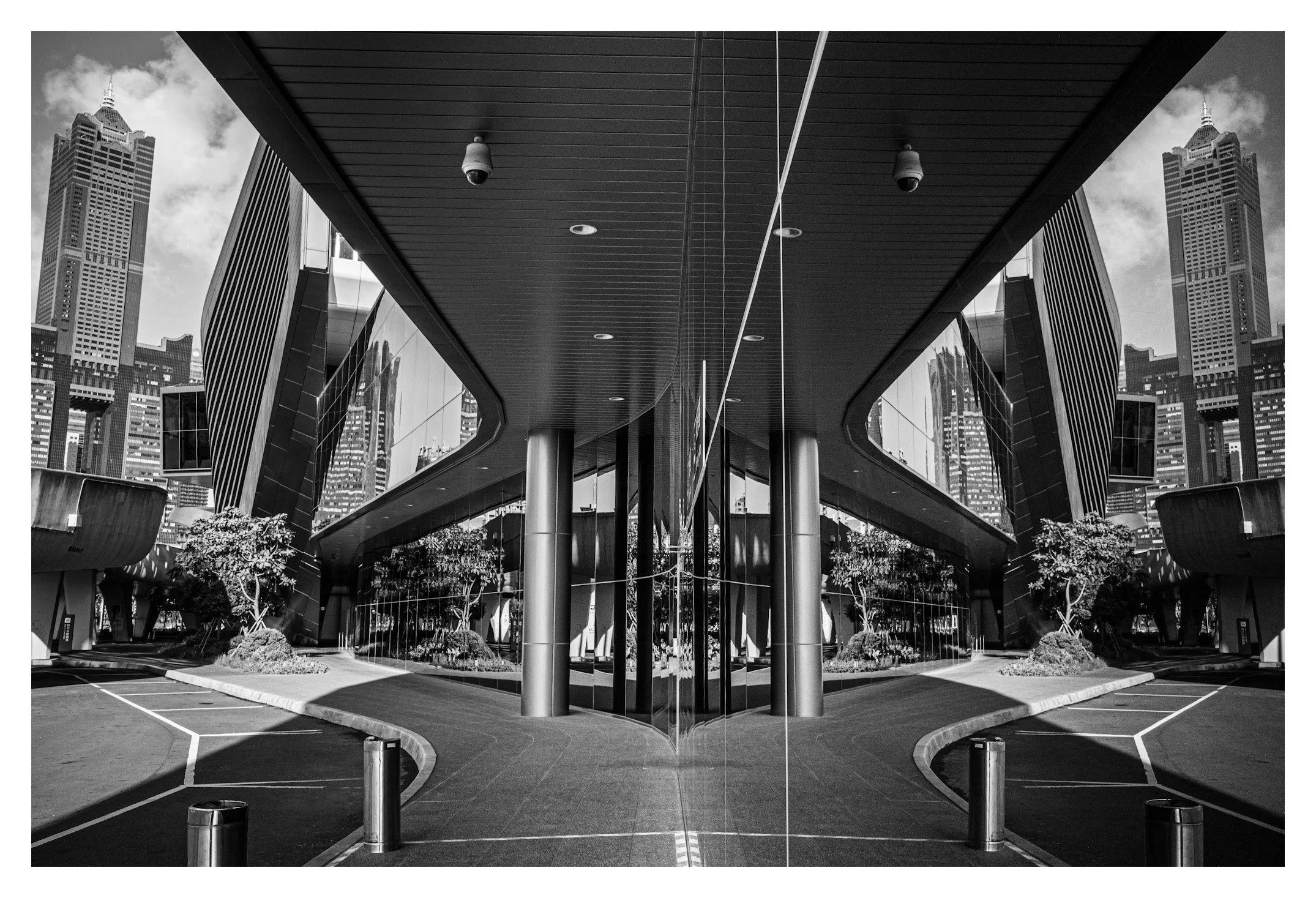
An ordinary modern transition zone is forced into a state of absolute graphic symmetry. You’ll discover how a split-second positioning shift alters the underlying psychological tension of a cityscape, and why tracking your camera mechanics transforms subconscious habits into deliberate visual style.
Image Metadata
Camera Model: Ricoh GRIII
Shutter Speed: 1/400
Aperture: f5.6
ISO: 200
Architectural Symmetry and Form Analysis
The frame functions as a rigid exercises in structural geometry, slicing an urban environment into a perfectly mirrored landscape. By placing a heavy overhead canopy as a central wedge, the composition forces a dramatic perspective shift that pulls the viewer deep toward a central vanishing point. The flanking monolithic skyscrapers act as vertical gatekeepers, balancing the intense reflective symmetry across the central glass pane. It is a calculated, clean perspective that captures the imposing scale of modern city infrastructure.
Yet, this severe perfection carries a clinical stillness. The presence of security cameras and cold metal bollards strips the space of organic warmth, transforming an everyday public corridor into an imposing landscape of architectural surveillance and artificial structure.
Critical Adjustments for Visual Tension
To push this formal composition beyond an architectural study and into a compelling document, consider these visual corrections:
Introduce Scale and Friction: The geometric precision is so absolute that it lacks a human counter-weight. Allowing a solitary, moving silhouette to break the clean lines of the pavement on one side would introduce narrative friction, immediately giving the viewer a sense of scale and emotional contrast against the architecture.
Refine the Focal Alignment: In an image built entirely on precise geometric axes, even fractional errors become obvious. Looking closely at the lower boundary, the curved curbs meet the frame at slightly uneven angles. A minute lateral adjustment of the camera chassis—moving only a few millimeters to the right—would harmonize these bottom anchor points perfectly.
Control Spatial Resolution: While f5.6 delivers strong performance on a wide lens, stepping down to f8 or f11 ensures that the deep facade textures of the distant skyscrapers maintain the exact sharpness found in the immediate foreground pillars.
Long-Term Growth: The Analytical Framework
True progression in photography requires moving past reliance on pure artistic intuition and analyzing your work as a structured dataset. By cataloging the structural decisions behind your frames, you turn random successes into a repeatable, evolving method.
Track these core parameters across your archive using standard text logs:
Meta Factors: Calendar Date, Exact Time of Day, Nature of Environment
Technical Profile: Lens Focal Length, Chosen Aperture, Shutter Duration, Sensor ISO
Structural Architecture: Composition Pattern (such as Symmetry, Triadic, or Negative Space), Dominant Axis, Light Behavior
Reviewing this systematic log every few months will reveal clear technical signatures. You will identify whether you rely too heavily on a specific light angle or aperture value, giving you the clarity needed to intentionally disrupt your own patterns and venture into unexplored stylistic choices.
Curated Research and Educational Resources
Photographers to Analyze
Michael Wolf: Essential reading for his clinical look at urban density, containment, and structural geometry. Look closely at his spatial isolation tactics to see how structural repetition strips down or highlights human presence.
Robert Frank: The definitive reference for breaking rigid aesthetics to find raw, narrative truth. Inspecting his handling of street geometry offers a stark contrast to sterile architectural compositions.
Essential Literature
The Americans (Robert Frank): An unmatched masterclass in tone, mood, and compositional subversion within a documentary framework.
Tokyo Compression (Michael Wolf): A harrowing, brilliant exploration of architectural confinement and human adaptation in dense urban structures.
Recommended Video Masterclasses
Joel Meyerowitz - What Makes a Great Photograph – An insightful breakdown of framing, spatial awareness, and finding order within urban environments.
Michael Wolf - Complexity and Density in the Modern City – A deep dive into how strict framing and a clear focus on architectural layout expose the psychological weight of city planning.