

Day 240/365 Monolithic Melancholy: Carving Light at the Kaohsiung Music Center
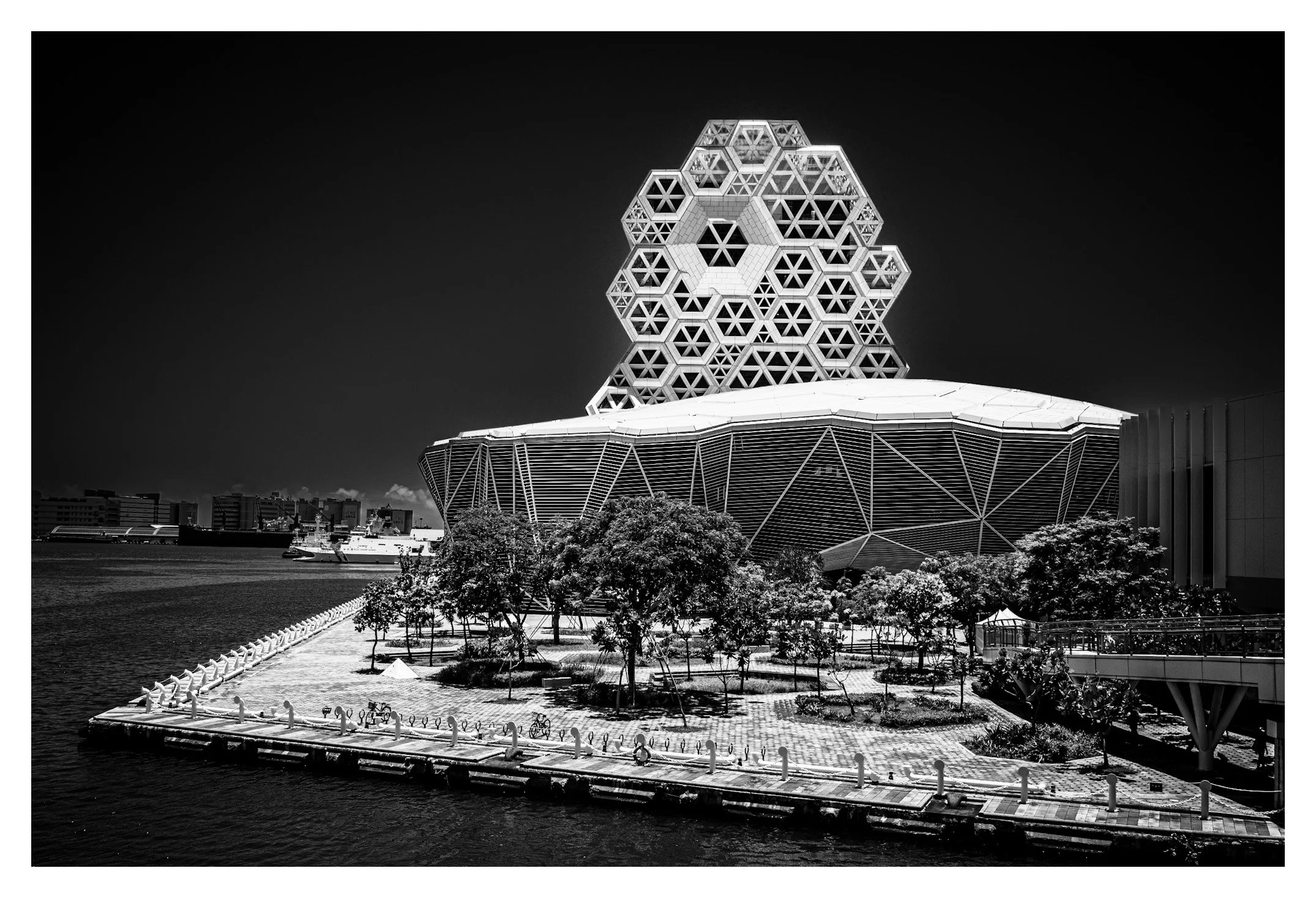
Discover how a stark black-and-white approach completely transforms contemporary architecture into a study of pure geometry and emotion. You will learn why embracing deliberate technical limitations can elevate your street frame and how tracking your patterns reveals the true path to visual mastery.
Camera Model: Ricoh GRIII
Shutter Speed: 1/1000
Aperture: f5.6
ISO: 200
The composition captured here presents a striking dialogue between nature and the ultra-modern architecture of the Kaohsiung Music Center. By rendering this scene in a high-contrast monochrome palette, the image sheds the casual distractions of color, choosing instead to focus entirely on texture, form, and structural repetition.
The heavy, ink-black sky serves as a profound backdrop, forcing the intricate, organic honeycomb patterns of the upper tower to explode forward with dramatic luminance. Below it, the fractured, low-slung geometric canopy anchors the frame, while the foreground park provides a delicate, chaotic counterpoint to the rigid, mathematical certainty of the buildings.
Refinement and Improvement
While the frame carries undeniable graphic strength, a few adjustments could elevate its impact from a successful architectural record to a deeply evocative piece of art:
Mind the Distractions: Along the far-left horizon, the distant industrial ships and buildings pull attention away from the central architectural harmony. A slightly tighter crop or a shift in your physical positioning could isolate the primary structure completely against the water and sky.
Foreground Balance: The walkway and barricades running along the bottom edge introduce a rigid diagonal that competes slightly with the clean geometry of the center. Waiting for a single, well-placed human silhouette on that path would introduce a vital element of scale and human emotion.
Tone Down the Vignette: The darkening in the upper corners is a bit heavy-handed. Softening the vignette will ensure the deep sky feels like an expansive, natural void rather than a digital choice.
Evolving Through Image Data
To truly master your craft over time, look inward at the data you are already creating. Every time you press the shutter, your camera records a digital footprint. Begin a practice of compiling and auditing your metadata over months-long periods.
Create a simple log to track your most frequently used focal lengths, apertures, and the times of day you shoot. If you notice a high concentration of shots at f5.6 during harsh midday light, challenge yourself to shoot exclusively at twilight or wide open for a week. By analyzing your metadata, you diagnose your creative habits, allowing you to intentionally break out of comfort zones and build a more versatile visual vocabulary.
Masterclass Studies
To expand your perspective on form, light, and the urban landscape, dedicate time to studying these foundational creators and resources:
Photographers to Research
Fan Ho: A master of using uncompromising light, shadow, and geometry to turn everyday city corners into cinematic masterpieces.
Michael Wolf: Famous for his series Tokyo Compression, his work is an essential study in how to use extreme framing to strip away the horizon and emphasize architectural density.
Books to Read
Thoughts on Street Photography by Matt Stuart: An insightful look into the mindset, humor, and relentless observation required to find extraordinary moments in ordinary spaces.
Uncommon Places by Stephen Shore: A masterclass in how to evaluate structural form, scale, and the quiet vernacular of the built environment.
Videos to Watch
To understand how classic visionaries manipulated scale and contrast, watch the documentary essay Fan Ho: The Photographer Who Saw Silence in Chaos on YouTube.
For deep technical and artistic insights into framing structures, explore the lessons on the Steven Brooke Photography YouTube Channel.