

Day 245/365 The Harbor's Edge: Isolation and the Geometry of the Street
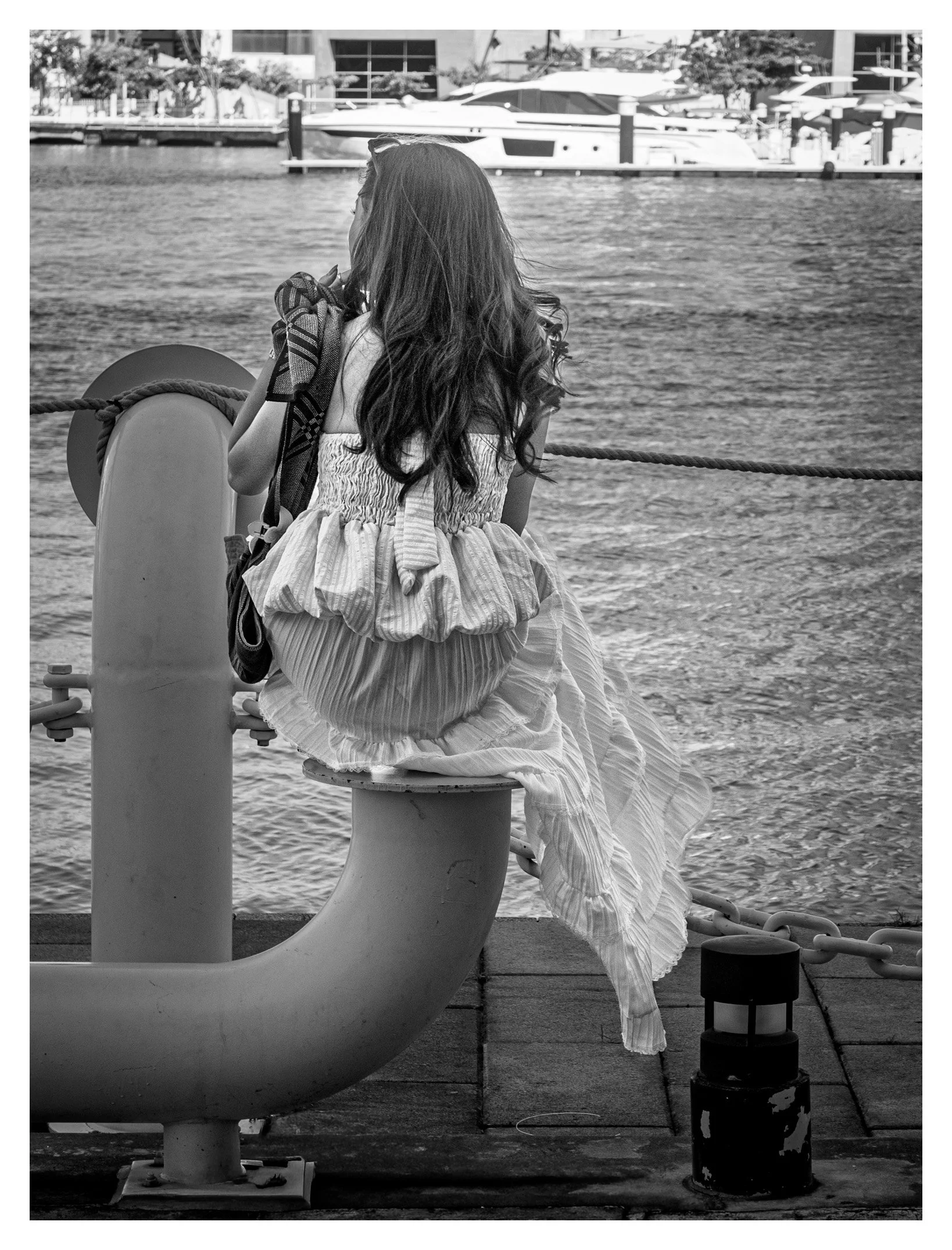
A solitary figure at the edge of Kaohsiung Harbour reveals the delicate balance between human emotion and urban clutter. You'll learn why minor adjustments in framing and a sharper awareness of background intersections can transform a casual candid into a timeless street portrait.
EXIF Data
Camera Model: Leica D-Lux 8
Shutter Speed: 1/200
Aperture: f5.6
ISO: 200
The Critique: Form, Texture, and the Battle for Space
There is an undeniable romanticism in looking at a subject from behind—it forces the viewer to share their gaze, to wonder what occupies their thoughts as they stare out into the open water. By stripping away color, you have rightly forced us to focus on the interplay of pure tone and texture. The cascading dark values of the subject's hair create a beautiful anchor against the high-key, tactile ruffles of her dress.
However, street and documentary photography is as much about what you leave out of the frame as what you keep in.
The primary challenge in this composition is the battle for visual dominance. On the left, the massive, curved architectural bollard commands an enormous amount of frame real estate. Because its smooth surface shares a similar mid-tone value with the lower half of the subject's dress, her silhouette becomes pinned against it rather than isolated by the water. Furthermore, the sharp, geometric lines of the luxury yacht and dockside infrastructure in the deep background slice directly through the subject’s head. This creates visual friction, pulling our eyes away from the human element and trapping them in the top third of the frame.
Refining the Frame: Technical and Compositional Adjustments
To elevate a scene of this nature, you must actively manage the relationship between your foreground subject and the background chaos:
Change Your Angle of Approach: Stepping two paces to your right would have decoupled the subject from the heavy bollard on the left. This simple shift would utilize the open water as a clean, high-contrast canvas to fully isolate her form.
Decouple with Depth of Field: At f5.6, the background elements retain too much structural definition. By opening your lens to f2.8 or f4, you can gently soften the yachts and buildings into a painterly backdrop, ensuring the background serves the subject rather than competing with her.
Isolate the Horizons: Always scan the edges of your subject before pressing the shutter. Ensuring that safety ropes, distant docks, or ship masts do not intersect or "cut" through a person's head or neck preserves the emotional clarity of the silhouette.
Building Your Craft: The Analytical Approach to Photography
To grow from a competent shooter into a master of the craft, you must move past emotional curation and begin analyzing your work systematically. I recommend establishing a digital ledger to track the anatomy of your frames over time.
Do not just log basic camera metadata. Instead, categorize your images by Intent and Compositional Style (e.g., Environmental Portrait, Layers/Juxtaposition, Silhouette). Most importantly, create a dedicated column for Primary Visual Distraction.
When you review your work on a large monitor at the end of each month, objectively note what went wrong: Was it an overlapping line? A hot spot of light? An intrusive foreground element? By tracking these recurring errors across hundreds of frames, you will identify your personal blind spots. Eventually, your brain will automatically flag these distractions before you click the shutter, fundamentally altering how you see on the street.
Curated Assignments for Study
Photographers to Research
Masahisa Fukase: To understand how high-contrast monochrome can be used to convey profound isolation and psychological depth, study his masterpiece Ravens. His work will show you how to embrace raw, dark tones to evoke deep moodiness.
Garry Winogrand: The antithesis of minimalism, Winogrand’s work is a masterclass in managing immense urban energy and chaotic frames. Study his tilt and wide-angle compositions to learn how to find order within sprawling street scenes.
Essential Reading
"The Decisive Moment" by Henri Cartier-Bresson: The absolute bible of photographic geometry. Reading his philosophies on the perfect alignment of form, line, and time will completely change how you position yourself relative to your background elements.
"Uncommon Places" by Stephen Shore: Though shot in color on large format, this text is crucial for understanding structural discipline. Shore's absolute precision with borders and spatial arrangements teaches you how to give every single object inside the frame its own deliberate breathing room.
Critical Video Material
"How to Composed like Fan Ho": A brilliant visual breakdown of how the master of light and shadow utilized bold architectural lines, deep shadows, and singular human figures to slice through urban clutter. Watch on YouTube
"Garry Winogrand - The Animals (1960s Street Photography)": Footage and analysis of Winogrand's relentless, high-energy approach to framing, demonstrating how to capture authentic, unposed human behavior in public spaces. Watch on YouTube