

Day 244/365 The Theatre of the Flesh: Chaos and Confrontation in the Wet Market
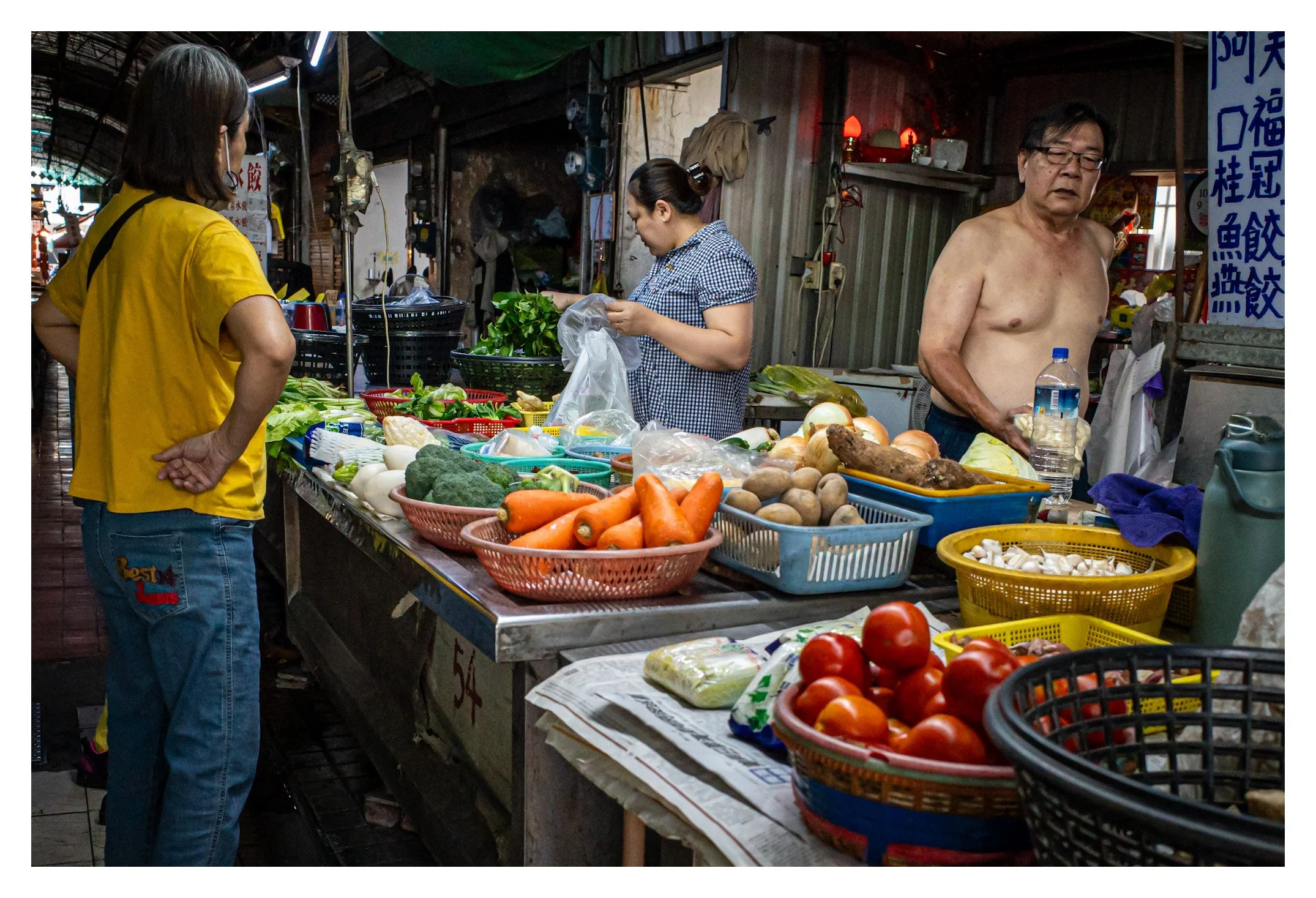
Behind the vibrant, stacked displays of a bustling street market lies a complex web of spontaneous human drama. You will learn how minor adjustments in physical vantage point and timing can elevate a dense, chaotic snapshot into a gripping environmental narrative that refuses to let the viewer look away.
EXIF Data
Camera Model: Ricoh GRIII
Shutter Speed: 1/320
Aperture: f3.2
ISO: 3200
The Critique
There is a raw, electric friction at play in this frame. Wet markets are notorious for overwhelming the senses, yet here you have managed to slice through the noise and capture a classic narrative triad. The visual weight shifts dynamically between three distinct human pillars: the woman on the left in her brilliant yellow shirt who serves as our compositional anchor, the vendor in the center absorbed in the quiet rhythm of labor, and the shirtless man on the right. It is his direct, unblinking gaze that shatters the fourth wall, injecting a sudden psychological tension into an otherwise domestic scene.
Your color palette is remarkably punchy. The deep reds of the foreground tomatoes and the warm orange carrots lead the eye down an intentional diagonal path. The industrial textures—the weathered corrugated metal, the exposed wiring, and the harsh fluorescent glow—give the image an undeniable authenticity. It feels heavy, humid, and entirely real.
Areas for Improvement
To push this image from a strong slice-of-life document into a truly masterful street photograph, you must contend with the chaotic geometry of the market stall.
Purge Foreground Clutter: The dark plastic basket in the bottom-right corner is sliced awkwardly by the frame line. It draws unnecessary visual weight away from the subjects. Stepping a few inches to your left or slightly tilting your axis upward would drop this dead weight and give the midground elements more room to breathe.
Create Negative Space Around Profiles: The woman in yellow is captured from a direct side profile, which flattens her against the left edge. A slight shift in your physical positioning would create a sliver of negative space between her back and the background, allowing her posture to frame the market stall more elegantly.
Wait for the Clean Gesture: While the central vendor adds context, she is slightly obscured by hanging bags and foliage. In dense street photography, a fraction of a second makes the difference between a cluttered midground and a perfectly isolated gesture. Patience is your greatest tool when waiting for the elements to align.
Elevating Your Craft Through Data Tracking
Becoming a world-class photographer is not just about intuitive looking; it is an analytical pursuit. To systematically refine your vision, you should begin compiling technical metadata on your shoots to uncover hidden behavioral patterns.
Track Your Focal Planes: Analyze your most successful environmental portraits over a six-month period. Document whether you lean toward wider apertures like f3.2 or if your storytelling strengthens when you stop down to f8 to pull the entire environment into sharp focus.
Analyze Shutter Speeds Against Human Gesture: Review frames where a subject's hands or facial movements felt slightly soft. Tracking whether a shutter speed of 1/320 effectively freezes the fast-paced, unpredictable interactions of street vendors versus a faster speed like 1/500 will sharpen your technical muscle memory.
Correlate ISO to Atmospheric Texture: Monitor how your camera sensor handles high-gain environments. Documenting the exact threshold where digital noise stops looking like classic film grain and begins destroying crucial environmental textures will allow you to make more deliberate exposure compromises in low light.
Resources for Further Study
To expand your visual vocabulary and discover new ways of organizing complex, multi-layered environments, immerse yourself in the following masters.
Photographers to Research
William Eggleston: Study his legendary use of color, particularly how he transforms mundane, everyday objects into arresting visual statements.
Garry Winogrand: Analyze his explosive energy, his use of tilted horizons, and his unmatched ability to capture the chaotic dance of human crowds.
Mary Ellen Mark: Research her profound documentary approach, observing how she establishes immediate intimacy and dignity with subjects in complex, gritty environments.
Books to Read
The Americans by Robert Frank: A seminal masterclass in look, rhythm, and capturing the raw, bittersweet truth of a culture from the perspective of an outsider.
Suffering by Inside Design by Alex Webb: A brilliant look into complex, hyper-saturated compositions where multiple distinct narratives unfold simultaneously across different layers of a single frame.
Videos to Watch
To understand how a legendary master uncovers profound beauty and composition in the ordinary routines of life, watch Saul Leiter - An Integral Part of The Beautiful Chaos.
For a deep dive into using absolute simplicity, geometry, and patience to capture timeless moments on the pavement, view Henri Cartier-Bresson: The Decisive Moment.