

Day 253/365 Monolithic Geometry: Shifting Perspectives on Urban Architecture
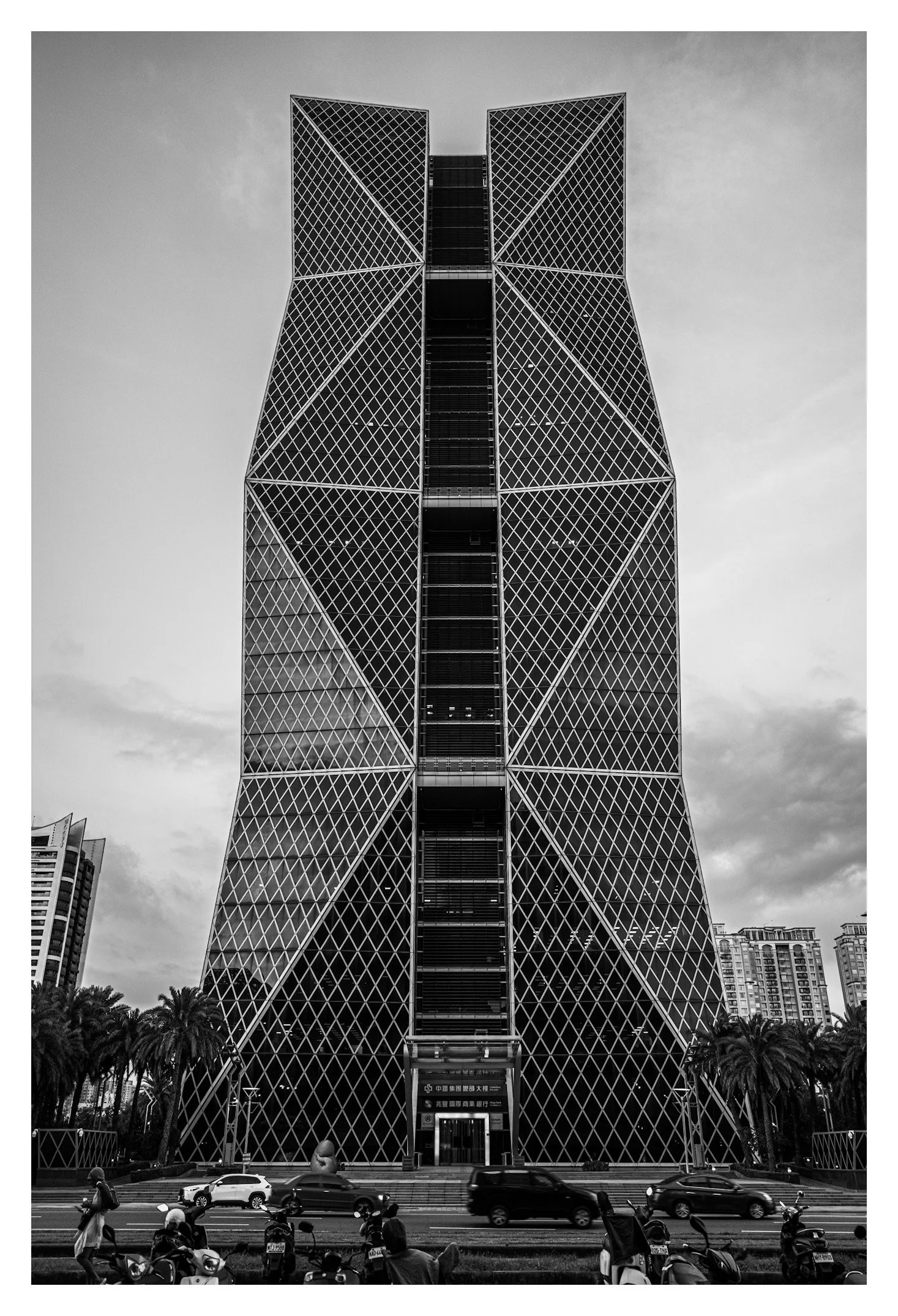
Modern cityscapes often trap us in predictable patterns of looking. But what happens when you combine strict symmetry with the unpredictable chaos of the street? Discover how a few precise adjustments in composition and data-tracking can entirely transform your architectural frames.
EXIF Data
Camera Model: Ricoh GRIII
Shutter Speed: 1/125
Aperture: f3.2
ISO: 200
The Critique: Theo Marr's Analysis
The central monolith in this frame commands absolute authority, utilizing the grid-like lattice structure of the building to establish an imposing graphic presence. The high-contrast monochrome rendering elevates the geometry, playing the hyper-structured lines of the facade against the organic texture of a cloud-swept sky. The compelling friction here occurs at the bottom edge, where scooters, cars, and passing figures inject a layer of transient human reality into an otherwise sterile architectural study.
How to Improve the Image
To push this photograph from a strong graphic study into a true masterwork, consider two critical adjustments:
Purity of Alignment: When working with severe architectural symmetry, any microscopic tilt or keystone distortion becomes instantly apparent. Perfecting your camera pitch or applying a meticulous vertical lens correction in post-processing will ensure the structural lines run perfectly parallel to the frame edges, anchoring the composition.
Depth of Field Optimization: Shooting at f3.2 introduces a subtle softness at the absolute extremes of the frame. Stopping down to a sharper mid-range aperture like f5.6 or f8 would tighten up the hyper-detailed lattice pattern from the street level all the way to the top pinnacles.
Evolution Through Data: Compiling Your Work
Becoming a better photographer requires moving past isolated snapshots and looking at your work as a living archive. To systematically improve over time, begin building a personal database of your images:
Log the Metadata: Catalog your exposure settings alongside the lighting conditions of the day.
Identify the Inconsistencies: Use your data to spot patterns. Are you consistently losing sharpness because your shutter speed is too low for a handheld street frame? Is a wide-open aperture causing you to miss critical depth?
Audit Your Choices: Reviewing these technical patterns quarterly removes the guesswork from your growth, helping you select camera configurations instinctively long before you even press the shutter.
Masters of the Craft: Research and Study
To broaden your visual vocabulary, study how historical and contemporary masters negotiate structural space and human scale.
Photographer to Research: Fan Ho. The legendary master of light and shadow who treated the streets as an evolving theater, masterfully carving out geometric shapes within bustling urban environments.
Book to Read: Portrait of Hong Kong by Fan Ho. A masterclass in monochrome composition, showing how nostalgia, structural geometry, and humanism can intersect flawlessly within a single frame.
Video to Watch: Why Your Photos Are Too Cluttered (The Fan Ho Method). An exceptional video breaking down how to use subtraction, negative space, and architectural lines to simplify chaotic compositions. Watch the video tutorial on YouTube via this link: Why Your Photos Are Too Cluttered.