

Day 255/365 Chasing Chiaroscuro: Geometry and Ghostly Silhouettes on the Kaohsiung Asphalt
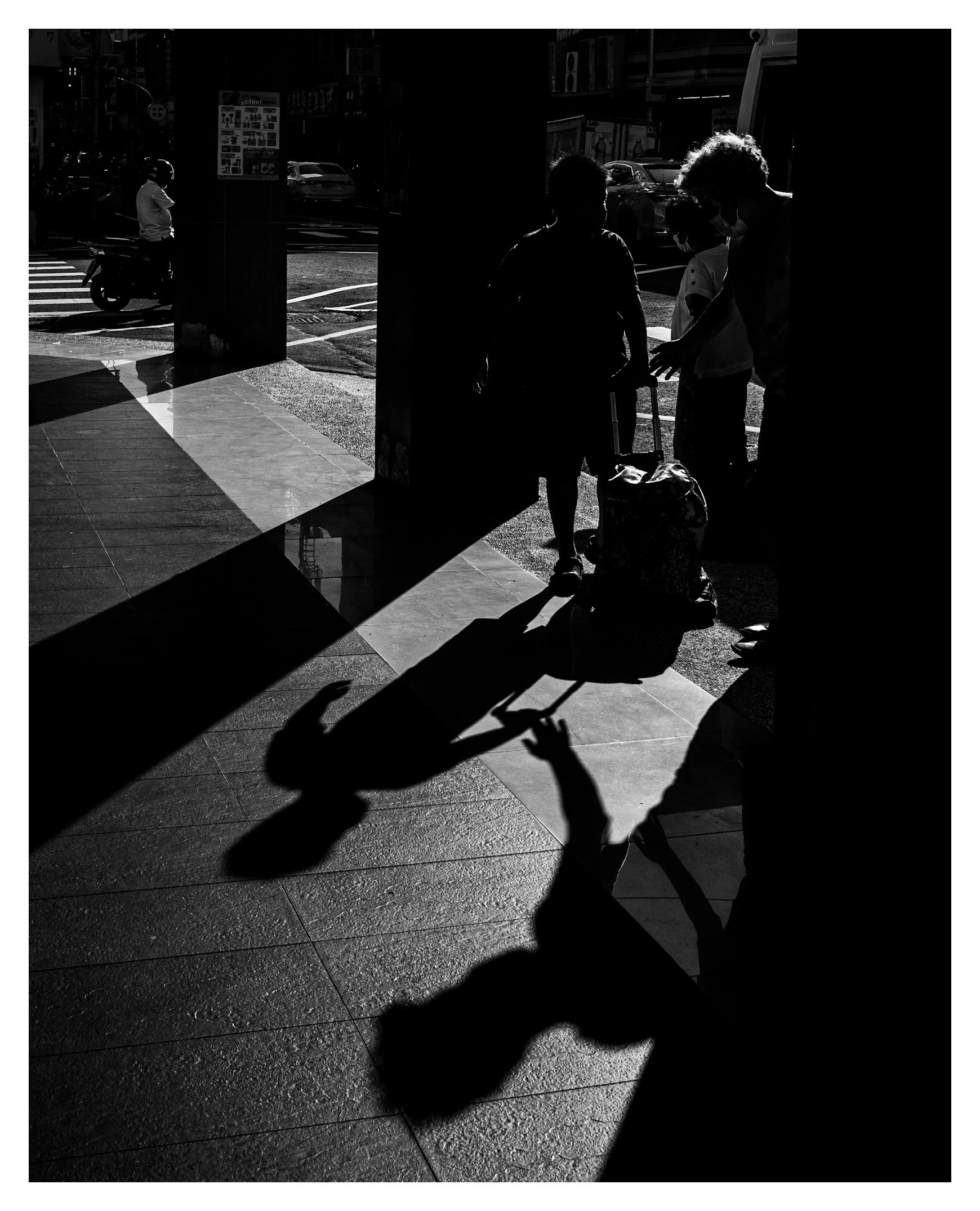
A single slice of blinding light transforms a mundane Kaohsiung sidewalk into a dramatic theater of silhouettes. In this critique, we unpack the geometric precision of high-contrast street photography and discover how tracking your shooting data can elevate a fleeting daily frame into a timeless masterpiece.
EXIF Data
Camera Model: Ricoh GRIII
Shutter Speed: 1/640
Aperture: f5.6
ISO: 100
The street demands absolute decisiveness, and this frame captures the architectural and human geometry of Kaohsiung with remarkable graphic power. By exposing strictly for the intense Taiwanese sun cutting across the covered sidewalk, the midtones and shadows drop into an uncompromising, rich black. This deep chiaroscuro strips away the modern visual noise of billboards and concrete, leaving behind a timeless dance of pure form and elongated silhouettes.
The highlight slashing diagonally across the frame establishes a powerful compositional baseline. The framing captures the primary subjects in mid-stride, their shadows stretching out like independent characters across the tiled floor. The rim light catching the edge of the figure on the right is an excellent touch, providing just enough separation to keep the human form from completely dissolving into the background pillar.
Refinements for the Frame
While the high-contrast aesthetic is incredibly striking, a few micro-adjustments could tighten the visual narrative:
Tame the Background Distractions: In the upper-left quadrant, the scooter and the white car emerging into the sunlight create minor pools of high-contrast detail. Because the human eye naturally seeks out the brightest point of an image, the white vehicle slightly pulls attention away from the elegant interplay of shadows in the foreground. A subtle burn or exposure reduction on that specific background highlight would lock the viewer's focus entirely within the lower two-thirds of the frame.
The Micro-Second Separation: In street photography, inches and milliseconds dictate the clean separation of forms. The shadow of the central figure's hand just barely brushes against the edge of the dark architectural column. Waiting a fraction of a second longer—or taking a half-step to the left—might have completely isolated that reaching hand silhouette against the bright concrete gap, maximizing its graphic impact.
The Analytical Photographer: Tracking Your Growth
To evolve from a talented observer into a master of the craft, you must treat your body of work not just as an art gallery, but as a rich dataset.
At the end of every month, export the metadata of your top fifty favorite images into a spreadsheet. Catalog the camera model, focal length, aperture, shutter speed, time of day, and geographic location. Over time, look for statistical anomalies. You might discover that 80% of your successful street frames are shot at f5.6, or that you subconsciously avoid shooting when the sun is directly overhead.
By analyzing these patterns, you expose your creative comfort zones. True growth happens when you deliberately break these statistical habits—forcing yourself onto the pavement during the harsh light of noon with a completely different shutter speed archetype, or restricting yourself to wide-open apertures to see how it alters your spatial awareness.
Masters to Study
Fan Ho: The definitive reference for utilizing architectural scale and sharp shadows to frame human emotion. His work illustrates how to treat urban alleyways as a grand stage for light.
Daido Moriyama: If you want to understand how to lean into raw, high-contrast grit, Moriyama’s rough, blurry, and out-of-focus aesthetic shows how shadow can convey pure atmosphere over clinical sharpness.
Alex Webb: A master of complex, multi-layered frames. Studying Webb will teach you how to manage multiple subjects moving through distinct planes of light and shadow simultaneously.
Required Reading
Bystander: A History of Street Photography by Colin Westerbeck and Joel Meyerowitz: This text is an essential academic reference that tracks the evolution of the genre and the philosophies of the photographers who shaped it.
Thoughts on Street Photography by Wu Jia-Tang: A phenomenal retrospective that blends compelling imagery with insightful essays on the surrealism, humor, and absurdity tucked away in everyday life.
Essential Viewing
Fan Ho: The Master of Light and Shadow – A deep dive into how Fan Ho patiently waited for hours at a single location for the perfect human element to step into his pre-composed geometric light beams.
Alex Webb: Composing the Complex Street Frame – An exploration of Webb's use of color, intense shadows, and complex layers, offering insight into how to balance busy urban environments.
The Street Photography Philosophy of Daido Moriyama – A documentary look at how Moriyama wanders the pavement, using his camera as an extension of his senses without getting bogged down by technical perfection.