

Day 260/365 A Feast of Color: Reading the Watermelon Stalls of Kaohsiung
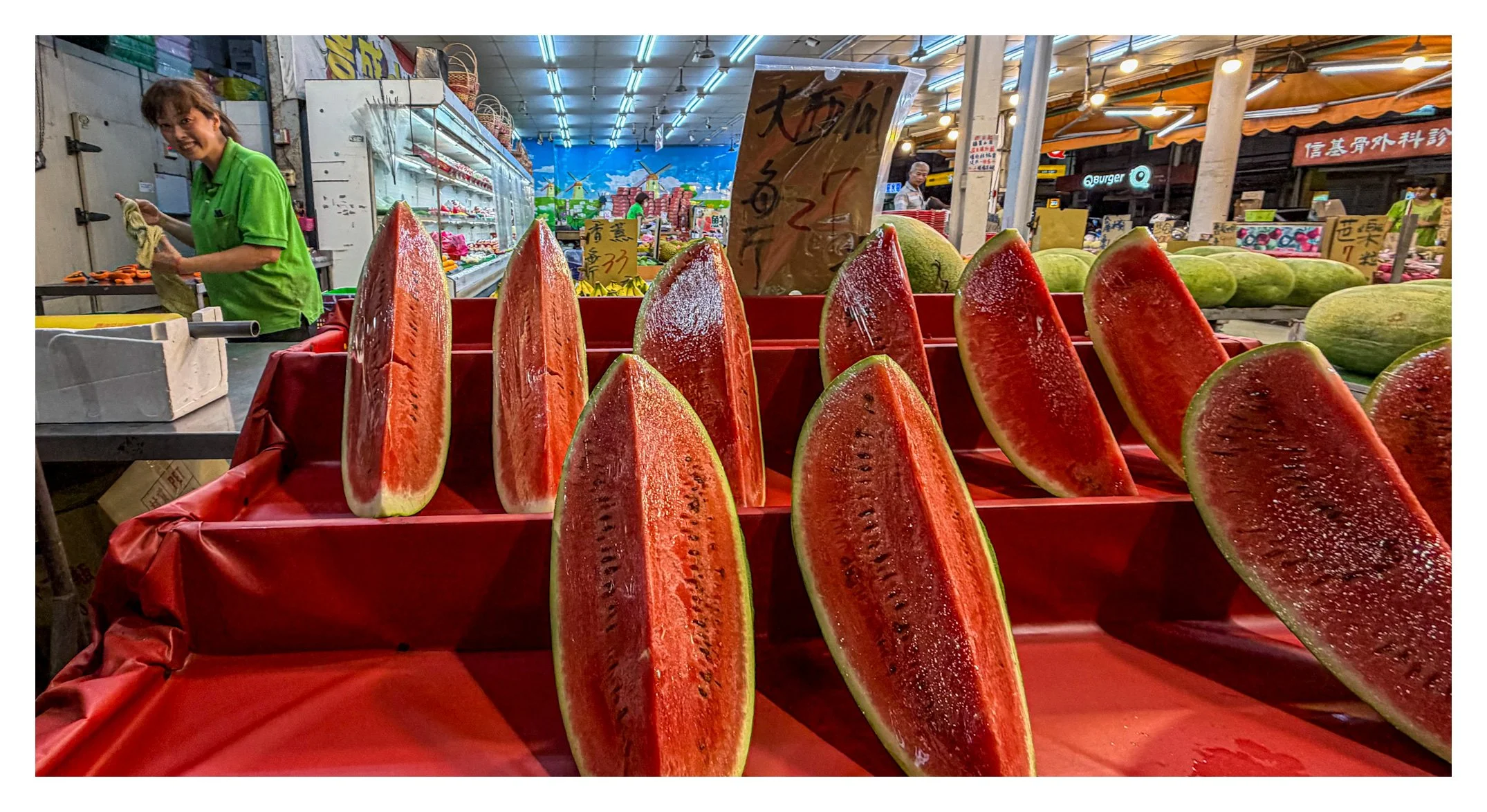
What does a wedge of watermelon under fluorescent market light have to do with Alex Webb or Martin Parr? More than you’d think. A close look at a Kaohsiung street market scene reveals lessons in color, chaos, and framing that separate a snapshot from a photograph.
Camera Model: Apple iPhone 17
Shutter Speed: 1/60 sec
Aperture: f/2.2
ISO: 250
The Critique
There is an old truism in photography that color is content — that the hue of a scene can carry as much narrative weight as the subject itself. This photograph, taken inside a bustling Kaohsiung wet market, understands that instinctively, even if not entirely by design. The saturated red of the watermelon wedges, fanned out like a row of paper boats, dominates the frame with a boldness that recalls the market work of Martin Parr or the tropical palettes of Alex Webb. It is a photograph built on color contrast: the cool fluorescent blue-white of the ceiling lighting against the hot red flesh of the fruit, punctuated by that one flash of green shirt worn by the vendor in the background.
The composition has real ambition. The ultra-wide lens (a 14mm-equivalent field of view) pulls the viewer into the scene, and the diagonal thrust of the watermelon slices creates a strong leading line that pushes the eye from the lower right corner back toward the vendor and the hand-painted signage beyond. This is the kind of layered, chaotic frame that street and documentary photographers spend years learning to organize — foreground, midground, and background all doing work simultaneously.
That said, the image is not without its tensions. The extreme wide-angle distortion, while energizing, stretches the watermelon slices in a way that borders on caricature rather than intention — a hazard of shooting this close with such a wide field of view. The frame is also busy in the upper third: the signage, ceiling structure, and background stalls compete for attention rather than supporting the main subject. A photographer with more time to work the scene might have crouched lower to simplify the sky of clutter above, or waited for the vendor to turn fully toward camera to create a genuine human anchor point rather than a peripheral figure. The exposure itself is well handled for a mixed-lighting environment — the reds are not blown out, and shadow detail holds — but the color temperature has a slight cool cast that flattens some of the warmth of the fruit.
How This Image Could Be Improved
Lower the vantage point. Shooting from a slightly crouched position would minimize the ceiling clutter and let the watermelon wedges dominate against a simpler backdrop.
Wait for the decisive moment. The vendor is present but disengaged from the frame. A beat later, with her gaze or gesture directed toward the fruit or the camera, would transform this from a still life into a story.
Watch the edges. The right side of the frame is cropped tightly against another wedge, creating a slightly claustrophobic edge. A touch more breathing room, or a deliberate crop that isolates the diagonal rhythm, would help.
Correct white balance in post. A slight warm-up in editing would counteract the cool fluorescent cast and let the reds sing even more.
Becoming a Better Photographer Over Time
The single most useful thing you can do, beyond simply making more pictures, is to start tracking your own patterns. Photographers improve fastest when they stop treating every image as an isolated event and start treating their body of work as data. A few habits worth adopting:
Keep a shooting log. Note the lens, aperture, and lighting conditions for images you’re proud of versus images that fall flat. Over months, patterns emerge — you may discover you consistently succeed with high-contrast light and struggle in flat overcast conditions, or that your best work happens when you shoot wider rather than tighter.
Do a monthly edit. Once a month, select your ten strongest images from the period and ask why they work. Is it color, gesture, geometry, timing? This retrospective habit builds critical vocabulary faster than shooting alone ever will.
Revisit the same location repeatedly. Markets, in particular, reward returning again and again. The light changes, the vendors change, your understanding of the space deepens. Some of the great documentary bodies of work were built on a single location visited dozens of times.
Study composition independently of camera gear. The habits of seeing — line, color, layering, timing — transfer regardless of whether you’re shooting with a phone or a rangefinder.
Photographers to Study
Alex Webb — for his mastery of color, layering, and controlled chaos in dense public spaces. His Magnum work on markets and street scenes across Latin America and Southeast Asia is directly relevant to the kind of image discussed here.
Martin Parr — for his saturated, often satirical eye toward food, consumerism, and public life. His book “Common Sense” is a study in how color and subject can carry social commentary.
Fan Ho — for his black-and-white studies of Hong Kong street life in the 1950s and 60s, a masterclass in geometry and light within crowded urban environments.
Steve McCurry — for his use of color and human presence to anchor otherwise chaotic frames, particularly in Asian markets and public spaces.
Harry Gruyaert — for color theory applied to everyday, unglamorous scenes; his work proves that color itself can be the subject.
Books Worth Reading
The Suffering of Light by Alex Webb
Common Sense by Martin Parr
Visually Speaking by Ted Forbes
The Photographer’s Eye by Michael Freeman
On Photography by Susan Sontag, for the critical and philosophical dimension of the medium
Videos Worth Watching
Sean Tucker, “Street Photography: Practical Advice for a Good Mentality” — a grounded look at mindset over gear, useful for anyone shooting candid public scenes.
Sean Tucker, “White Balance: My (slightly odd) Approach” — directly relevant to the color-temperature note above.
Ted Forbes, The Art of Photography channel — deep dives into composition, color theory, and the history of the medium.
Samuel Lintaro Hopf (Streetlife) — strong tutorials on working color and composition into dense, crowded scenes, useful for market and street environments.
Mango Street — concise, well-produced tutorials on composition and editing for photographers who want quick, practical takeaways.