

Day 261/365 The Theater of the Tarmac: Joy and Geometry on Kaohsiung’s Streets
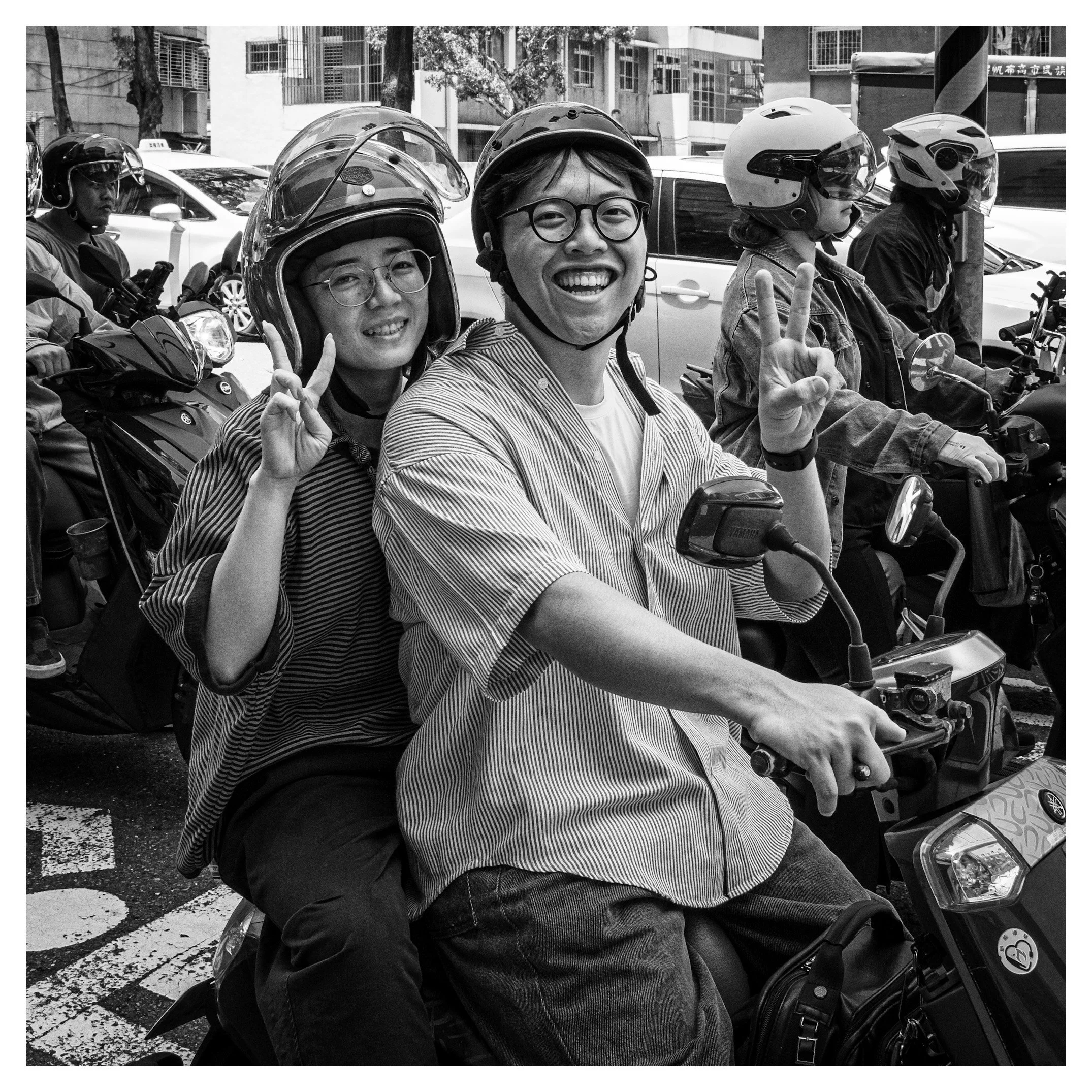
What happens when the chaotic energy of Taiwan’s scooter lanes meets a split-second window of pure human connection? You’ll learn how a high-contrast choice and a classic wide-angle approach transformed a routine daily commute into an evocative study of urban intimacy—and where the composition leaves room to grow.
Image Metadata
Camera Model: Ricoh GRIII
Shutter Speed: 1/320
Aperture: f8
ISO: 800
The Critique: An Analysis by Theo Marr
Street photography thrives on the tension between the anonymous flow of the city and the sudden, fleeting flash of human individuality. In this square-crop capture from Kaohsiung, that tension is handled with delightful immediacy. The central subjects—a couple sharing a playful, simultaneous peace-sign gesture from their scooter—burst out of the frame with an infectious, unforced joy. It is an authentic manifestation of the street’s underlying theater.
By choosing monochrome, you have effectively stripped away the competing visual noise of a brightly colored Taiwanese traffic scene. The harsh, high-contrast midday sun works to your advantage here, carving deep shadows and brilliant highlights across the rider's striped shirt and the reflective curves of their helmets. The choice of an f8 aperture provides an excellent depth of field, keeping the primary subjects incredibly crisp while maintaining enough environmental context in the background riders to ground the image firmly in its location.
Where the Frame Demands Refinement
While the energy is exceptional, a critical eye reveals where the geometry falls slightly short of perfection. The top right corner suffers from a distracting, severe vertical element—likely a striped utility pole or vehicle edge—which introduces an unintended geometric line that pulls the eye away from the couple’s expressions. Furthermore, the scooter rider on the far left is partially severed by the edge of the frame, creating an untidy boundary.
To improve a shot like this in the future, consider a slight shift in your physical positioning or timing. A fraction of a second later, or a step to the left, might have cleared the distracting background elements and fully isolated the couple against a cleaner backdrop of traffic, elevating a strong street snap into a seamless, masterful composition.
Elevating Your Craft Over Time: The Analytical Approach
To truly grow as a photographer, you must look beyond individual images and analyze your work systematically. I recommend establishing a personal metadata ledger to compile data on your shoots. By tracking your technical choices over months—such as how often you shoot at f8 versus wide open, or your distribution of shutter speeds in varying light—you will start to identify unconscious patterns in your shooting habits.
Correlating this technical data with your successful frames reveals your true artistic defaults. For example, tracking your data will show whether your sharpest street interactions happen when you are zone-focusing at a distance, or when you are actively engaging with your subjects up close. Systems like this transform accidental masterpieces into a deliberate, repeatable practice.
Masters of the Medium: Research and Study
To broaden your visual vocabulary, look to historical and contemporary masters who have captured the essence of East Asian urban life and the philosophy of the street.
Chang Chao-Tang: Study his retrospective monograph, Moments in Time 1959-2013. His work masterfully blends environmental portraiture with a distinct sense of the absurd and the surreal within Taiwanese culture.
Fan Ho: Read his definitive book, Portrait of Hong Kong. Ho’s use of dramatic shadows, geometric lines, and nostalgic light is a masterclass in how to slice through urban chaos to find clean, poetic compositions.
Watch and Learn: To understand the mindset behind capturing these split-second street interactions, watch the Street Photography Masterclass with Sean Tucker on YouTube. This video provides brilliant insight into how street photography books and a focused creative mindset influence your everyday work on the pavement.