

Day 265/365 Rage, Rage: A Still Life in Ink and Shadow
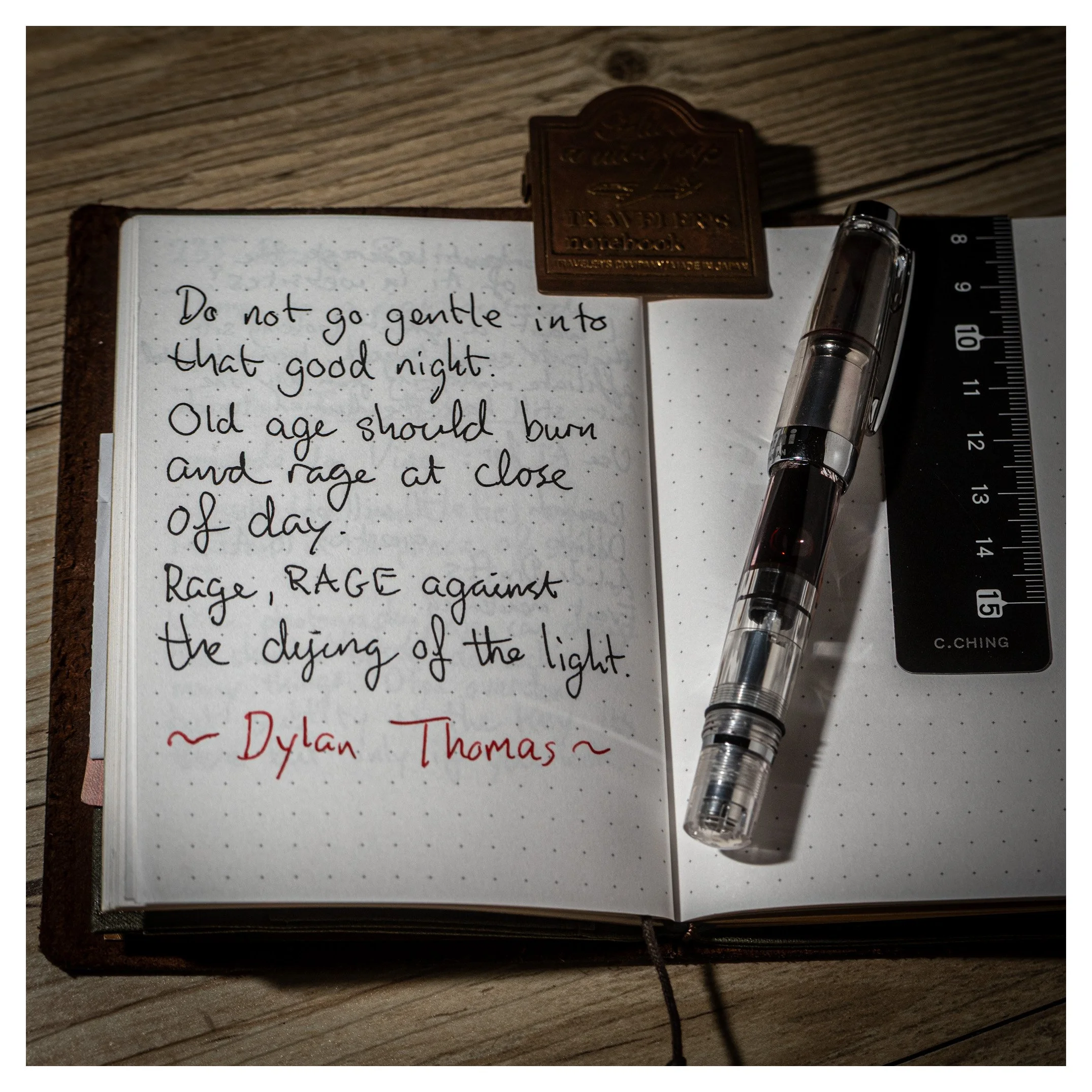
A fountain pen rests across an open notebook, its handwritten verse caught in a single shaft of light. A quiet departure from the street into the world of tabletop composition, chiaroscuro, and the discipline of arranging stillness.
EXIF Data
Camera Model: Leica D-Lux 8
Shutter Speed: 1/125 sec
Aperture: f/4
ISO: 100
The Critique
This photograph marks a deliberate shift in register — from the chaos of the street to the controlled hush of the tabletop. It belongs to a tradition that runs through still-life photography since its earliest days: the careful arrangement of ordinary objects under considered light, elevated into something worth pausing over. Here, the objects are a leather-bound travel notebook, a page of handwritten verse, a fountain pen laid diagonally across the paper, and a metal ruler — a quiet cast of characters assembled with real intentionality.
The lighting is the strongest formal decision in the frame. A single hard source falls across the scene from the upper right, raking across the wood grain of the tabletop and throwing the brass notebook clasp into sharp relief, its shadow stretching dramatically across the paper below. This is chiaroscuro in the classic sense — light and dark in active conversation rather than a flat, evenly-lit product shot. It recalls the tabletop work of Josef Sudek, whose photographs of ordinary studio objects under directional window light turned still life into something meditative. The warm wood tones, the cool metal of the pen and ruler, and the crisp white of the paper create a controlled, limited palette that reads as considered rather than accidental.
Compositionally, the diagonal thrust of the fountain pen is doing real work — it cuts across the right side of the frame and creates a visual counterweight to the block of handwriting on the left page, while the ruler’s numerals add a secondary layer of typographic interest that rewards a slower look. The handwritten verse itself, rendered in a confident, slightly slanted hand with a flash of red ink for the attribution, gives the whole image a literary, almost diaristic quality — the sense of catching a private act of writing mid-thought.
Where the image could tighten is in its handling of depth and focus. At f/4, the depth of field is shallow enough that the far page and the notebook’s spine soften noticeably, which is a reasonable choice for a hero object like the pen, but the eye is pulled toward that softness at the top of the frame rather than settling comfortably in the sharp zone. The brass clasp, while beautifully lit, sits close to the top edge and creates a slightly crowded transition between the paper and the darker background — a touch more negative space above it would let it breathe. There is also a faint visual competition between the handwriting (the intended emotional center) and the pen’s chrome highlights, which are bright enough to pull the eye away from the text on first glance.
How This Image Could Be Improved
• Stop down slightly for the whole plane. Moving to f/5.6 or f/8 would extend the depth of field enough to keep both the handwriting and the pen crisp without sacrificing the falloff toward the background.
• Give the clasp room. Recomposing with a touch more space above the brass clasp, or angling the notebook slightly lower in the frame, would resolve the crowding at the top edge.
• Consider a fill card. A small white or silver reflector camera-left would lift the shadow side of the pen and notebook spine just enough to reveal detail without flattening the dramatic falloff of the main light.
• Watch specular highlights. The chrome pen barrel is catching hard, bright reflections that compete with the handwriting for attention; a slight change in camera angle or a diffusion panel over the light source would tame those hot spots.
Becoming a Better Photographer Over Time
Still life and flatlay work rewards a completely different kind of discipline than the street, and it’s worth building habits specific to it:
• Sketch your light before you shoot. Since nothing in a tabletop scene is moving, take the time to test two or three light angles before settling. Small changes in light direction dramatically change the mood of the same arrangement.
• Build a prop and texture library. Keep a small collection of surfaces (wood, linen, stone, paper) and objects with interesting texture. Over time you’ll develop an eye for how materials interact under directional light.
• Practice restraint. The temptation in still life is to add more objects. Log your compositions and note which ones actually benefit from every element included — often the strongest images are the ones with the fewest props.
• Study negative space deliberately. Because you control every element in the frame, still life is an ideal genre for training your eye on how empty space supports or undermines a compos