

Day 264/365 The Sleeping Giant of the Crosswalk: A Night in Kaohsiung
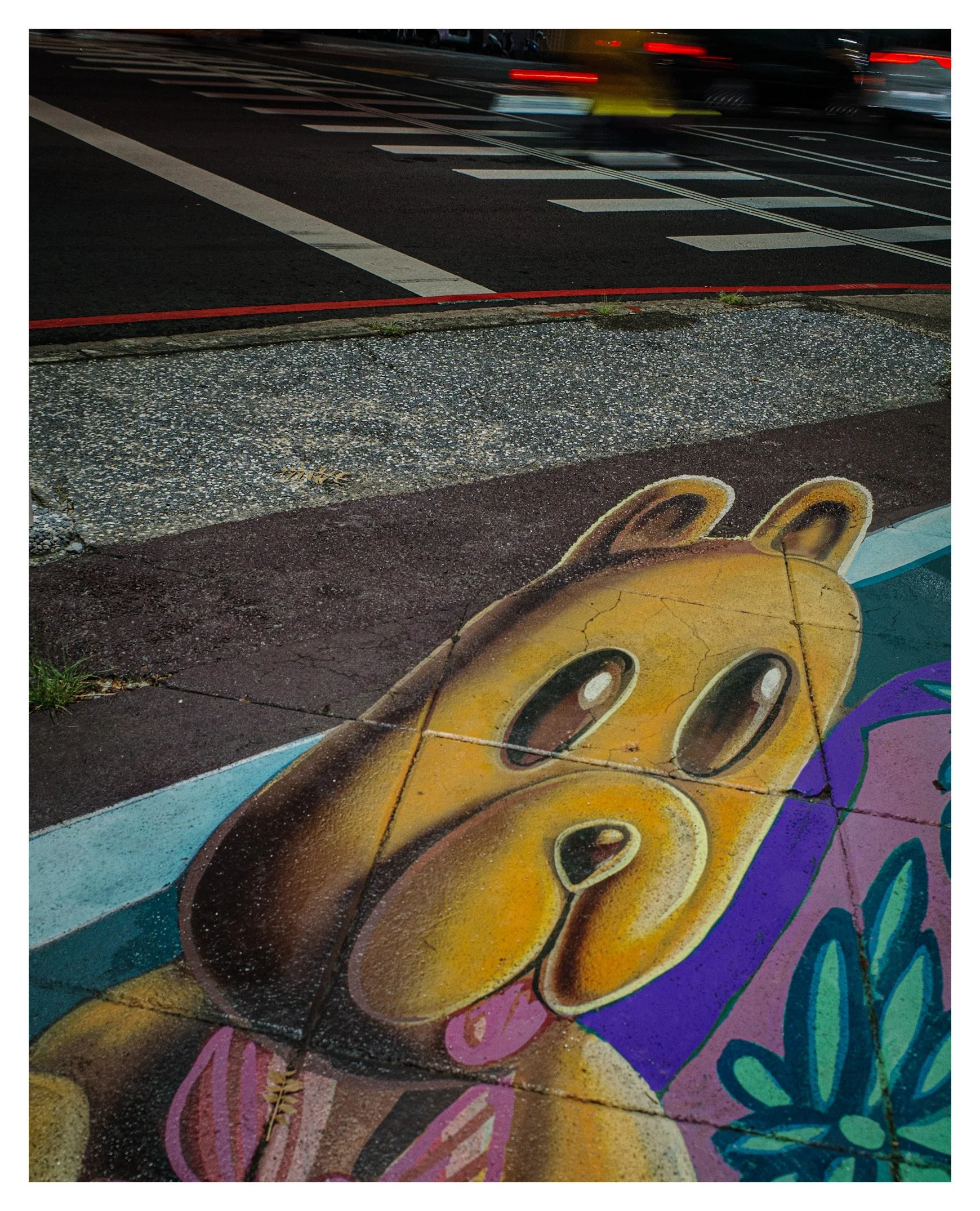
A painted dog dozes at the edge of a Kaohsiung intersection while the city blurs past in ribbons of red and gold. A study in tilted frames, night color, and the strange stillness that long exposure lends to street art.
EXIF Data
Camera Model: Ricoh GR III
Shutter Speed: 1/15 sec
Aperture: f/3.5
ISO: 640
The Critique
There is a long tradition in photography of finding the surreal hiding in plain sight within the urban environment — Eugène Atget’s empty Parisian streets, Daido Moriyama’s grainy, dreamlike Tokyo. This image belongs to that lineage, though its subject is decidedly more playful: a large-format street mural of a floppy-eared dog, painted directly onto the pavement of a Kaohsiung curb, its face rendered with the exaggerated, glossy-eyed sweetness of children’s book illustration.
The photograph’s central strategy is the tilt. By canting the frame diagonally, the mural’s face is thrust into the foreground with startling scale, while the road above recedes into a streak of motion and neon. This is a classic Dutch angle deployed with real purpose — it destabilizes the mundane geometry of a street corner and turns a painted curb into something closer to a floating apparition. The slow shutter speed, a full 1/15th of a second, was clearly a deliberate choice: it renders the passing traffic as elongated trails of red taillight and white headlight, a visual shorthand for urban motion that photographers have used since the earliest night exposures of Brassaï’s Paris. Against that streaking chaos, the mural sits perfectly still, and that stillness becomes the emotional center of the image — the sleeping giant amid the rush of the city.
Color does real work here too. The warm ochre and brown of the dog’s face plays against the cool blue-gray of the mural’s background paint and the deep black of the empty road, while the red curb line running through the middle third acts as a quiet connective thread between the two halves of the frame. It is a well-observed piece of color architecture for a photograph made largely on instinct, at night, likely without a tripod.
That said, the execution has some rough edges worth naming honestly. At 1/15th of a second handheld, there is a real risk of camera shake softening fine detail, and close inspection shows the mural’s texture is a touch softer than the crisp graphic linework of the painting itself would suggest it could be. The composition, while bold, leaves the upper third of the frame somewhat undefined — the light trails are compelling, but they compete for attention rather than resolving into a clear secondary point of interest. And the crop cuts the dog’s face at an angle that feels slightly arbitrary rather than fully intentional, leaving the viewer unsure whether the whole creature was meant to be legible or whether the fragment was the point.
How This Image Could Be Improved
• Stabilize the shot. At this shutter speed, even the GR III’s in-body stabilization has limits. Bracing against the curb, a low wall, or using a small travel tripod would sharpen the mural’s fine linework without sacrificing the light-trail effect.
• Resolve the top third. Consider whether a tighter crop that excludes some of the ambiguous upper roadway, or conversely a wider frame that fully includes the crosswalk markings as a graphic element, would give the eye a clearer path through the image.
• Commit to the crop of the subject. Decide whether the mural should read as a fragment (in which case crop even tighter, more abstractly) or as a complete character (in which case step back slightly to include the full head and ears without truncation).
• Consider a second, slower exposure. A shutter speed closer to 1–2 seconds, with the camera locked down, would produce longer, more dramatic light trails and allow a lower ISO, reducing noise in the shadow areas of the mural.
Becoming a Better Photographer Over Time
Night photography rewards a very specific kind of patience that daylight shooting doesn’t require, and it is worth building deliberate habits around it if this is a direction you want to keep exploring:
• Return to the same intersection at different hours. Traffic density, light color, and pedestrian activity all shift through the night. A corner that feels empty at 10 PM might be alive with motion at midnight during a weekend, or eerily still at 3 AM.
• Track your shutter speed choices against outcomes. Log which exposures rendered sharp subjects and which introduced unwanted blur. Over time you’ll develop an intuitive sense of the minimum shutter speed you personally need for a stable handheld shot with a given lens.
• Carry a lightweight support. A gorilla-pod or even a beanbag transforms what’s possible at night. Many of the photographers whose night work endures — Todd Hido chief among them — treat stability as a creative tool, not a limitation.
• Study your tilts. A Dutch angle is powerful but easy to overuse or misjudge. Review your tilted frames after the fact and ask whether the angle earns its place, or whether a level horizon would have served the image better.
Photographers to Study
• Todd Hido — for his mastery of color, night, and the eerie stillness of built environments; his work on suburban houses at dusk is essential viewing for anyone drawn to artificial light after dark.
• Rut Blees Luxemburg — for long-exposure night photography of urban spaces that transforms ordinary infrastructure into something monumental and strange.
• Daido Moriyama — for a grittier, more instinctual approach to Japanese street life at night, heavy on contrast and motion.
• JR — for his large-scale public art interventions and documentation of murals and street pieces in their urban context.
• Boogie — for his high-contrast, unflinching documentation of nocturnal city life and its overlooked corners.
Books Worth Reading
• Todd Hido: Excerpts from Silver Meadows
• Rut Blees Luxemburg: London: A Modern Project
• Trespass: A History of Uncommissioned Urban Art
• Night Photography and Light Painting: Finding Your Way in the Dark by Lance Keimig
• Daido Moriyama: The Complete Works
Videos Worth Watching
• Pierre Lambert, “EASY Long Exposure NIGHT Street Photography Tips + Shoot” — a practical, street-specific walkthrough directly relevant to this kind of shot.
• Mark Wallace / Adorama TV, “Shoot Stunning Light Trail Photos” — a concise nine-minute primer on settings and composition for light trails.
• Ray Scott, “10 Tips For Long Exposure Photography Light Trails” — useful for building a broader technical toolkit around this genre.
• Nick Carver — strong general coverage of exposure control and composition that translates well to challenging night conditions.
• Samuel Lintaro Hopf (Streetlife) — for his eye toward color and mood in dense urban night scenes.