

Day 266/365 Against the Wind: The Umbrella Duel of a Kaohsiung Afternoon
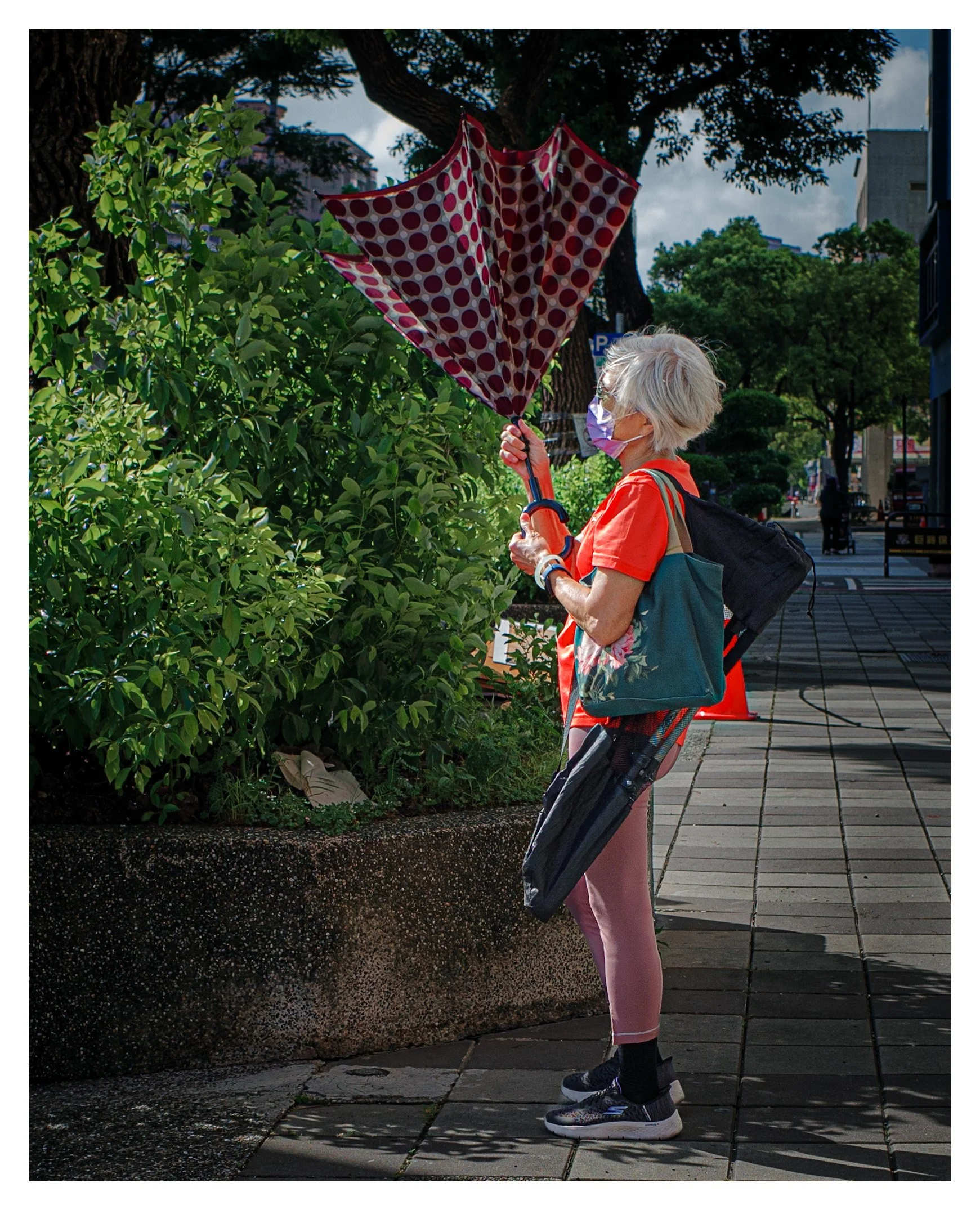
A gust turns an ordinary umbrella into a chaotic flower of polka dots, and one woman’s brief, unglamorous battle against the wind becomes a study in gesture, color, and the split second that separates a snapshot from a photograph.
EXIF Data
Camera Model: Ricoh GR III
Shutter Speed: 1/200 sec
Aperture: f/3.5
ISO: 100
The Critique
This is a photograph built entirely on timing — the kind of image Henri Cartier-Bresson had in mind when he coined the phrase “the decisive moment.” A gust of wind has inverted a polka-dot umbrella into a jagged, almost sculptural burst of red and cream, and the photographer has caught it at precisely the instant of maximum visual chaos, a fraction of a second before the woman wrestles it back into shape. That timing is the entire achievement of the frame; a moment earlier or later and this is simply a woman holding an umbrella.
The color relationships here are doing serious work. The saturated orange of her shirt, the bubblegum pink of her leggings, and the maroon-and-cream polka dots of the inverted umbrella form a tight, almost matched palette against the cool green of the hedge and the neutral gray pavement — a combination that recalls the saturated, slightly surreal color sensibility of Martin Parr or the tropical intensity of Alex Webb, but achieved here through pure observation rather than staging. The profile composition is a smart choice: by catching her in strict side view, the photograph reads almost like a diagram of the action, the umbrella’s chaos balanced against the calm vertical of her body and the straight edge of the planter box beneath her.
There’s also a lovely secondary detail working quietly in the background — the second umbrella, collapsed and tucked under her arm, unwittingly doubling the visual joke of “umbrella” as a recurring motif in the frame, alongside her surgical mask, a leftover visual signifier of a particular moment in recent history that gives the image a subtle documentary timestamp.
Where the image loses a little of its potential is in the surrounding clutter. The hedge on the left, while providing good color contrast, is a somewhat undifferentiated green mass that doesn’t add much structurally. The right side of the frame trails off into a fairly empty stretch of pavement and background pedestrians who don’t quite register as meaningful secondary subjects — there’s a missed opportunity for a tighter crop that would let the umbrella and figure dominate more completely. The horizon line and background buildings, while not distracting, don’t contribute much either; a slightly lower or higher vantage point might have simplified that backdrop further.
How This Image Could Be Improved
• Tighten the crop. Cropping in from the right, closer to the edge of the planter, would eliminate the somewhat empty middle-distance and put more visual weight on the central action.
• Watch the background at the moment of the shot. A half-step to the left or right might have removed some of the more cluttered signage and parked scooters visible in the upper right, simplifying the read.
• Consider a slightly lower angle. Shooting from a bit lower would isolate the umbrella and figure more cleanly against the sky and treeline, rather than the somewhat busy urban backdrop.
• Keep working the scene. Cartier-Bresson rarely got his best frame on the first exposure of a scene — a burst of two or three more frames as she continued fighting the umbrella might have produced an even more extreme or more resolved gesture.
Becoming a Better Photographer Over Time
Gesture-driven street photography like this rewards a very specific kind of training — less about gear, more about pattern recognition:
• Study repeated human gestures. People react to wind, rain, sun, and surprise in remarkably similar ways across cultures. Spend time simply observing these moments without a camera raised, and you’ll start to anticipate them before they happen.
• Practice “working the scene.” When you spot something promising, don’t take one frame and move on. Stay, keep shooting, and let the moment evolve — the best frame is often not the first one.
• Review in sequences, not singles. When you get home, look at your shots from a single scene as a set rather than judging each frame in isolation. This trains your eye for which specific instant within an unfolding event carried the most information.
• Track your hit rate on decisive moments. Over months, note how often a “chaotic” or fast-moving scene produces a frame you’re proud of. Improvement here is measurable and highly motivating.
Photographers to Study
• Henri Cartier-Bresson — the foundational reference for this entire mode of photography; study his sense of timing and how form and gesture align in a single frame.
• Joel Meyerowitz — for his pioneering use of color in street photography and his instinct for finding beauty in ordinary urban chaos.
• Melissa O’Shaughnessy — for her contemporary, wry, color-driven street work that often finds humor in gesture and coincidence, much like this frame.
• Vivian Maier — for her extraordinary instinct for candid human moments captured with total discretion.
• Constantine Manos — for his bold, saturated color and his ability to find graphic order within busy public scenes.
Books Worth Reading
• The Decisive Moment by Henri Cartier-Bresson
• Where I Find Myself by Joel Meyerowitz
• American Color by Constantine Manos
• Vivian Maier: Street Photographer
• Perfectly Placed by Melissa O’Shaughnessy
Videos Worth Watching
• Brian Lloyd Duckett, StreetSnappers YouTube channel — a working street photographer’s practical, no-nonsense approach to timing and technique, including a dedicated video on Joel Meyerowitz.
• “The Decisive Moment: Timing in Photography” — a focused look at the concept this image exemplifies.
• Ted Forbes, The Art of Photography channel — for historical context on Cartier-Bresson and the development of candid street photography.
• Sean Tucker’s channel — his videos on mindset and presence remain useful for training the anticipation this kind of shot demands.
• Mango Street — for quick, digestible editing and composition tips that help refine gesture-based street images in post.