

Day 270/365 The Sentinel at 286: A Study in Steel and Shadow
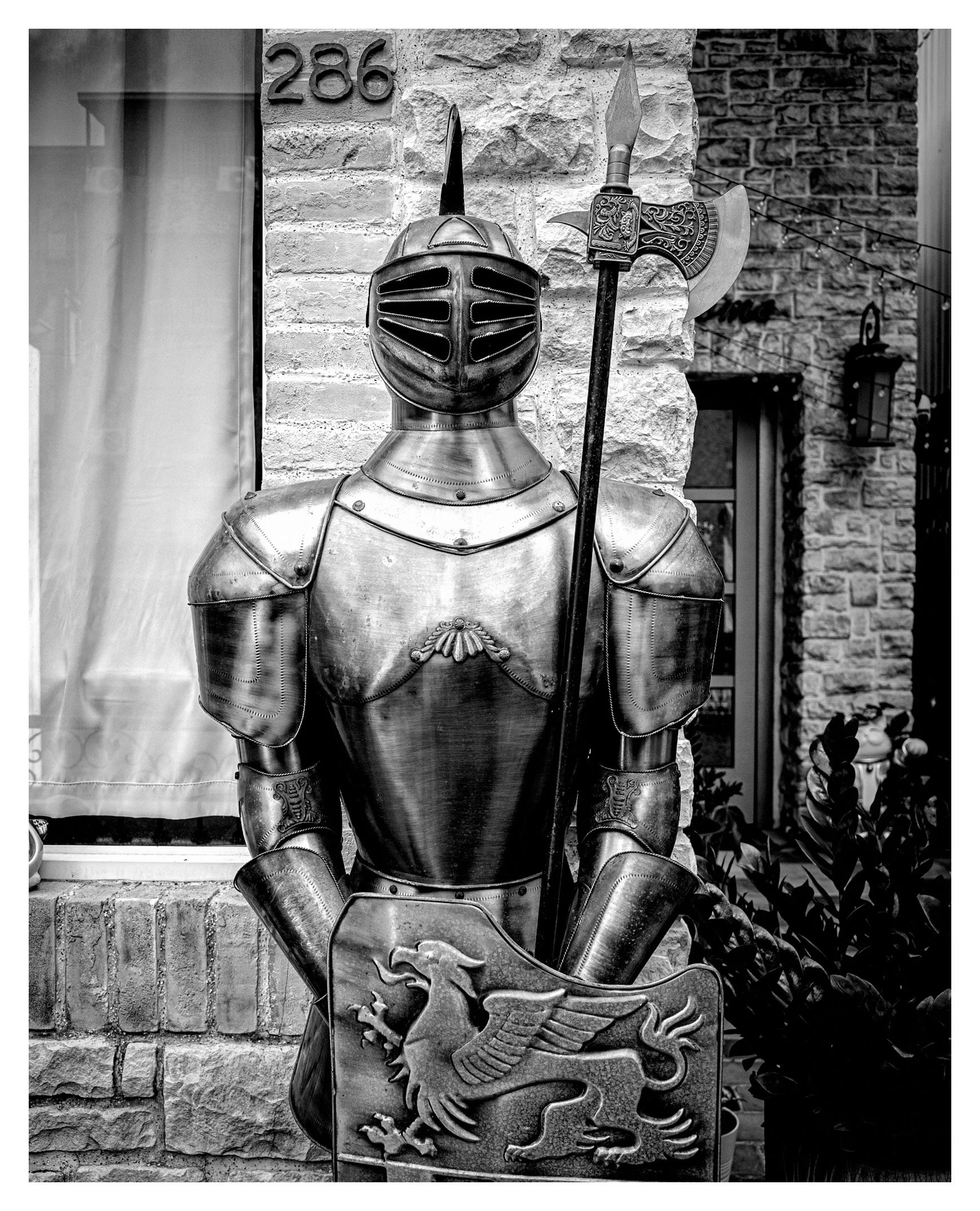
A suit of armor stands guard beside a doorway, halberd in hand and heraldic shield at its feet. A black-and-white close study in texture, form, and the theatrical dignity objects can carry when photographed with the same seriousness as a human portrait.
Camera Model: Ricoh GR III
Shutter Speed: 1/640 sec
Aperture: f/3.2
ISO: 200
The Critique
This photograph treats an inanimate object with the compositional respect usually reserved for portraiture, and that decision is what elevates it beyond a simple documentation shot. The suit of armor, photographed frontally and tightly cropped, fills the frame with the same authority a formal portrait sitter would command — shoulders squared, helm slightly canted, halberd rising diagonally out of frame like a scepter. There’s a knowing theatricality to it, the kind of wit that runs through object photography when a photographer treats a decorative piece as though it has presence and intent.
The black-and-white conversion is doing essential work here, much as it did with the tiled facade — it collapses what would otherwise be a slightly kitsch, decorative color scene into a study of pure form and texture. The polished steel of the armor reads as a rich, varied gray scale, catching and bouncing daylight across its curved surfaces, while the rough-hewn stone wall behind provides a coarse textural counterpoint. That contrast between the armor’s manufactured smoothness and the wall’s organic roughness is the image’s real subject, more than the armor itself.
Compositionally, the halberd’s diagonal thrust through the upper right is a strong device, breaking the frame’s verticality and drawing the eye upward and out, while the heraldic shield at the base — with its engraved eagle or griffin — grounds the composition and rewards a closer look. The house number “286” carved into the stone above adds a small but valuable documentary detail, anchoring this otherwise timeless-feeling object firmly in a specific, real address.
Where the image could be pushed further is in its tonal range. At this exposure, the helm’s visor slats fall into near-total black, losing some of the detail that might have added intrigue to that darkest part of the frame. There’s also a slight compositional tension in how tightly the armor is cropped against the top and left edges — a touch more breathing room might have let the piece feel less confined and more monumental.
How This Image Could Be Improved
• Recover shadow detail in the visor. A touch of fill light or a slightly less contrasty conversion would preserve some texture in the helm’s dark slats without flattening the overall drama.
• Reconsider the crop margins. A little more space above the helm’s spike and to the left of the shoulder plate would let the figure breathe and feel more monumental within the frame.
• Watch the background separation. The stone wall’s tonal range is close to the armor’s mid-tones in places; a slight further contrast push between subject and background would help the figure pop more decisively.
Becoming a Better Photographer Over Time
• Practice treating objects as portrait subjects. Photograph a static object — a statue, a machine, a piece of furniture — as though it had a personality, choosing angle and light the way you would for a person. This trains a different kind of compositional discipline.
• Build a tonal-range vocabulary in black and white. Study how much shadow detail you want to preserve versus sacrifice for drama, and track your preferences over a body of work.
• Look for the small anchoring detail. The house number in this fr