

Day 269/365 The Choreography of the Noodle Stall
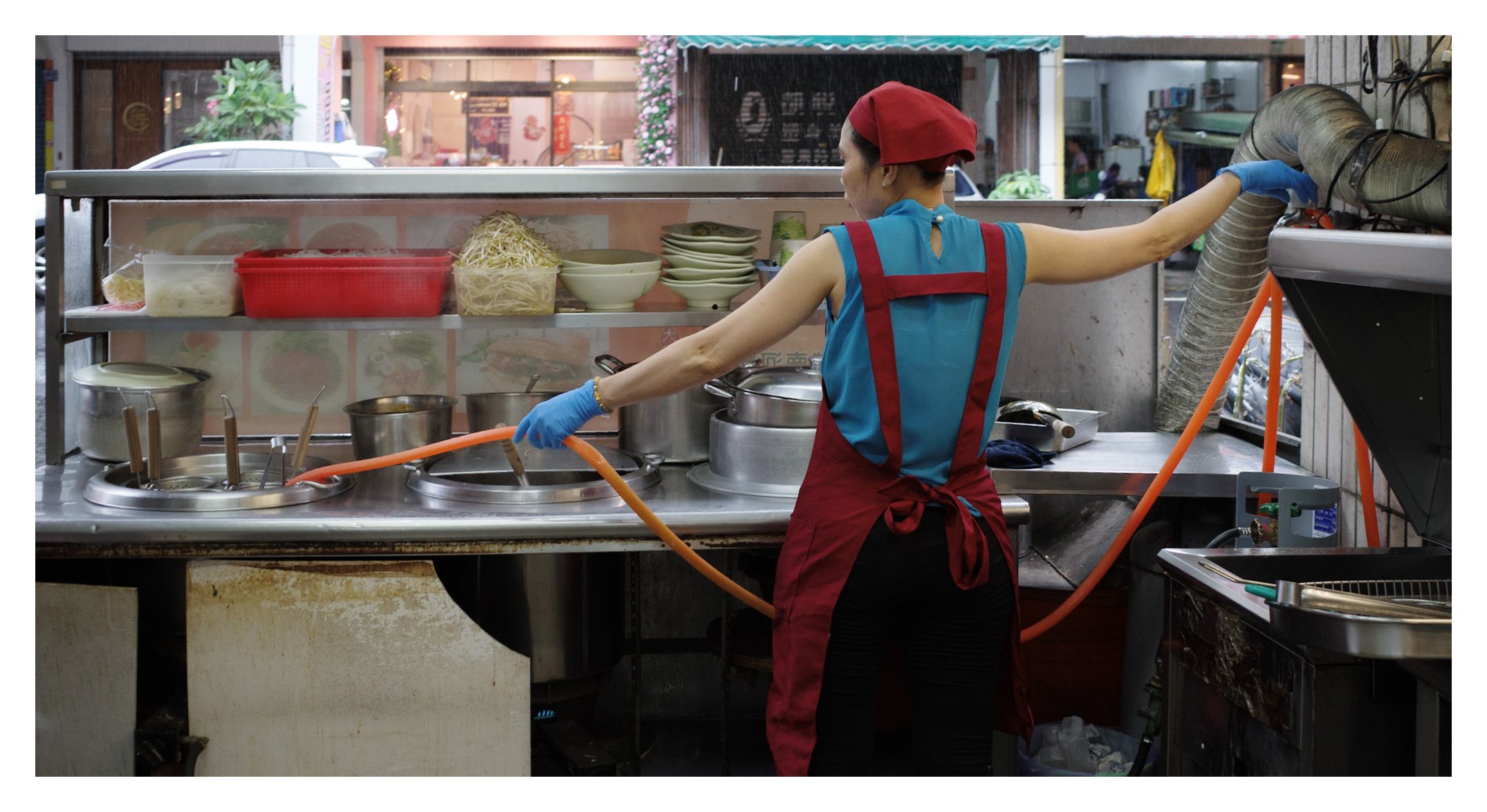
A cook reaches across her workstation mid-motion, orange hose in hand, rain streaking the street behind her. A study in color, gesture, and the quiet dignity of skilled repetitive labor caught in a single frame.
Camera Model: Ricoh GR III
Shutter Speed: 1/125 sec
Aperture: f/2.8
ISO: 800
The Critique
This photograph belongs to a tradition of dignified labor photography — the kind that treats the choreography of skilled work as worthy of the same formal attention as any posed portrait. Shot from behind as the cook reaches across her stall, one gloved hand extended toward the exhaust vent and the other gripping the coiled orange hose, the frame captures a moment of pure functional motion: not a pose, but the unconscious grace of someone who has performed this exact reach a thousand times.
The color relationships are doing real work here. The teal of her sleeveless top and the deep maroon of her apron and headscarf form a striking complementary pair, made more vivid by the industrial gray of the stainless steel counters and pots surrounding her. That orange hose, arcing diagonally across the lower third of the frame, becomes an unexpected compositional gift — a bright, saturated line that echoes the red of her headscarf and pulls the eye from her raised hand down through the workspace, tying the whole frame together kinetically. Rain streaking softly in the background, caught by the shutter speed, adds atmospheric depth without becoming a distraction, and confirms this was a woman working through weather rather than pausing for it.
The choice to shoot from behind is a smart one. It resists the temptation toward a posed or aware expression and instead lets her body do the storytelling — the extended arm, the set of her shoulders, the practiced economy of the gesture. This is observational, not portraiture, and it’s stronger for it. The layered depth of the scene, from the pots and bowls in the foreground shelving through to the rain-streaked storefronts across the street, gives the frame a genuine sense of place within Kaohsiung’s street food culture.
Where the image could tighten slightly is in the top of the frame — the shelf of bowls and containers along the upper third is informative but visually busy, competing somewhat with her raised arm for attention. And while the hose’s diagonal is a strength, its bright color at the very bottom edge of the frame creates a slight pull toward the corner that a marginally different crop might resolve.
How This Image Could Be Improved
• Consider a tighter crop on the top shelf. Reducing the visual noise of the stacked bowls and containers would let her raised arm and the exhaust vent read more clearly as the frame’s structural top point.
• Watch the hose at the frame edge. A slightly wider stance or half-step left might keep the hose’s brightest saturation from bleeding into the very corner of the frame.
• Lean into the weather. The rain is a lovely detail; a touch more contrast or a slightly longer exposure next time could make it a more deliberate visual element rather than a background texture.
Becoming a Better Photographer Over Time
• Build a specific “labor and gesture” study practice. Spend dedicated outings photographing only people at work — market vendors, mechanics, cooks — and pay attention to the specific moment mid-motion that reads as most physically eloquent.
• Track your success rate with backs versus faces. This frame works without ever showing her expression. Log how often your strongest images rely on gesture and posture rather than facial expression, and use that to sharpen your instinct for when to wait for a face and when a back tells the story better.
• Study color pairing deliberately. The teal-and-maroon relationship here is close to complementary on the color wheel. Review your strongest color images and note which pairings you’re naturally drawn to.
Photographers to Study
• Sebastião Salgado — for his monumental, dignified treatment of labor and working bodies across decades of documentary work.
• Lewis Hine — for his foundational documentation of workers and the belief that labor itself is a worthy photographic subject.
• Marc Riboud — for his decades of observational work across Asia, with a particular gift for catching bodies mid-gesture.
• Werner Bischof — for his humanist documentary work throughout Asia, often centered on ordinary labor and daily life.
• Elliott Erwitt — for his instinct for finding grace and quiet humor in unposed human gesture.
Books Worth Reading
• Workers: An Archaeology of the Industrial Age by Sebastião Salgado
• Marc Riboud: 50 Years of Photography
• Werner Bischof: Photographs
• Elliott Erwitt: Personal Best
• Men at Work by Lewis Hine
Videos Worth Watching
• “Mastering Motion in Street Photography: How to Capture Energy, Emotion, and Decisive Moments” — directly relevant to the gesture-driven timing in this frame.
• Ted Forbes on capturing motion and gesture, The Art of Photography channel — for the theoretical grounding on how implied motion reads in a still frame.
• “How I do Documentary Street Photography” — a working photographer’s approach to observational, unposed documentary work.