

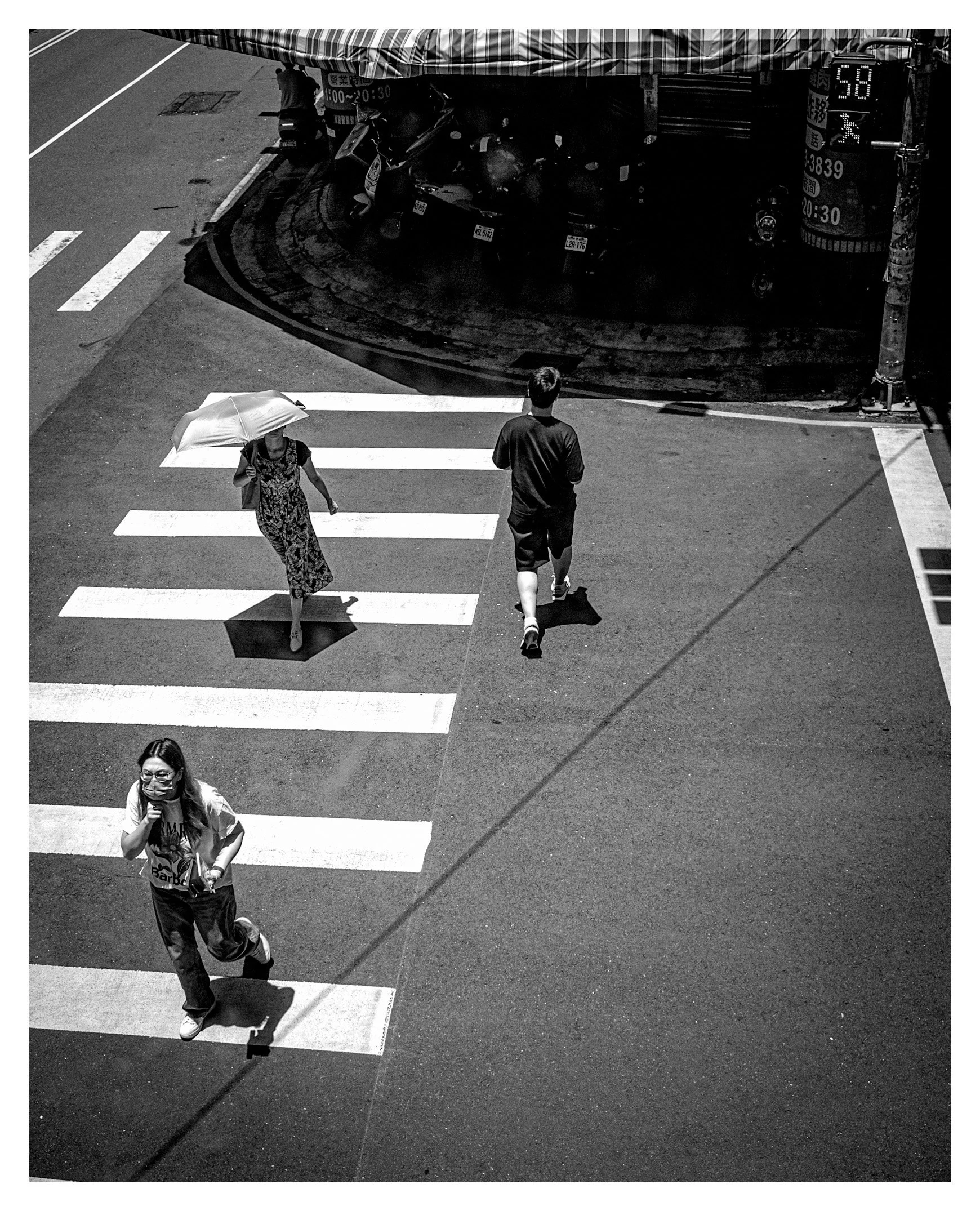
Three pedestrians cross a Kaohsiung intersection at different points, their shadows stretching long across sun-bleached pavement. A high-angle black-and-white study in geometry, timing, and the choreography strangers unknowingly perform together.
Camera Model: Ricoh GR III
Shutter Speed: 1/320 sec
Aperture: f/8
ISO: 200
The Critique
This photograph draws directly on one of street photography’s most cinematic traditions — the elevated vantage point that transforms a mundane intersection into pure geometric theater, a technique most closely associated with Fan Ho’s legendary Hong Kong work of the 1950s and 60s. Shot from a high window or rooftop looking almost straight down onto the crosswalk, the frame reduces three unrelated pedestrians into a study of line, shadow, and implied narrative, their long midday shadows doing as much storytelling as the figures themselves.
The composition’s real strength is its layered timing. Three people occupy three distinct zones of the frame — the woman with the pale umbrella mid-crossing, the man walking briskly toward the far curb, and the woman with sunglasses and a mask crossing the nearest band of white paint — and none of them appear to acknowledge one another, despite occupying the same visual space. That disconnection is the photograph’s quiet subject: strangers, briefly overlapping in geometry, entirely separate in experience. The diagonal seam running through the asphalt from lower-left to upper-right adds a second strong structural line that slices the frame into two triangles of differing tone, giving the whole composition an almost architectural rigor.
The black-and-white treatment, combined with the hard midday sun, produces the kind of stark, high-contrast shadow work that Fan Ho built an entire career around — his subjects’ shadows often carried as much compositional weight as the subjects themselves, and that’s precisely what happens here. The woman under the umbrella casts a dark, sharply defined rectangle onto the crosswalk stripes, echoing the umbrella’s own circular form and adding a second visual anchor beyond her figure. Stopped down to f/8, the depth of field keeps the entire scene — from the parked scooters at the top of the frame to the nearest pedestrian — rendered with democratic sharpness, appropriate for a composition that’s fundamentally about the whole geometric arrangement rather than any single subject.
Where the frame could be pushed further is in the placement of the third pedestrian, at lower left — her position feels slightly incidental compared to the more deliberate spacing of the other two, and a beat earlier or later in her stride might have created a more resolved three-point rhythm across the frame. The crosswalk countdown timer at the top right, while a nice documentary detail, sits close enough to the edge that it feels slightly like an afterthought rather than an integrated compositional element.
How This Image Could Be Improved
• Work the timing of the third figure more deliberately. A slightly earlier or later shutter release might have positioned her stride to better balance the diagonal rhythm established by the other two pedestrians.
• Consider the countdown timer’s placement. If it’s meant to be a narrative detail (urgency, time pressure), a composition that gives it more deliberate placement rather than tucking it at the very edge would strengthen that reading.
• Explore repeat visits to this vantage point. A location like this, viewed from a fixed high angle, is a genuine gift — revisiting at different times of day would reveal how the shadow geometry shifts and could yield an even stronger variant.
Becoming a Better Photographer Over Time
• Scout elevated vantage points deliberately. Fan Ho’s best work often came from windows, balconies, and rooftops. Build a mental map of high vantage points in your city and return to them at different times of day.
• Study shadow-to-subject ratios. Log which of your strongest black-and-white images rely on the shadow being as compositionally important as the subject itself, and pract
Photographers to Study
• Fan Ho — the essential reference point for this image; study his mastery of shadow, geometry, and elevated vantage points in 1950s–60s Hong Kong.
• René Burri — for his graphic, high-contrast compositions and his eye for architectural geometry intersecting with human figures.
• Sergio Larrain — for his poetic, high-contrast black-and-white street work throughout South America and Europe.
• Herbert List — for his classically composed, dramatically lit black-and-white photography.
• Andreas Feininger — for his structural, often elevated views of urban environments.
Books Worth Reading
• Hong Kong Yesterday by Fan Ho
• René Burri: Impossible Reminiscences
• Sergio Larrain (Aperture monograph)
• Herbert List: Photographs 1930–1972
• Andreas Feininger: New York
Videos Worth Watching
• “Fan Ho | the art of light, shadow, and humanism” — a short documentary directly relevant to this frame’s entire visual approach.
• “SHADOW & GEOMETRY: How Fan Ho Turned Hong Kong Streets into Art” — a focused breakdown of the exact technique on display here.
• “Fan Ho: Master of Light and Shadow” — further context on his career and visual philosophy.