

Good, solid links found. Here’s the full writeup:
The Loaded Scooter: A Portrait of Vernacular Kaohsiung
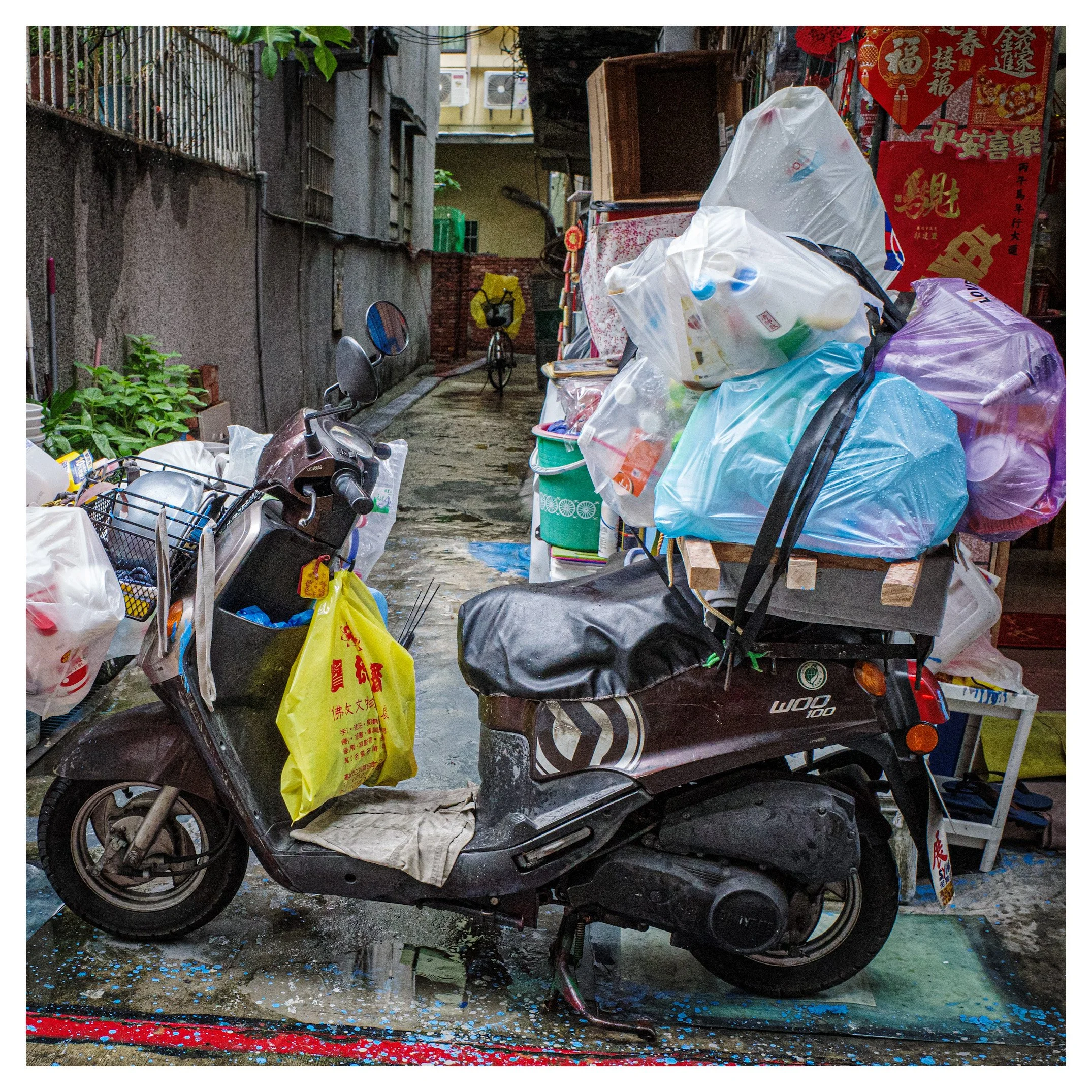
Excerpt: A scooter buried in plastic bags of recyclables sits parked in a rain-slicked alley, festooned with red lucky charms on the wall behind it. A study in color, clutter, and the poetry of ordinary domestic life caught without staging.
Camera Model: Ricoh GR III
Shutter Speed: 1/320 sec
Aperture: f/5.6
ISO: 2500
The Critique
This photograph belongs firmly to the tradition established by William Eggleston and Stephen Shore in the 1970s — the radical idea that the vernacular, the domestic, the unglamorous accumulation of everyday objects could carry the same formal weight as any deliberately composed scene. There’s no human figure here, no decisive gesture, just a battered scooter loaded impossibly high with plastic bags, buckets, and cardboard, parked in a narrow alley slick with recent rain. And yet the frame is alive with color, narrative implication, and texture in a way that rewards genuinely slow looking.
The color palette is doing extraordinary work. Against the muted gray-brown of the wet concrete and weathered walls, the bags erupt in a cluster of translucent whites, a cool sky-blue, and a startling violet-purple, while the red spring festival couplets pinned to the wall on the right punch through with real intensity. That red, in particular, functions almost like a compositional anchor — a splash of saturated color that both balances the pale cluster of bags and roots the image specifically in Taiwanese domestic and lunar new year tradition, giving the frame cultural specificity beyond generic urban clutter.
There’s a wonderful sense of accumulated narrative in this scene too — the yellow plastic bag with its printed text hanging from the handlebar, the small red amulet dangling near the ignition, the mirror catching a sliver of reflected alley behind. Every element speaks to a life lived in this particular space, day after day, without ever needing a person present to convey that. The deep perspective down the alley, with a second bicycle visible in the middle distance, adds real spatial depth and invites the eye to travel the full length of the frame rather than settling only on the loaded scooter.
Technically, the exposure holds up well in mixed, overcast light — the whites in the plastic bags retain detail rather than blowing out, a real risk given how much reflective, translucent material is bunched together at the top of the frame. Where the composition could tighten slightly is in the top edge, where the load crowds close to the frame’s boundary, leaving little breathing room above the tallest bag; a touch more headroom would let that precarious, teetering quality of the load read even more clearly.
How This Image Could Be Improved
• Give the load more headroom. A slightly lower shooting position or a step back would create breathing space above the tallest bags, emphasizing their precarious height rather than crowding them against the frame edge.
• Consider the depth of field more deliberately. At f/5.6, both the scooter and the background alley are reasonably sharp; a wider aperture might isolate the scooter more dramatically from the receding alley, or a narrower one could render the whole scene in crisp documentary detail — either is a valid choice, but worth making consciously.
• Watch the left edge. The plastic bags on the far left crop somewhat abruptly; a slightly wider frame might let that visual chaos resolve more naturally rather than being cut off.
Becoming a Better Photographer Over Time
• Practice photographing absence of people as presence of life. This image proves a scene can feel deeply inhabited without a figure in it. Seek out more subjects like this — a workspace, a doorway, a loaded vehicle — and study how much narrative you can build from objects alone.
• Build a personal color vocabulary from vernacular subjects. Eggleston and Shore both developed distinctive eyes by returning obsessively to ordinary, overlooked corners of the world. Revisit the same kinds of scenes — alleys, storefronts, parked vehicles — and track which color combinations you’re consistently drawn to.
• Study depth-of-field choices as narrative decisions, not just technical ones. Log which of your images benefit from isolating a subject versus rendering an entire scene in sharp, democratic detail.
Photographers to Study
• William Eggleston — for pioneering the idea that color and the mundane could carry serious artistic weight.
• Stephen Shore — for his deadpan, precise documentation of vernacular American (and later international) scenes.
• Alec Soth — for his patient, narrative-driven approach to overlooked places and objects.
• Naoya Hatakeyama — for his disciplined, often unpeopled studies of urban Japanese environments.
• Rinko Kawauchi — for her tender, luminous attention to small, ordinary details of daily life.
Books Worth Reading
• William Eggleston’s Guide
• Uncommon Places by Stephen Shore
• Sleeping by the Mississippi by Alec Soth
• Illuminance by Rinko Kawauchi
• Naoya Hatakeyama: Excavating the Future City
Videos Worth Watching
• “William Eggleston: Colour in the Everyday” — a solid introduction to the color-in-the-mundane tradition this image belongs to.
• “William Eggleston vs Stephen Shore” — a useful comparative look at the two photographers most relevant to this frame.
• “Exploring William Eggleston’s Approach to Photography” — practical takeaways on finding significance in ordinary subjects.