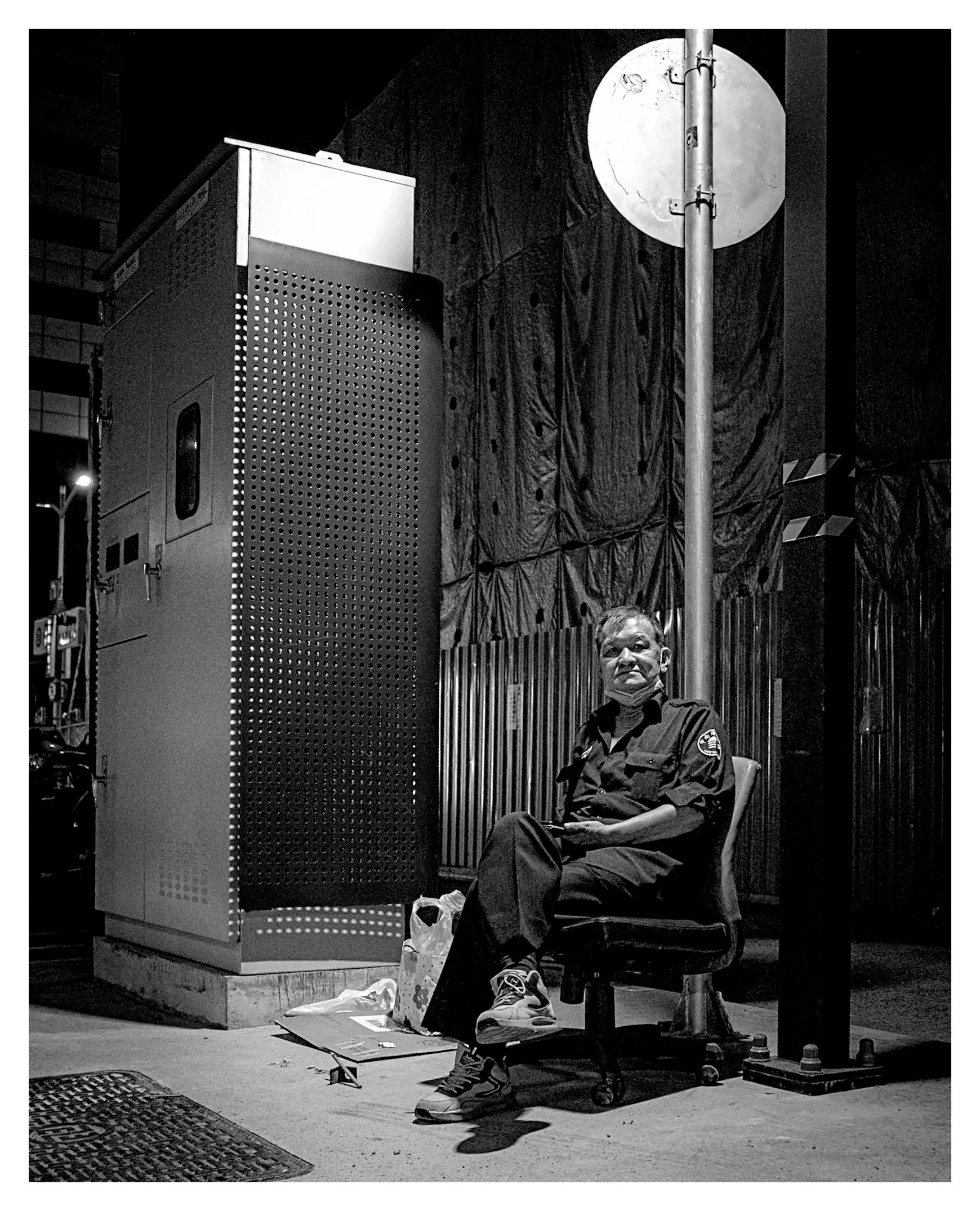
A night watchman rests in a rolling office chair beside a humming utility box, caught in a single hard pool of light. A study in quiet dignity, environmental portraiture, and the theater that available night light can create around an ordinary moment of rest.
Camera Model: Ricoh GR III
Shutter Speed: 1/125 sec
Aperture: f/2.8
ISO: 2500
The Critique
This photograph belongs to the tradition of dignified environmental portraiture — the kind that treats an ordinary working person’s moment of rest with the same formal seriousness as a studio sitting. A night watchman sits in a battered rolling office chair, legs crossed, hands resting easily, gazing directly and calmly at the camera. He isn’t posing exactly, but he isn’t unaware either — there’s a settled, unbothered quality to his expression that suggests someone comfortable being seen doing his job, however unglamorous the surroundings.
The lighting is doing extraordinary work here. A single hard source falls on him from above and slightly to the left, carving his face and uniform out of near-total darkness while the perforated metal cabinet beside him catches just enough light to reveal its texture — hundreds of small circular openings rendered in crisp detail against deep shadow. That interplay of illuminated subject against engulfing black recalls the theatrical night photography tradition running from Weegee’s flash-lit New York through to more contemporary observational night work; the darkness isn’t empty, it’s compositional, pushing every lit element into sharper relief.
The environment surrounding him tells its own story without needing narration. The draped, quilted fabric behind him, the road sign glowing faintly overhead like a second moon, the striped hazard markers on the pole, the plastic bags and cardboard scattered at his feet — all of it builds a specific, lived-in sense of place, the unglamorous furniture of a long night shift. His uniform, with its visible insignia, grounds him as a specific kind of civic presence, someone whose job is simply to be there, watching, through the hours most people sleep.
Where the composition is strongest is in its restraint — the photographer resisted the urge to crop in tighter on his face, and that choice pays off. The wider frame lets the environment carry as much weight as the man himself, making this as much a portrait of a place and a role as of an individual. If there’s a small tension, it’s in the right side of the frame, where the pole and hazard markers, while visually interesting, pull slightly toward decorative rather than essential; a viewer’s eye lingers there a beat longer than the composition’s hierarchy probably intends.
How This Image Could Be Improved
• Consider a very slight crop from the right. Trimming a touch of the space around the hazard-striped pole would tighten the composition’s focus back toward the man and the glowing sign above him.
• Watch highlight clipping on the cabinet. The perforated panel is beautifully lit but sits close to blown highlights in places; half a stop less exposure might preserve a touch more texture there.
• Try a second frame closer to eye level. The current angle works well, but a slightly lower vantage point looking up at him could add even more presence and monumentality to the pose.
Becoming a Better Photographer Over Time
• Study available-light theater. Night portraiture like this depends entirely on finding and using existing hard light sources rather than adding your own. Practice scouting locations specifically for where ambient light creates natural, dramatic falloff.
• Build trust before you raise the camera. A subject this settled and unguarded usually means a brief exchange happened first. Track how often your strongest portraits come after some acknowledgment versus a purely candid grab, and notice which approach serves which kind of image.
• Log your ISO ceiling for usable grain. At ISO 2500, this frame holds together well; understanding your own camera’s noise threshold in low light lets you shoot with confidence rather than hesitation after dark.
Photographers to Study
• Bruce Davidson — for his patient, respectful environmental portraits of people in their working and living spaces.
• Dorothea Lange — for her enduring belief that photographing ordinary people doing ordinary work, taken seriously, carries real dignity and weight.
• Chien-Chi Chang — for his rigorous, high-contrast documentary portraits exploring isolation and institutional environments.
• Trent Parke — for his dramatic use of available light and shadow in Australian street and night photography.
• Josef Koudelka — for his stark, theatrical black-and-white environmental portraits.
Books Worth Reading
• Bruce Davidson: Subway
• Dorothea Lange: A Life in Pictures
• The Chain by Chien-Chi Chang
• Minutes to Midnight by Trent Parke
• Exiles by Josef Koudelka
Videos Worth Watching
• “Night Street Photography for Beginners (Settings, Light & Editing)” — a practical primer on the technical side of shots like this.
• “Pro Night Street Photo Tips Anyone Can Master” — useful for building confidence working in available light after dark.
• “NIGHT STREET PHOTOGRAPHY TIPS” — further grounding in finding and using existing urban light sources.