

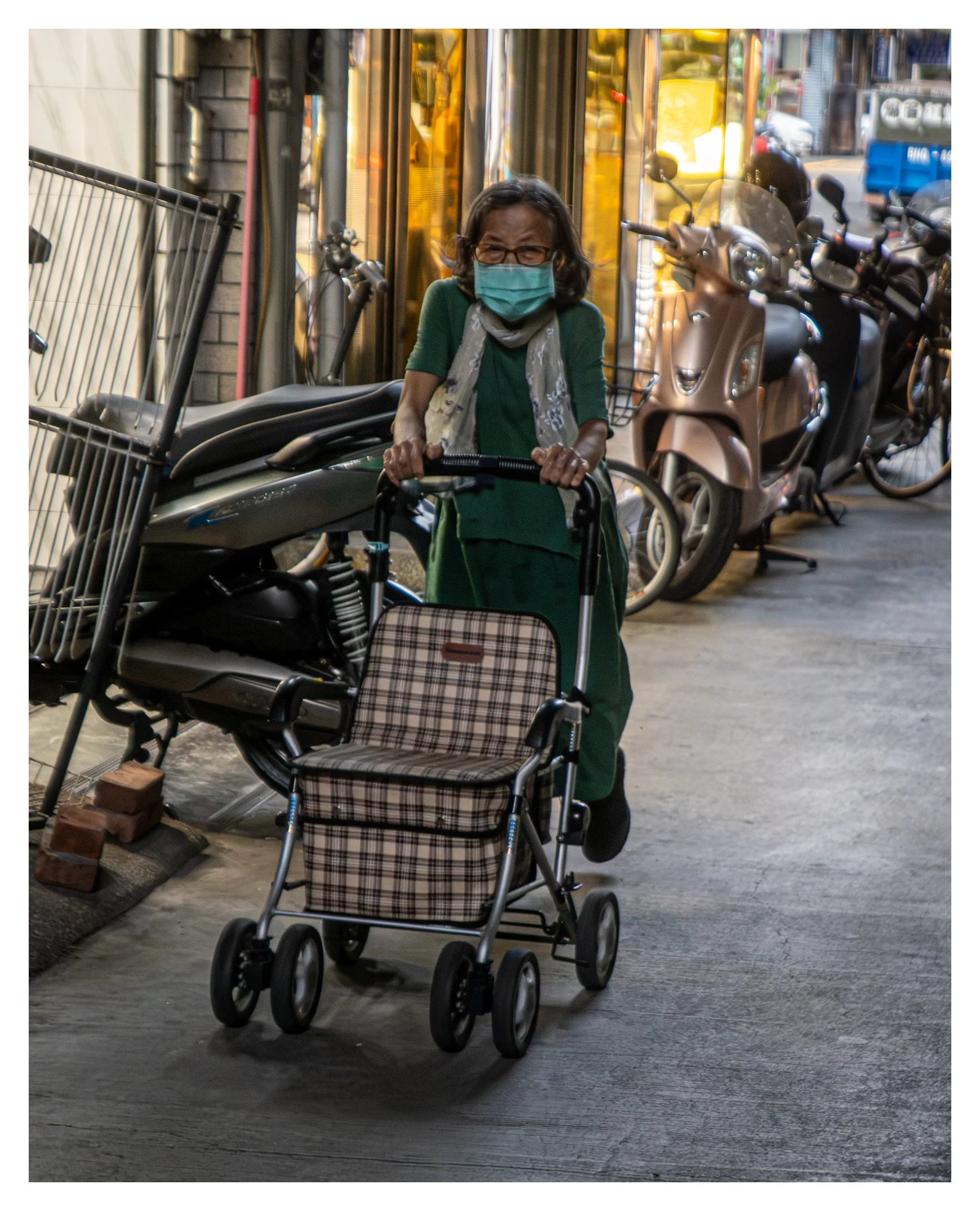
An elderly woman pushes a plaid-seated rollator down a covered arcade near Kaohsiung's computer street, moving at exactly her own pace between two rows of parked scooters built for speed. A study in direct gaze, warm light against cool shadow, and what it means to photograph age without asking it to perform for the camera.
METADATA
• Camera Model: Leica D-Lux 8
• Shutter Speed: 1/125 sec
• Aperture: f/2.8
• ISO: 2500
THE CRITIQUE
There is an easy, lazy version of this photograph that does not exist here, and it is worth naming before discussing what does. The easy version treats an elderly woman using a mobility aid as an object of pity, shot from above or at a distance, softened into a generic symbol of frailty. This photograph refuses that entirely. She walks directly toward the lens at eye level, upright, both hands gripping the rollator's handles with evident control, her gaze meeting the camera with something closer to alertness than vulnerability. Whatever this photograph is doing, it is not asking the viewer to feel sorry for its subject.
The setting does real work here, and it is worth reading before the woman herself. This is a covered arcade near Kaohsiung's computer street, a district defined by speed — turnover, upgrades, the newest processor, the fastest connection. Parked scooters line both sides of the frame in receding rows, machines built entirely around velocity, currently doing nothing but sitting still. Into that context walks the one thing in the frame actually in motion, moving at a pace those machines were never designed to accommodate. That contrast is not commentary the photograph is straining to make. It is simply what was there, and the photographer's job was to recognise it and stand in the right spot.
Light and colour are carrying more of this image's character than composition alone. Behind her, illuminated shopfront glass and metal shutters glow a rich amber, warm enough to rim her hair and shoulders with a soft gold that reads almost like studio backlighting despite being entirely found. In front of that glow, she and the foreground concrete sit in cooler, greyer tone, the temperature drop marking a clear boundary between the warmth of the light source and the neutrality of the working space it illuminates. This is now a recognisable pattern across a run of frames in this ongoing series — warm artificial light pushing against cool ambient shadow, doing quiet compositional work almost every time it appears — and it is worth naming here as an established visual signature rather than a coincidence specific to this single photograph.
The rollator itself is nearly a second subject rather than a supporting prop. Its plaid seat panel, tan and black checked fabric with a small brand tag stitched to one corner, catches enough of the ambient light to hold real graphic weight in the lower frame, four wheels splayed at slightly different angles suggesting the small continuous adjustments of a machine being steered rather than simply pushed. This is, again, a pattern this series keeps returning to: an object sharing genuine compositional authority with its human subject rather than sitting passively at their feet. A pile of fruit did it in a market portrait. A valve mechanism did it in an industrial study. Here, a piece of medical equipment does it, and does it without ever undercutting the dignity of the person using it — which is the harder trick, and the photograph manages it.
Her expression is difficult to read fully behind a surgical mask, and that difficulty is itself worth sitting with rather than working around. Eyes, brow, the set of glasses frames: that is the entire available vocabulary, and it reads as focused, direct, slightly guarded — the look of someone navigating a narrow, obstacle-crowded arcade rather than someone posing for a photograph. Nothing here has been staged or requested. This is a candid frame of a stranger going about an ordinary errand, made with enough respect to let her simply be what she actually was in that moment: a person moving carefully and competently through her own city.
Technically, the frame holds up well under difficult conditions. At ISO 2500, in fading evening light under cover, some noise is visible in the shadow areas, but it reads as fine grain rather than as a distracting flaw, and the 1/125 shutter speed was fast enough to hold her mostly sharp at a walking pace, with only the faintest softness at the leading edge of the rollator's front wheels where motion was greatest. Given the light available, this is a well-judged exposure rather than a compromised one.
What makes this photograph worth including in this series is not technical polish. It is the restraint of its own gaze — the choice to photograph an elderly woman moving through public space exactly as she was, without softening her into a symbol or hardening her into a spectacle. That is a harder discipline than it sounds, and it is the discipline this frame actually practises.
HOW THIS IMAGE COULD BE IMPROVED
• Watch the leading edge of the rollator's front wheels for motion softness at this shutter speed. A slightly faster setting, if light allows on a repeat visit, would hold that detail as crisply as the rest of the frame.
• Consider a second frame from a lower angle, closer to the height of the rollator's seat, to let the plaid fabric's texture read with even more presence without diminishing the woman's own prominence in the frame.
• If revisiting this arcade, try the same composition with a wider aperture to push the parked scooters further into soft abstraction, strengthening the contrast between her motion and their stillness even further.
• Check for any distracting hot spots in the amber shopfront glass behind her head. At this exposure they remain controlled, but a slightly different standing position could avoid any bright reflection sitting too close to her silhouette.
• If the opportunity arises respectfully, a brief second frame after she has passed — from behind, showing her continuing down the arcade — would extend this into a short sequence rather than a single decisive moment, without requiring anything further from her.
ON BECOMING A BETTER PHOTOGRAPHER: LET THE DATA SPEAK
• Track how you photograph elderly or visibly vulnerable subjects specifically, separate from your general street work. Reviewing that subset alone will show you quickly whether your instinct leans toward dignity or toward pity, which is a distinction worth being deliberate about.
• Confirm the warm-light-against-cool-shadow pattern as a genuine signature rather than an assumption. Pull every frame from this series that uses it and look at what unites them technically — time of day, light source type, your own positioning — so the pattern becomes something you can invoke on purpose.
• Note how often an object shares real compositional weight with a human subject in your portraits, and whether that object usually belongs to the person or simply happens to be near them. The distinction matters for what the photograph is actually about.
• When a subject's face is partially obscured — by a mask, by shadow, by an angle — practice reading and recording what remains legible rather than treating the obstruction as a loss. Eyes and posture alone carry more information than they are usually given credit for.
• Revisit the crop-ratio pattern already being tracked across this camera. A cleaner version of the earlier finding is emerging: square by default, portrait rectangle specifically when a single person's face and body are the close, dominant subject of the frame. This image fits that refined pattern exactly.
PHOTOGRAPHERS TO RESEARCH
• Mary Ellen Mark — decades spent photographing people on the margins of comfort and visibility with unflinching respect rather than sentimentality.
• Nicholas Nixon — has photographed ageing and mortality directly and repeatedly throughout his career, including extended work with elderly subjects in care settings.
• Eugene Richards — an unflinching documentary eye trained on illness, hardship and the body, always insisting on his subjects' full humanity.
• Miyako Ishiuchi — explored ageing, memory and the body through her mother's skin, belongings and eventual absence, with extraordinary tenderness.
• Rineke Dijkstra — direct, dignified full-length portraits of ordinary people, holding a steady, respectful gaze that never tips into spectacle.
BOOKS TO READ
• "Streetwise" — Mary Ellen Mark. Vulnerable subjects photographed with total respect and zero condescension, still the standard to measure against.
• "The Brown Sisters: Forty Years" — Nicholas Nixon. The same four women, photographed annually for four decades, ageing in plain sight.
• "Exploding Into Life" — Eugene Richards, with Dorothea Lynch. An unflinching, deeply humane account of illness and the body, made from within rather than at a distance.
• "Mother's" — Miyako Ishiuchi. A daughter's photographic reckoning with her mother's ageing, illness and death, told through skin and belongings.
• "Rineke Dijkstra: A Retrospective" — a career-spanning survey of direct, patient portraiture at its most disciplined.
VIDEOS TO WATCH
• Mary Ellen Mark: There Is Nothing More Extraordinary Than Reality
https://www.youtube.com/watch?v=4w2aaO9WYh4
• Nicholas Nixon — The Brown Sisters
https://www.youtube.com/watch?v=Q7jgYS9Gl0E
• Global Journalist: Eugene Richards And The Art Of Photography
https://www.youtube.com/watch?v=vAwV09XgFzo
• Ishiuchi Miyako: On Mother's