

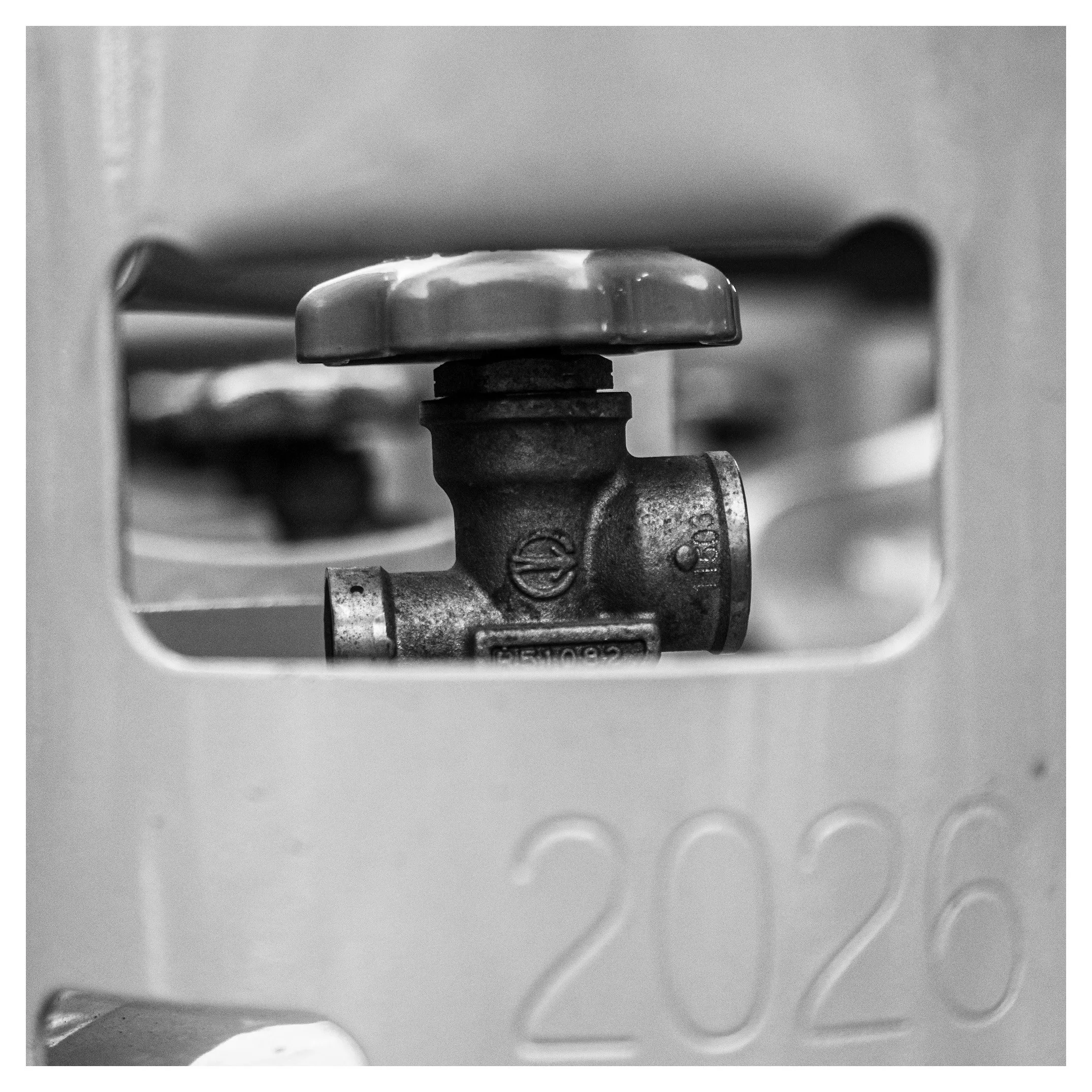
A gas cylinder's own carrying handle becomes an accidental viewfinder, framing a small brass valve like a specimen under glass. Below it, cast into the tank itself, a number that happens to match the year the photograph was taken. On finding a frame inside a frame, and why the least dramatic subjects sometimes hold still the longest.
METADATA
• Camera Model: Leica D-Lux 8
• Shutter Speed: 1/125 sec
• Aperture: f/2.8
• ISO: 640
THE CRITIQUE
The most useful compositional tool in this photograph was not chosen by the photographer. It was welded there, years ago, by whoever manufactured a gas cylinder's carrying handle. A rectangular cutout in that handle — there purely for grip and weight, with no aesthetic intention whatsoever — happens to sit at exactly the right height and angle to isolate the cylinder's valve mechanism behind it, and the photograph's entire structure depends on recognising that accident and using it.
This is the frame-within-a-frame device in one of its purest forms: not a doorway, not a window, but an industrial cutout doing the job a picture frame does in a gallery, presenting its contents as something worth looking at simply by drawing a hard edge around them. Inside that rectangle sits a small tee-shaped brass valve body, capped with a pale plastic wing knob, a manufacturer's mark stamped into one face like a coin, a metal plate below it carrying a partial serial number. Outside the rectangle, everything else — the painted steel of the handle itself, more cylinders and equipment receding into soft blur behind — recedes into supporting material. The photograph has, in effect, been composed twice: once by whoever designed the cylinder, and once by whoever noticed what that design had accidentally produced.
Rendered in black and white, the valve becomes a study in contrasting textures rather than contrasting colours, and this is where the image does its best work. The plastic knob is smooth, glossy, catching a hard highlight along its ridged edge. The cast metal body beneath it is matte, pitted, patinated with age in a way that reads as genuine use rather than neglect. The stamped medallion and the small rectangular plate carry their own tiny, dense typographic detail, legible enough to reward close inspection without ever becoming the actual subject. Three distinct surface qualities, three different ages of manufacture and wear, all held in the same tight patch of frame, and monochrome does exactly what it should here: it strips away any colour information that might have flattened those differences into a single visual note, leaving only the texture to carry the read.
There is a small, genuine coincidence worth naming once. Embossed into the cylinder body below the valve, in raised industrial lettering, is the number 2026 — almost certainly a manufacture or next-inspection-due date stamped into the steel at the point of production. The photograph was made in September of 2026. This is not a message, and it does not need to be treated as one; it is simply the kind of small alignment between an object's own information and the moment it happens to be photographed that a patient eye occasionally gets handed for free, and it is worth noticing exactly once and then leaving alone.
Depth of field is doing careful, deliberate work here rather than happening by accident. At f/2.8 on the telephoto end of this camera's zoom, focused close on the valve, the plane of sharpness holds the entire mechanism — knob, body, plate — while the handle's cut edges, close to the same distance from the lens, stay reasonably crisp too, anchoring the frame. Everything beyond that plane, the other cylinders and equipment stacked behind, dissolves into a soft grey wash with just enough shape retained to read as "more of the same" without ever competing for attention. This is exactly the kind of separation a longer lens at a moderate aperture is good at, and it has been used here with real precision rather than left to chance.
If there is a figurative reading available in this image — and there usually is one, in any sufficiently attentive close study of a manufactured object — it is in how nearly the valve resembles a small standing figure: a wide hat, a rounded shoulder, a stamped medallion at chest height like a badge, a plate below like a belt buckle bearing a name no one can quite read. Photographers have been finding faces and figures in machinery for a century, and this frame falls comfortably into that tradition without ever needing to insist on it. The valve does not need to be anthropomorphised to be interesting. It is simply available to be read that way, if a viewer wants to.
What the photograph does not attempt, and is right not to attempt, is any commentary on the gas delivery business itself, or on Kaohsiung's infrastructure, or on anything beyond the object in front of the lens. This is a close, careful, formally precise study of a small manufactured thing, made because the thing was worth looking at closely. That used to be considered sufficient justification for a photograph. It still is.
HOW THIS IMAGE COULD BE IMPROVED
• Consider a companion frame from slightly further back, showing the full cylinder and its handle in context. The tight crop here is the stronger single image, but a wider establishing frame would let a viewer understand exactly how the found window was created.
• Watch the small metal plate's legibility. It carries a partial serial or lot number that is nearly, but not quite, readable at this resolution; a slightly different angle or a touch more light on that specific surface would let it hold its own as a secondary point of interest rather than reading as texture alone.
• If revisiting this subject, try the same composition with the valve in a different rotational position — many of these fittings can be turned on their fitting — to see whether the wing knob's shadow falls more or less sympathetically against the handle's cut edge.
• Photograph the full row of cylinders straight on, in the same flat, even light, as a companion typology. A single found frame is a nice observation; a series of them, each isolating a different valve or fitting through a different cutout, would be a genuine small project.
• Check whether the embossed year stamp appears consistently across the other cylinders in the row. If it does not, that variation is worth a frame of its own — a quiet record of stock rotating in and out of service over time.
ON BECOMING A BETTER PHOTOGRAPHER: LET THE DATA SPEAK
• Keep a folder specifically for accidental frames — windows, cutouts, gaps in fencing, anything in the built environment that isolates a subject without your help. Reviewing it periodically will sharpen how quickly you spot the next one in the field.
• Log how often close, texture-focused subjects like this one get converted to black and white versus kept in colour. A clear pattern either way tells you something about which subjects you instinctively read as tonal problems rather than colour ones.
• When a manufactured object offers a figurative or anthropomorphic reading, note it once in your own captions or records and then leave it alone in the edit. The temptation to lean harder on a cute resemblance than the photograph can bear is a common and avoidable weakness.
• Track your depth-of-field choices against subject type — portraits, street scenes, close object studies — to see whether you are choosing aperture deliberately for each genre or defaulting to a single comfortable setting across all of them.
• When an object carries a stamped date, serial number or other incidental text, get in the habit of checking it before you leave the scene. It costs nothing in the moment and occasionally hands you the exact detail that makes a passing observation into a proper photograph.
PHOTOGRAPHERS TO RESEARCH
• Albert Renger-Patzsch — the defining figure of Neue Sachlichkeit object photography, who treated manufactured things with the same clarity and respect he gave to natural forms.
• Charles Sheeler — an American modernist who found monumental, almost architectural beauty in industrial machinery and factory forms.
• Margaret Bourke-White — a pioneer of industrial photography who solved genuinely difficult technical problems to make the machinery of steel mills and factories legible and striking.
• Minor White — developed the idea of the photographic "equivalent," where an ordinary object photographed with enough attention becomes a stand-in for something beyond its literal self.
• Aaron Siskind — moved from documentary work into close, abstracted studies of texture and surface, isolating fragments of the built world until they became almost unrecognisable as their source.
BOOKS TO READ
• "Die Welt ist schön" — Albert Renger-Patzsch. The founding document of object photography as its own serious discipline, still startling in its clarity.
• "Charles Sheeler: Across Media" — a survey spanning Sheeler's photography, painting and film, essential for understanding how closely he studied industrial form.
• "Margaret Bourke-White: The Photography of Design, 1927-1936" — her early industrial and architectural work, before the war reporting that made her famous.
• "Mirrors Messages Manifestations" — Minor White. A career-spanning monograph and the clearest entry point into his theory of photographic equivalence.
• "Aaron Siskind, Photographer" — a thirty-year survey moving from documentary work into pure abstraction, tracking exactly the shift this photograph borrows a little from.
VIDEOS TO WATCH
• Manhatta (1921) — A Film By Charles Sheeler And Paul Strand
https://www.youtube.com/watch?v=NWLveLZJx4g
• Margaret Bourke-White Photographer (Documentary): Part II — Industrial Photography And Soviet Russia
https://www.youtube.com/watch?v=hBmRQ9xR63g
• Minor White Captures The Ornate Beauty Of Portland's Past — Oregon Art Beat