

Day 354/365 The Blind Eye in the Middle: Lenses Under Hard Light
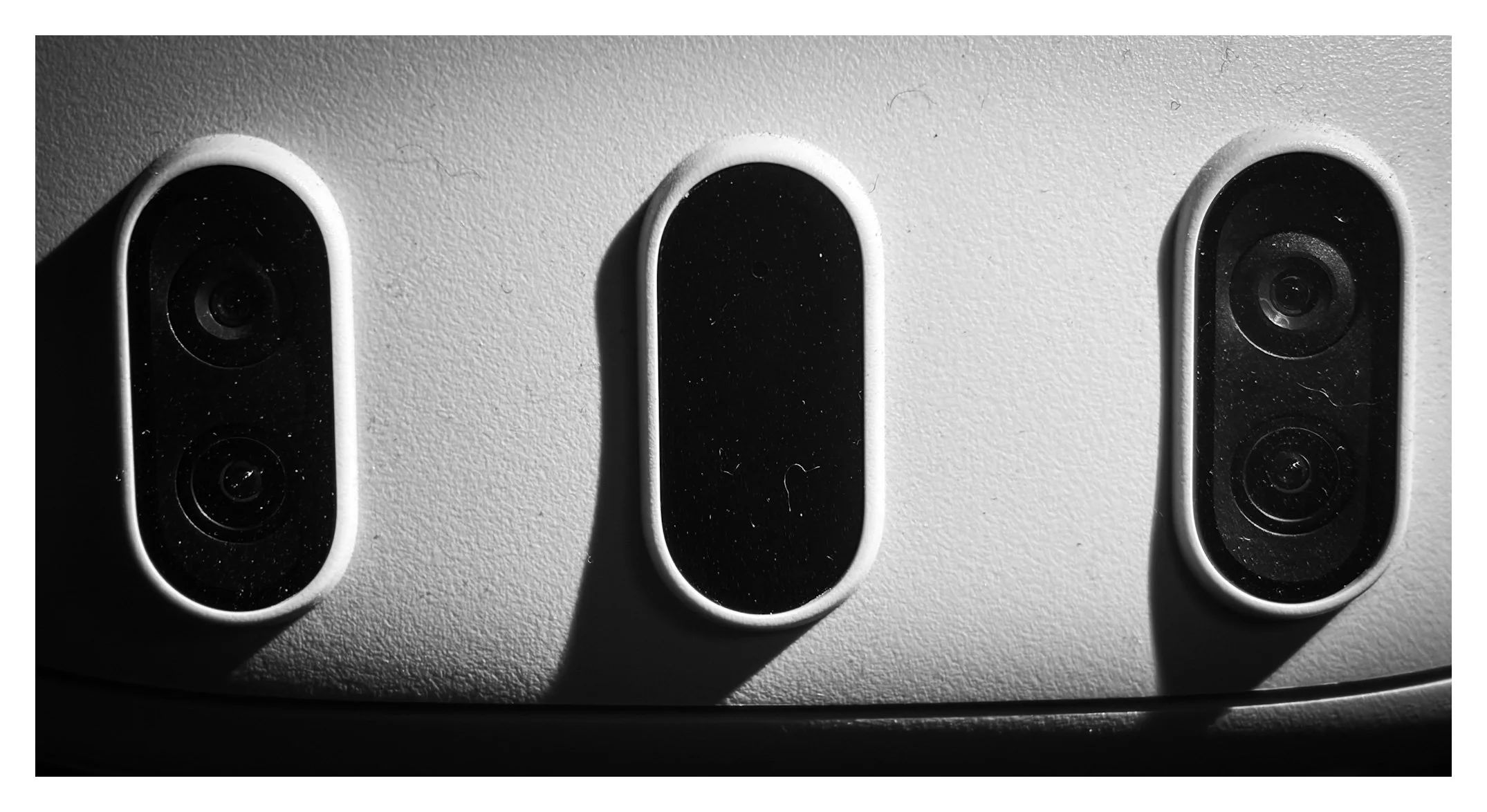
Three pill-shaped windows, two with lenses and one staring back blank, cut by hard light into long, graphic shadows. Theo Marr looks at how a humble close-up on an iPhone becomes a study in rhythm, texture and dust, and what a quick wipe, a lower exposure and a series could add.
Metadata
Camera Model: Apple iPhone 17
Shutter Speed: 1/100 sec
Aperture: f/1.6
ISO: 50
Also recorded: main wide camera at 5.96mm, 10 October 2026, 20:33, HEIC, 12.2MP (4032 x 3024), cropped to 3663 x 1918 in monochrome
Critique
This is a very different kind of picture from anything else in the series. There is no street, no weather and no person. Three pill-shaped windows sit in a pale, pebble-textured surface. The left and right windows each hold a pair of small lenses, and the middle one is blank, a black pane with no pupil. A hard light from the upper right throws a long, sharp shadow down and to the left of each rim. The result is a face of sorts, two eyes and one blind one, and that small surprise carries the whole frame.
The rhythm is the first strength. The three windows are almost evenly spaced across a wide panoramic crop, and the three shadows repeat like a beat. The second is texture. The matte, grainy surface is crisp, and it sets up a strong contrast against the glossy black glass and the bright white rims. The third is the light itself. It is hard, directional and consistent, and every shadow agrees about where it came from. That is what makes the abstraction read as deliberate, not accidental.
The blank middle window is the best decision in the frame, whether you planned it or found it. It breaks the symmetry. The eye goes to the lenses on the sides, and then back to the empty centre.
The problems are small, but they matter in a picture this graphic. There is a lot of dust. Fibres and specks sit on all three panes and across the surface, and in a picture about lenses they read as neglect more than concept. If the dust is the subject, it needs to be shot as the subject. If it is not, a blower and a microfibre cloth would have removed most of it in a minute.
The white rims are close to clipping, and so is the brightest part of the surface at the top right. The shadow side falls away into black at the left edge and along the bottom, where a dark curved band takes up the lowest tenth of the frame and swallows the base of the left window's shadow. The right window also sits closer to its edge than the left one does, so the spacing is not quite symmetrical.
On technique, the settings are what a phone chooses. f/1.6 is the main camera's fixed aperture, so it is not a creative control, and ISO 50 at 1/100 in the evening tells me the light was strong and close. You shot HEIC at 12 megapixels and kept 57 percent of it. That is enough for this, but it leaves less room for rescue in the highlights.
Improvement
• Clean first. Blow and wipe the windows and the surface before you shoot, or decide that the dust is part of the picture and light it to show it off.
• Protect the highlights. On the phone, tap the bright rim and drag the exposure down by about two thirds of a stop before shooting, since HEIC has little headroom to recover clipped whites.
• Open the left edge. A white card held just out of frame on the left would lift the shadow side a little, and the left window's shadow would keep its shape.
• Keep the lens parallel to the surface. Use the grid and the timer, and prop the phone on something stable, so the three windows stay perfectly square to the camera.
• Even up the edges. Frame so the left and right windows sit the same distance from their edges.
• Check the resolution setting. If your phone offers a higher-resolution mode, turn it on, since it would give you more room to crop.
• Try the light lower. Raking it closer to the surface would bring out the texture even further.
• Compare with colour. Shoot a colour frame too, and see whether the black and white version holds up better.
• Make it a series. Photograph other machine eyes in the same way: camera lenses, CCTV domes, phone backs, car sensors. Ten of them together would make a strong typology.
Growth and Data
Thirteen images in thirteen consecutive days. This frame adds a few firsts.
• ISO: this is your lowest ISO yet, at 50. The range is now ISO 50 to 640, and ISO 200 remains the most common at seven frames out of thirteen. The high-ISO test at night is still owed.
• Aperture: six frames at f/2.8 or wider, including this f/1.6, which is your fastest so far, and seven between f/3.2 and f/13. On the phone, aperture is fixed, so it is not a decision.
• Shutter: from 1/20 to 1/2000 sec. 1/125 is still the most common speed at five frames out of thirteen, and 1/100 is new.
• Cameras: seven frames on the Leica D-Lux 8, four on the Ricoh GR III, one on the Fujifilm X-Pro2 and one on the iPhone 17.
• Crop: twelve of thirteen frames are cropped. Seven are squares, three are 4:5, two are widescreen at 1.9:1 and one is uncropped. This frame has the same widescreen shape as your harbour pier photograph from day three.
• Subject: this is the first frame with no scene at all, just an object and light. Together with the self-portrait it shows you are getting comfortable making pictures indoors.
• Light: a fourth kind of light in four days, and your second hard, directional source in the last three.
Next steps
• Try the same object in three different light positions and compare them at home.
• Clean the subject before every close-up.
• Check the highlights on the phone before you press the shutter.
• Start a machine-eyes series.
• Keep the daily habit going.
Photographers to Study
• Paul Strand: his early abstractions, such as Porch Shadows, show realism and abstraction held in the same frame, which is exactly what this picture is attempting.
• Man Ray: turned everyday objects into shadows and light, and his rayographs are the best argument for a picture made of nothing but shape and shadow.
• Imogen Cunningham: a co-founder of Group f/64, who photographed simple subjects very close and very sharp, and found a world in them.
• Shoji Ueda: made cool, carefully composed black and white pictures, including still lifes of small everyday objects, and is a master of quiet, deliberate arrangement.
• Thomas Ruff: his work asks what photography itself is made of. A picture of lenses is a photograph about photography, and his Taiwan exhibition at the National Taiwan Museum of Fine Arts in Taichung in 2021 makes him relevant locally.
Books to Read
• Paul Strand: Sixty Years of Photographs (Aperture)
• Man Ray (Masters of Photography series)
• Imogen Cunningham: Photographs (University of Washington Press)
• Shoji Ueda (Chose Commune)
• Jpegs, Thomas Ruff (Aperture)
Videos to Watch
• Strand: Under the Dark Cloth, documentary on Paul Strand: https://www.youtube.com/watch?v=89MGYTQcre8
• "Crimes against Photography": Man Ray and the Rayograph: https://www.youtube.com/watch?v=2umyxWJslJY
• Interview with Thomas Ruff: https://www.youtube.com/watch?v=LEeRVt048R8
• Ueda Shoji: https://www.youtube.com/watch?v=6ksj6orN4wo
• Portrait of Imogen, Imogen Cunningham's own commentary on her work (Internet Archive): https://archive.org/details/SCV23
Manufacturer Note
For Apple Taiwan and Apple Japan: this series is shot daily across Taiwan, and the iPhone 17 produced a clean ISO 50 close-up with crisp surface texture and long, sharp shadows from its main camera. A phone that can be pushed into serious abstract work is the story I would like to tell with Apple, and I would welcome a conversation about a partnership. Contact via photosoftaiwan.com.