

Day 353/365 The Sidelong Glance: A Seated Portrait Among the Scooters
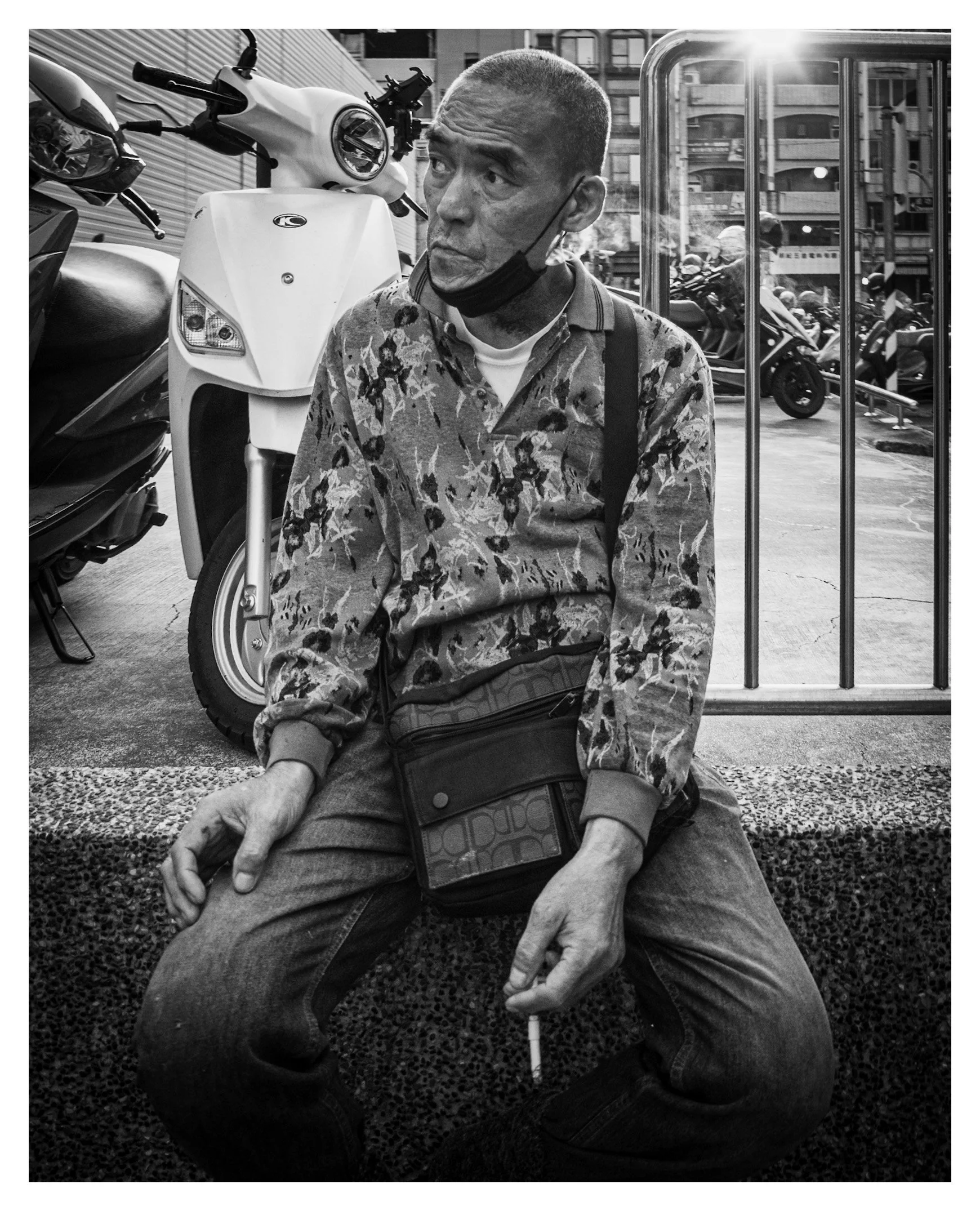
A man on a low wall, a cigarette hanging from one hand and his gaze pulled elsewhere. Behind him, scooters, steel railings and a flare of low sun. Theo Marr looks at what holds this street portrait together, what crowds it, and how a small step sideways could separate the sitter from the clutter.
Metadata
Camera Model: Ricoh GR III
Shutter Speed: 1/320 sec
Aperture: f/5.6
ISO: 640
Also recorded: GR LENS 18.3mm F2.8 (roughly 28mm full-frame equivalent), 9 October 2026, 16:40, DNG, cropped from 4000 x 6000 to 3299 x 4124
Critique
This is one of the most confident people pictures in the series. A man sits on a low stone wall with his shoulders square to the camera and his head turned sharply to look at something outside the frame. His mask is pulled down under his chin, a cigarette hangs low from one hand, and the other hand rests on his knee. Nothing about the pose feels staged. The sidelong glance is the whole picture, because it gives the viewer a question that the frame never answers.
The patterned knit sweater is the visual star. A dense black and grey floral pattern fills the centre of the picture with texture, and it separates the man cleanly from the plain white scooter behind him. The shape works too. His head, arms and hands form a loose triangle that anchors the lower two thirds, and the cross-body bag adds a dark note in the middle. Both hands are beautifully rendered and unposed, and they say as much about him as his face does.
The black and white conversion is well judged. The white scooter bounces against the dark aggregate ledge, the tones in his face hold their detail, and the file is clean at ISO 640, your highest so far. At 1/320 the pose is perfectly sharp.
The problems are all in the background. At 18.3mm and f/5.6, everything from the scooter to the apartment buildings is in focus, so nothing steps back. The white scooter's round headlamp and handlebar end right at his head, and the shapes nearly merge. A second scooter intrudes at the left edge. The steel barrier at right throws a row of vertical bars beside his shoulder, and a crowd of parked scooters adds more noise behind it.
A starburst of low sun flares at the top right, where the barrier meets the sky. It is the brightest point in the frame, so the eye is pulled up and away from the face. His glance sends the viewer in the same direction, which may be deliberate. If so, it works, but the bars slicing through the flare are untidy.
The wide lens also does what wide lenses do at close range. The knee and hand in the lower left are nearer to the camera, so they look large and add weight at the bottom. That gives depth, but it also makes the lower third heavy.
Improvement
• Separate the head from the headlamp. Move a pace left or right, or lower the camera a few centimetres, so his head sits against the darker building or a clear patch of wall rather than the white scooter.
• Clean the left edge. Step right a pace, or lose the second scooter in the crop.
• Manage the flare. Shift a few centimetres so the sun sits cleanly behind a bar or clear of it, or darken it in post.
• Burn the scooter. Darken the white fairing by about a third of a stop, so the face is the brightest large area, and dodge the face slightly.
• Use position before aperture. At 18mm, f/2.8 will only soften the background a little. A step sideways does far more than another stop.
• Take a sequence. Shoot several frames in a row, because the moment he turns, or glances back, may give you something stronger than this one.
• Think about height. A lower viewpoint would put the barrier and the scooters behind him, with his head against the building.
• Step in. You kept only 57 percent of the sensor here. Move closer, or use the camera's crop frame lines, so you compose the picture you want.
Growth and Data
Twelve images in twelve consecutive days. The habit is rock solid, and the numbers are moving in useful directions.
• ISO: this is your first frame above ISO 400, at ISO 640, and it holds up well. The ceiling test is still owed, but you have started it.
• Aperture: five frames at f/2.8 or wider and seven between f/3.2 and f/13. f/5.6 has now appeared twice.
• Shutter: from 1/20 to 1/2000 sec. 1/125 is still the most common speed at five frames out of twelve, and 1/320 has now appeared twice.
• Cameras: seven frames on the Leica D-Lux 8, four on the Ricoh GR III and one on the Fujifilm X-Pro2.
• Crop: eleven of twelve frames are cropped. Seven are squares and three are 4:5.
• People: yesterday you were the sitter, and today it is someone else. Two portraits in two days is a real shift from the street scenes and architecture earlier in the series.
• Light: three different kinds of light across three days: dusk colour, controlled flash with a gobo, and late-afternoon low sun.
Next steps
• Run a tangent check before every frame: look for anything that touches or merges with the head.
• Shoot three frames from one position, then step and shoot three more, and compare them at home.
• Push the ISO ceiling test to 3200 at night.
• Compose to the edges, and treat the crop as a last resort.
• Keep the daily habit going.
Photographers to Study
• Leon Levinstein: photographed strangers at very close range on New York streets, with bluntly framed black and white pictures that found intimacy in posture and gesture.
• Harry Callahan: a strict formalist with tonal control and geometry in everything he shot, and a good teacher for taming a crowded background.
• Dana Lixenberg: spent over twenty years making portraits at the Imperial Courts housing project in Los Angeles, which shows how a portrait deepens when you return to it.
• Liu Zheng: his seven-year project The Chinese made square black and white portraits across China in the tradition of August Sander and Diane Arbus. It is a lesson in building a whole body of work from portraits.
• Yutaka Takanashi: co-founder of the Provoke magazine in Tokyo, whose grainy black and white city pictures show how rough texture can carry a mood.
Books to Read
• Leon Levinstein (Steidl)
• Harry Callahan: Color 1945-1980
• Imperial Courts 1993-2015, Dana Lixenberg (Roma Publications)
• The Chinese, Liu Zheng (Steidl and ICP)
• Toshi-e (Towards the City), Yutaka Takanashi (Books on Books No. 6, Errata)
Videos to Watch
• Street Visionary: The Raw Eye of Leon Levinstein: https://www.youtube.com/watch?v=IPCEtrGbv-w
• Harry Callahan interviewed for Visions and Images (1981): https://www.youtube.com/watch?v=ChyLzJ-z7V4
• Dana Lixenberg, interview (2017): https://www.youtube.com/watch?v=hMktg38IR_A
• The Photographers' Gallery interviews Dana Lixenberg: https://www.youtube.com/watch?v=VPW-UuFinPI
• Dana Lixenberg, interview from the documentary Thru Dutch Eyes: https://www.youtube.com/watch?v=E4wLW5v1DpE
Manufacturer Note
For Ricoh Imaging Taiwan and Ricoh Imaging Japan: four of the twelve frames in this daily series so far were made on the GR III, and this portrait shows why. An 18.3mm lens that goes unnoticed at arm's length, stays sharp at 1/320, and holds clean detail at ISO 640 is the street kit I would like to tell the story of with Ricoh. I would welcome a conversation about a partnership.