

Day 355/365 Where the Light Splits: A City Canal in Afterglow
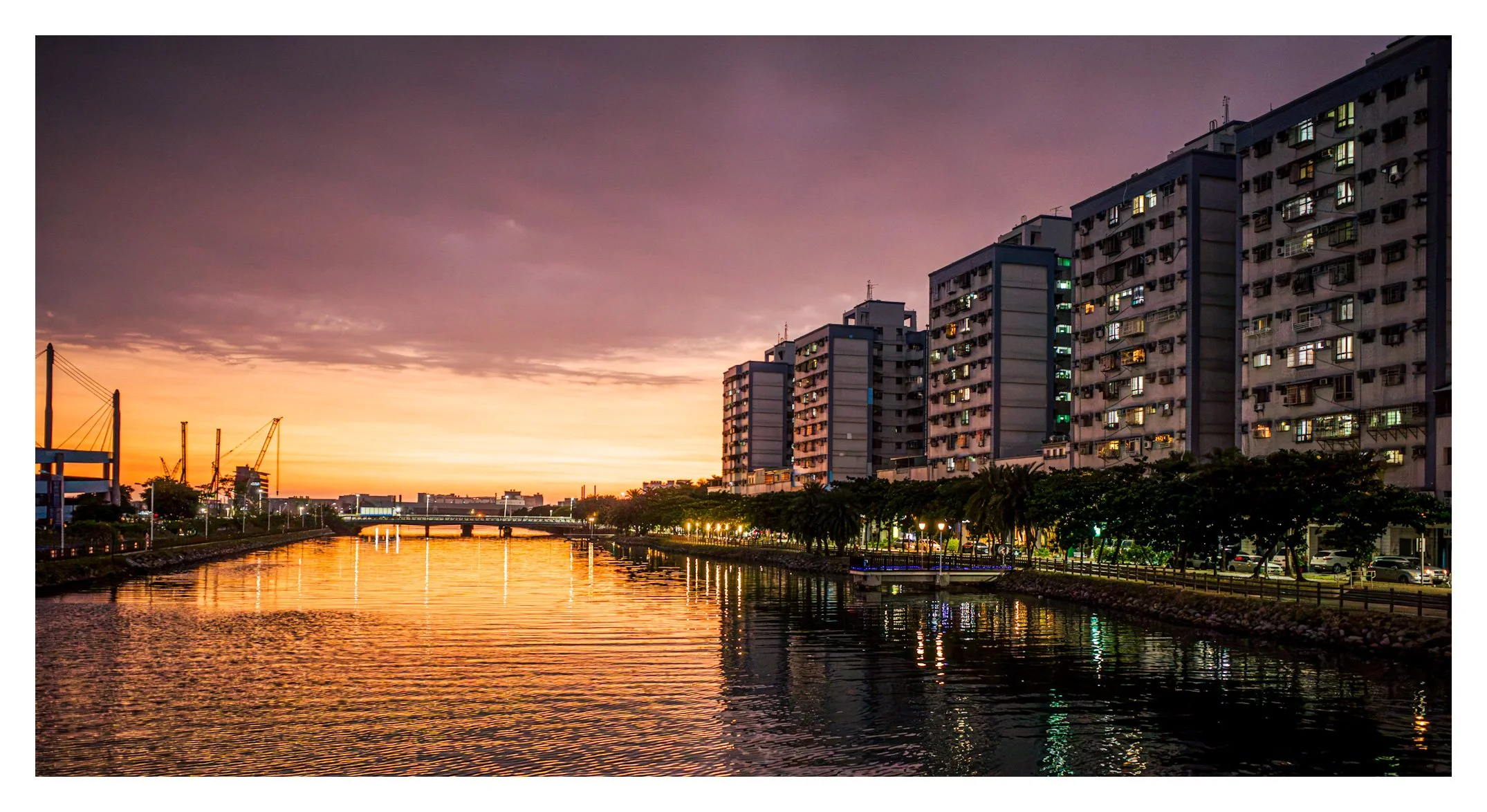
Orange fire on one side of the water, dark apartment blocks and a string of lamps on the other. A canal at dusk, and a sky that turns from amber to plum. Theo Marr looks at how this widescreen frame works, where its edges fight back, and why a calmer right-hand side would let the colour sing.
Metadata
Camera Model: Ricoh GR III
Shutter Speed: 1/30 sec
Aperture: f/2.8
ISO: 640
Also recorded: GR LENS 18.3mm F2.8 (roughly 28mm full-frame equivalent), 11 October 2026, 17:57, DNG, cropped from 6000 x 4000 to 6000 x 3141
Critique
This is a picture of a city caught at the moment it changes shifts. The sky is the star. A bruised plum and magenta cloud deck sits above a band of glowing orange at the horizon, and the canal below catches that fire and breaks it into thousands of ripples. The horizon sits about 60 percent of the way down the frame, so the sky gets the room it deserves.
The structure is strong. The river narrows toward a small bridge, which sits on the left third under the brightest part of the glow, and the string of street lamps along the right bank leads the eye to the same spot. Those lamps are the picture's second pleasure. Each one throws a vertical streak of orange, green and blue down the dark water, and the reflections turn a plain promenade into a row of lights. The apartment blocks on the right step upward toward the top corner like a staircase, with lit windows scattered across them, and those small yellow rectangles are the human presence in an otherwise empty frame. The cranes and the cable-stayed tower at the left, in silhouette, add an industrial note against the glow.
The weaknesses are about weight and edges. The right side is heavy. The apartment blocks fill nearly a third of the picture, and the tallest block touches both the top edge and the right edge, so the staircase runs out of frame and pushes the eye off with it. At the left, the tower and the platform are cut by the edge, and the cranes crowd the corner that should be the cleanest part of the glow. The lower right is a large block of black water with little in it.
The colour is rich, but I would check one thing. The plum in the sky is strong, and the grey concrete of the apartments has picked up a purple cast. If that is what you saw, it works. If it came from the edit, ease it back a little so the buildings stay grey. The horizon glow is also very hot, so check the red channel for clipping.
Technically, ISO 640 has held up well, and the dark water is clean. 1/30 at f/2.8 is a sensible handheld choice at 18mm, and the lamp points are crisp. You could do better with a brace, though. Leaning on a railing would let you stop down to f/5.6 for sharper corners and a deeper picture, with the shutter at about 1/8.
Improvement
• Rebalance the right side. Step a few paces along the bank so the tallest block sits inside the frame, or tilt up slightly. Check the uncropped frame as well, because the original 3:2 file may hold more of the building.
• Clear the left corner. Move so the pylon sits fully in or fully out, rather than half cut by the edge.
• Brace and stop down. Lean on a railing and try f/5.6 at about 1/8 sec. The ripples will soften a little and the corners will sharpen.
• Bracket the exposure. Shoot one frame for the sky and one for the water, and blend them if the horizon glow is clipping.
• Check the colour. Compare a version with the purple pulled back, and see whether the buildings look more natural.
• Wait for a subject. A cyclist on the promenade, a boat on the canal or a figure on the bridge would give the frame a story.
• Return in ten minutes. The sky will have deepened, and the lit windows and lamps will carry more of the picture.
Growth and Data
Fourteen images in fourteen consecutive days.
• Aperture: seven frames at f/2.8 or wider and seven between f/3.2 and f/13. The split is exactly even.
• Shutter: from 1/20 to 1/2000 sec. 1/125 is the most common speed at five frames out of fourteen, and 1/30 has now appeared three times.
• ISO: always between 50 and 640. ISO 640 has now appeared twice, and ISO 200 is the most common at seven frames. You have not yet gone beyond 640, so the ceiling test is still owed.
• Cameras: seven frames on the Leica D-Lux 8, five on the Ricoh GR III, one on the Fujifilm X-Pro2 and one on the iPhone 17.
• Crop: thirteen of fourteen frames are cropped. Seven are squares, three are 4:5, three are widescreen at 1.9:1 and one is uncropped. This crop keeps 78 percent of the sensor, your lightest since the lottery frame.
• Edges: awkward cuts at the frame edge appear again here, with the tower at the left and the tall block at the top right. It remains the most persistent weakness.
• Colour: dusk keeps bringing out your strongest colour, and this frame confirms it.
Next steps
• Run a corner check before you press the shutter: look at each corner for a half-cut structure.
• Brace the camera on a railing or wall at dusk and compare it with a handheld frame.
• Push the ISO test beyond 640 at night.
• Shoot one frame wider than you think you need, then crop with care.
• Keep the daily habit going.
Photographers to Study
• Berenice Abbott: documented a city in the middle of transformation, including night views from above, and showed how architecture and light can carry a whole picture.
• Rut Blees Luxemburg: photographs cities at night, turning street lamps, stairways and lit windows into something close to poetry.
• Philip-Lorca diCorcia: builds light in public spaces with a cinematic eye, and is a good teacher for making dusk colour look intentional.
• Yang Yongliang: a Shanghai artist who builds misty landscapes out of city buildings. His video Phantom Hsimenting takes its name from Taipei's Ximending, and his work invites you to see apartment blocks as cliffs.
• Tokihiro Sato: a Japanese photographer who works with light and space, and whose piece Mirror in the Sea makes reflections the subject.
Books to Read
• Changing New York, Berenice Abbott (The New Press and the Museum of the City of New York)
• London: A Modern Project, Rut Blees Luxemburg (Black Dog Publishing)
• A Storybook Life, Philip-Lorca diCorcia
• Yang Yongliang: New Landscapes (Chinese Contemporary Photography)
• Photo Respiration: Tokihiro Sato Photographs
Videos to Watch
• Berenice Abbott: A View of the 20th Century (The Met): https://www.youtube.com/watch?v=oZHhVQQNsyA
• Entrevista/Interview. Philip-Lorca diCorcia: https://www.youtube.com/watch?v=67U-0_wExLA
• Yang Yongliang: Artificial Wonderland: https://www.youtube.com/watch?v=g-RuDOT4XyE
• Yang Yongliang, Phantom Hsimenting (Galerie Paris-Beijing): https://www.youtube.com/watch?v=e3Yg2QO1CKM
• Tokihiro Sato, Mirror in the Sea: https://www.youtube.com/watch?v=9LBRi9qFJ2g
Manufacturer Note
For Ricoh Imaging Taiwan and Ricoh Imaging Japan: five of the fourteen frames in this daily series were made on the GR III, and this one shows what it does at dusk. An 18.3mm lens that stays sharp at f/2.8, holds clean dark water at ISO 640 and fits in a pocket on a walk along a canal is the story I would like to tell with Ricoh. I would welcome a conversation about a partnership. Contact via photosoftaiwan.com.