

Day 356/365 Curves in a Cage of Angles: A Tower Through the Ceiling
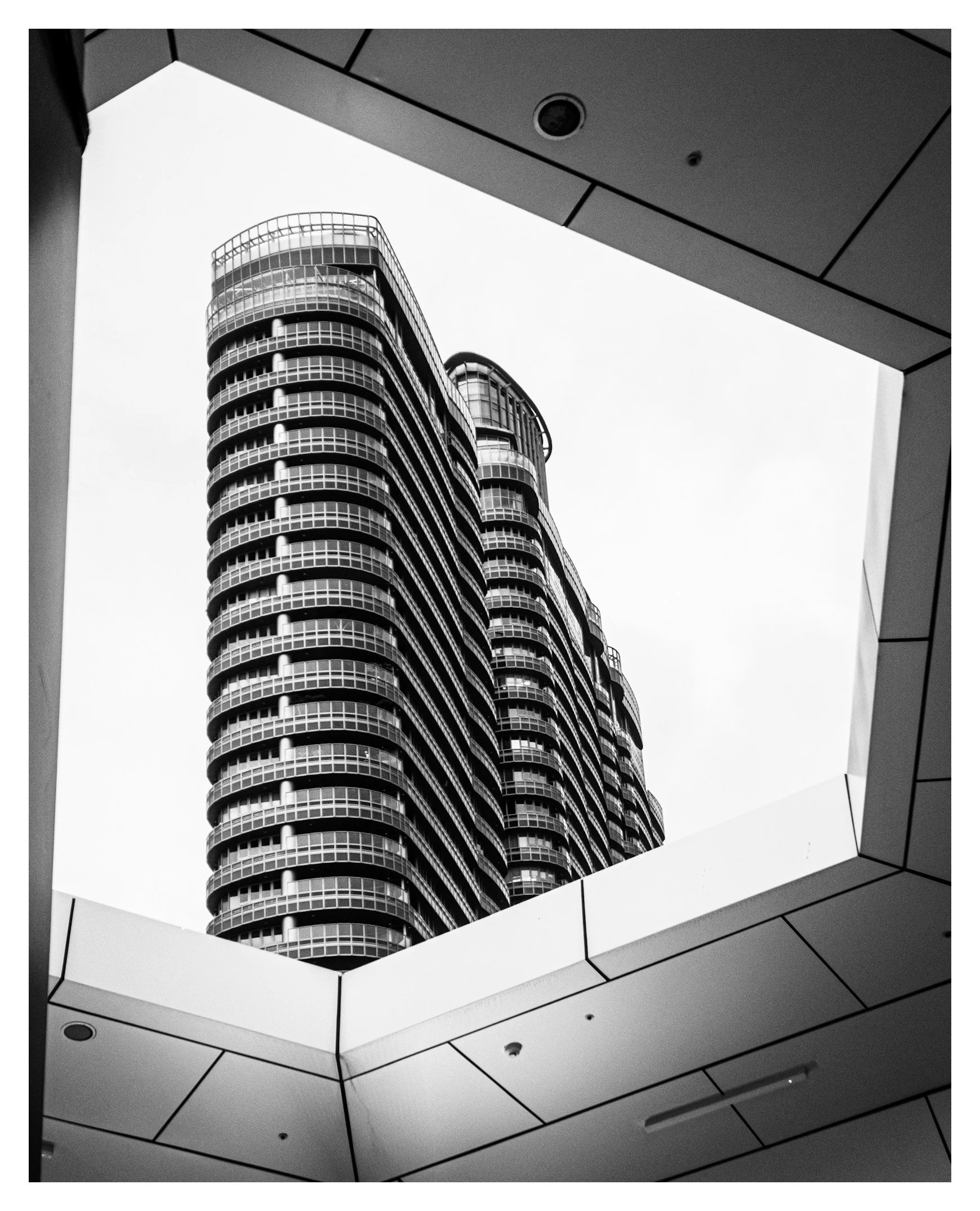
A curved apartment tower glimpsed through a jagged opening in a ceiling, the sky burned to pure white. Theo Marr examines how a frame within a frame turns a plain upward glance into a graphic puzzle, why the white sky works, and where the edges stop helping.
Metadata
Camera Model: Leica D-Lux 8
Shutter Speed: 1/60 sec
Aperture: f/2.8
ISO: 400
Also recorded: 31mm on the DC Vario-Summilux 10.9-34mm f/1.7-2.8 lens, 12 October 2026, 17:43, DNG, cropped from 3552 x 4736 to 3478 x 4348 (4:5), monochrome
Critique
This is the cleanest piece of graphic thinking in the series so far. A pair of curved apartment towers rises through an irregular opening in an overhead structure. The opening is a five-sided shape cut by black seam lines, and the sky inside it is pure white, so it reads like a paper cut-out. The result is a collision of two kinds of shape: the hard, faceted angles of the ceiling against the soft, rounded balconies of the tower.
The tower itself is the pleasure. Each floor is a curved ribbon, and the ribbons stack into a rhythm that runs from the base of the frame to the roof rail. You have shot it near the long end of the zoom, so the floors are compressed and the tower feels dense and close. The lower ledge slices through the base of both towers in a V, which seats the tower in the frame and hides the second tower's foot. The tonal range is strong as well, with a deep black wall on the left, mid-grey ceiling panels and a bright white sky. The tower is sharp and the balcony detail holds, and the grain at ISO 400 suits the subject.
The ceiling fixtures help more than they hurt. The round downlight at the top and the small sprinkler heads confirm that this is a ceiling and give the opening scale. The downlight also rhymes with the roundness of the tower, which is a nice accident.
My doubts are about edges and the sky. The white sky is clean and graphic, and if it is deliberate I would keep it. It is also pure, and where the bright inner faces of the opening meet it, at the right edge and along the lower ledge, the boundary nearly disappears. The fluorescent-looking strip at the lower right and the scattered marks on the panels are small distractions. The tower also sits left of centre, which leaves the right half of the opening as a large empty white area. That is breathing space, but it makes the picture feel weighted to one side.
The tower leans to the right, as upward views do. That adds drama, and I would leave it unless you want something steadier.
Improvement
• Decide on the sky. If you like it pure white, keep it. If you want a hint of cloud, drop the exposure by about a stop and see what the highlights keep.
• Protect the edges. Check where the bright faces meet the sky and, if you can, shift your angle by a step so a thin dark line separates them.
• Shift your position. A half step to the right would put more of the second tower above the ledge and rebalance the empty area.
• Watch the fixtures. Try a frame where the downlight sits clear of the tower's roof, or deliberately close to it.
• Bracket. The D-Lux can bracket exposures, so shoot three and choose at home.
• Try colour. Shoot the same view at sunset, when the sky inside the opening might glow.
• Make it a series. Frames within frames, such as ceiling openings, stairwell gaps and window cut-outs, would make a strong set.
Growth and Data
Fifteen images in fifteen consecutive days.
• Crop: fourteen of fifteen frames are cropped, but this one keeps 90 percent of the sensor, the lightest crop of any cropped frame. Seven frames are squares, four are 4:5, three are widescreen at 1.9:1 and one is uncropped. This is the clearest sign yet that you are composing to the camera frame, not to the crop.
• Aperture: eight frames at f/2.8 or wider and seven between f/3.2 and f/13. f/2.8 has now appeared five times.
• Shutter: from 1/20 to 1/2000 sec. 1/125 is still the most common speed at five frames, and 1/60 is a safe handheld speed at this focal length.
• ISO: between 50 and 640. ISO 200 is still the most common at seven frames out of fifteen. The ISO ceiling test above 640 is still owed.
• Cameras: eight frames on the Leica D-Lux 8, five on the Ricoh GR III, one on the Fujifilm X-Pro2 and one on the iPhone 17.
• Edges: the awkward cuts of earlier posts are replaced here by deliberate ones, which is a good sign. The remaining edge problem is where bright faces meet the white sky.
• Subject: a reminder that you see geometry well, as in the Jiadong rooftops in Post 9.
Next steps
• Shoot a frame within a frame every week for the next month.
• Bracket exposures whenever the sky takes up half the picture.
• Keep composing to the camera frame, and crop only to refine.
• Push the ISO test beyond 640.
• Keep the daily habit going.
Photographers to Study
• Iwan Baan: photographs architecture with the people who live in it, and his work on towers shows how much life sits behind a facade.
• Luisa Lambri: photographs windows and openings in modernist buildings, treating a window like a camera lens and letting light do the work.
• Ola Kolehmainen: reduces building facades to near-abstract geometry, removing what he calls visual noise, and is the closest match to this picture's graphic order.
• Thomas Demand: makes images of architectural spaces that feel built and almost empty of people, and shows how a clean, cut-out picture can feel strange.
• Yukio Futagawa: the Japanese photographer who founded GA magazine and spent sixty years photographing architecture, and a master of quiet, exact framing.
Books to Read
• Torre David: Informal Vertical Communities, Iwan Baan
• Brasilia & Chandigarh: Living With Modernity, Iwan Baan
• Fraction Abstraction Recreation, Ola Kolehmainen (Hatje Cantz)
• The Dailies, Thomas Demand
• Nihon no minka, Yukio Futagawa and Teiji Ito
Videos to Watch
• Iwan Baan, People and Place: The Power of Living Architecture: https://www.youtube.com/watch?v=2ZcLxWebs8k
• Architecture and the Media 2020, Talk with Iwan Baan: https://www.youtube.com/watch?v=06Wdcp-4dks
• Architecture Biennale, Luisa Lambri (NOW Interviews): https://www.youtube.com/watch?v=-NfKcOcdhQo
• Thomas Demand Interview: Constructing the Authentic: https://www.youtube.com/watch?v=U2Pn8SCFvjM
• Thomas Demand Interview: A World of Models: https://www.youtube.com/watch?v=09gZg9xOano
Manufacturer Note
For Leica Camera Taiwan and Leica Camera Japan: eight of the fifteen frames in this daily series were made on the D-Lux 8, including this black and white architectural study at the long end of the Vario-Summilux zoom. A compact with this reach, sharpness and tonal range makes serious geometric work possible on an ordinary evening walk, and I would like to tell that story with Leica. I would welcome a conversation about a partnership. Contact via photosoftaiwan.com.