

Day 357/365 The Alley Looks Back: Layers of Old Kaohsiung
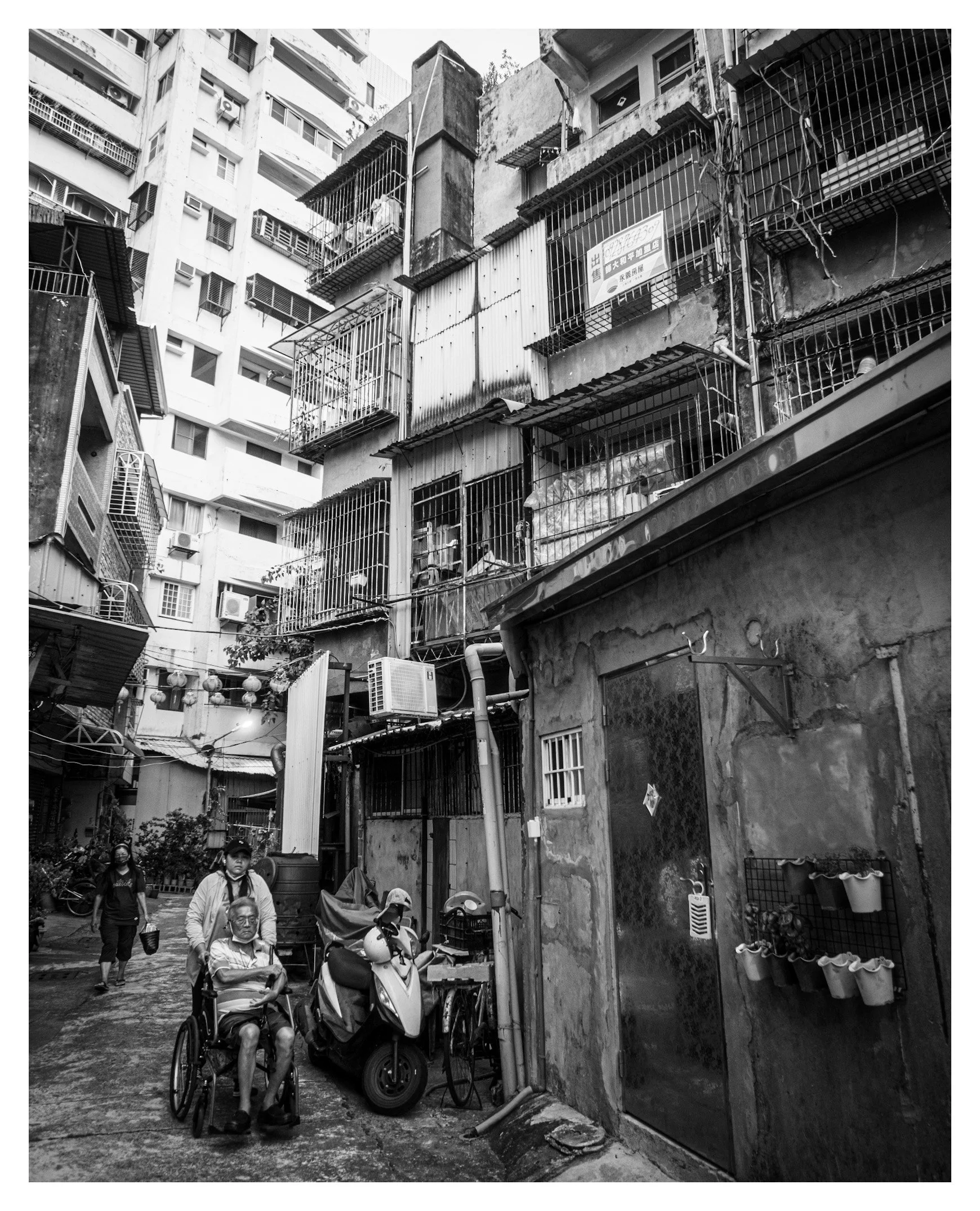
A narrow back lane, a wall of iron grilles and a tower looming behind, and a man in a wheelchair who looks straight at the lens. Theo Marr unpacks the layers of this Kaohsiung alley, why the story works, and where the corner of the frame gets crowded.
Metadata
Camera Model: Leica D-Lux 8
Shutter Speed: 1/125 sec
Aperture: f/2.2
ISO: 200
Also recorded: 11mm on the DC Vario-Summilux 10.9-34mm f/1.7-2.8 lens, 13 October 2026, 17:18, DNG, cropped from 3552 x 4736 to 3552 x 4440 (4:5), monochrome, Kaohsiung
Critique
This is the strongest street frame in the series, and it earns that because it is about layers. You are standing low in a narrow back lane and looking up. At the left, a pale apartment tower rises out of the frame. In the middle, a stack of older buildings is wrapped in iron window grilles, corrugated awnings and drainpipes. At the right, a stained concrete wall with a metal door fills the lower half, and a small grid of plant pots hangs beside it. At the lower left, a woman pushes an elderly man in a wheelchair out of the lane. A second woman walks behind them with a bag. A scooter and a bicycle are parked against the wall, a strip of red lanterns hangs in the distance, and a real estate sign reading 出售, for sale, sits on one of the grilles.
The story is in the contrast. A tall modern tower stands behind a low, crowded, weathered row. A for-sale sign hangs on a window, and a man in a wheelchair is being pushed through the lane. Nothing is staged, and nothing needs explaining. The man's look at the camera is the heart of the picture. He has seen you, and the picture is about that exchange as much as it is about the buildings.
The composition supports it. The long diagonal of the roof edge at the right drives the eye up and across, the drainpipe and the chimney carry it upward, and the wheels of the chair and the round shapes of the scooter echo each other. The light is soft and late. At 17:18 the alley is in shade, so the tonal range is gentle, and the concrete, metal and plaster all hold texture. At f/2.2 and 1/125 everyone is sharp, including the walkers, and ISO 200 keeps the grain fine.
The weak points are at the lower left. The group sits in the corner, and the front of the wheelchair almost touches the bottom edge. The scooter and its dark cover sit directly behind the woman's head and the chair, so the people merge with them. The upper half is very busy, and the sign is the brightest, sharpest thing up there, so it competes with the man for attention. The lower right is a heavy block of dark wall that anchors the frame but is dull, apart from the pots.
The verticals converge, as they do when you tilt a wide lens upward. The tower at the left leans noticeably to the right. It adds drama and suits the subject, and I would leave it unless you want a calmer picture.
Improvement
• Give the group room. Wait a few seconds, or step back, so the chair is clear of the bottom edge and has some floor below it.
• Separate the people from the scooter. A small step to the left would stop the dark cover from touching the carer's head and the chair.
• Place the sign deliberately. It is a strong story element, so try a frame where it sits in a clean part of the upper area, away from the figures.
• Tilt less. Hold the camera a little more level to ease the convergence, and compare both versions.
• Anchor a vertical. Use the drainpipe as a guide, and align it with the frame edge.
• Check the uncropped frame. The original 3:4 file may hold more floor below the wheelchair than the 4:5 crop does.
• Return at golden hour. Raking light on the wall would bring out more texture, and the lanterns would glow.
• Greet your subjects. A nod or a smile before the shutter is good manners, and it often improves the look you get back.
Growth and Data
Sixteen images in sixteen consecutive days.
• Crop: fifteen of sixteen frames are cropped, but this one keeps 94 percent of the sensor, following 90 percent last time. Those are your two lightest crops in a row. Seven frames are squares, five are 4:5, three are widescreen at 1.9:1 and one is uncropped.
• Aperture: nine frames at f/2.8 or wider and seven between f/3.2 and f/13.
• Shutter: from 1/20 to 1/2000 sec. 1/125 is now the most common speed at six frames out of sixteen.
• ISO: always between 50 and 640. ISO 200 now accounts for eight of sixteen frames, exactly half. The ISO ceiling test above 640 is still owed.
• Cameras: nine frames on the Leica D-Lux 8, five on the Ricoh GR III, one on the Fujifilm X-Pro2 and one on the iPhone 17.
• People: this is your second frame, after Post 12, in which a stranger's gaze meets the lens. It is also your most complete one, with a story built around the figures.
• Edges: the corner problem returns here, with the wheelchair almost touching the bottom edge.
Next steps
• Shoot one more alley frame this week, and wait for the subject to arrive in the clear space.
• Check all four edges before pressing the shutter.
• Keep composing to the camera frame, and crop only to refine.
• Push the ISO test beyond 640.
• Keep the daily habit going.
Photographers to Study
• Shirley Baker: photographed the streets of Manchester and Salford during the slum clearances, building images whose power comes from their layers, with people looking straight into her lens.
• Roger Mayne: spent five years on London's Southam Street, and wrote that he photographed poor streets because he loved the life on them.
• Deng Nan-kuang: a Taiwanese pioneer of realist photography who loved the Leica and made candid street pictures across Taiwan in the 1930s and 1940s.
• Chang Tsai: one of the three musketeers of Taiwanese photography alongside Deng Nan-kuang and Li Ming-diao, who helped establish realist photography in postwar Taiwan.
• Quo Ying-sheng: began with documentary pictures of his native Taiwan before moving to a personal, poetic vision, and shows where a Taiwanese street photographer can go next.
Books to Read
• Shirley Baker, edited by Lou Stoppard (MACK)
• The Street Photographs of Roger Mayne (V&A)
• Nostalgia, Memory, Deng Nan-kuang (鄉愁.記憶.鄧南光)
• Quo Ying-sheng: Private Scenery (私風景) (Garden City)
• Photographers of Taiwan series (Ministry of Culture), the third set includes Quo Ying-sheng
Videos to Watch
• Shirley Baker: Life Through a Lens, official trailer: https://www.youtube.com/watch?v=HmYRehZOFRA
• The glorious street photos of Roger Mayne: https://www.youtube.com/watch?v=5dK1h43hIjY
• Deng Nan-guang's 8mm Movies (鄧南光8mm家庭電影): https://www.youtube.com/watch?v=7R0UpyJLjyY
• Outstanding Taiwanese Photographers short film: Chang Tsai (NCPI): https://www.youtube.com/watch?v=Uc_eDWomIeQ
• Taiwanese Photographer: Quo Ying-sheng (臺灣攝影家:郭英聲): https://www.youtube.com/watch?v=RqRKx6WzPqU
Manufacturer Note
For Leica Camera Taiwan and Leica Camera Japan: nine of the sixteen frames in this daily series were made on the D-Lux 8, including this black and white alley study at 11mm. A compact that keeps a whole layered lane sharp at f/2.2 in the shade, with fine grain at ISO 200 and a lens made for the street, is the story I would like to tell with Leica. It also connects to Deng Nan-kuang, who used a Leica to photograph Taiwan in the 1930s. I would welcome a conversation about a partnership.