

Day 358/365 The Cardboard Cyclist: A Level Stare Across the Crossing
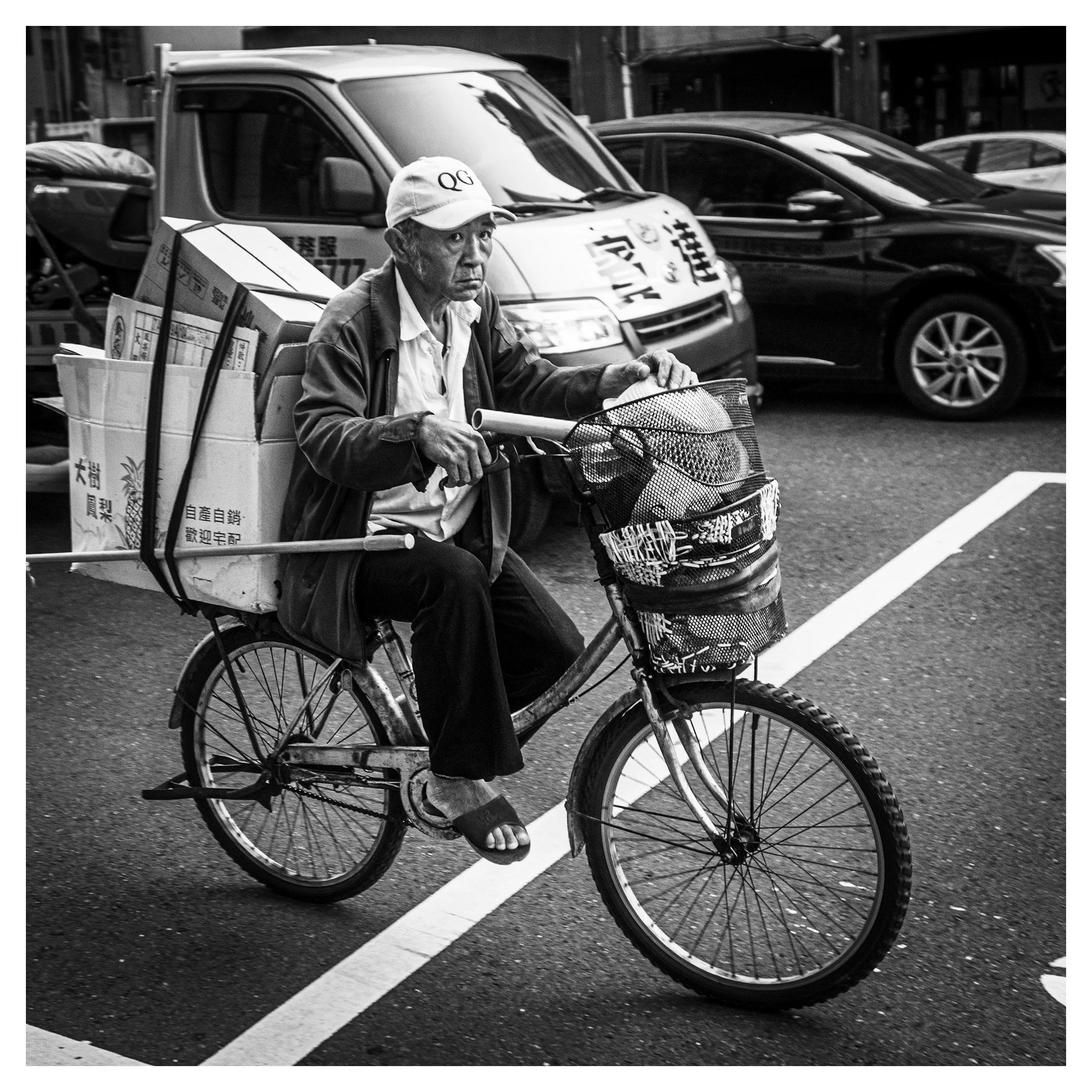
An older man crosses the road on a bicycle piled high with cardboard, and fixes the lens with a wary, unblinking stare. Theo Marr looks at what makes this square street portrait work, what the heavy crop gives and takes, and how to keep the trust of the people you photograph.
Metadata
Camera Model: Leica D-Lux 8
Shutter Speed: 1/250 sec
Aperture: f/2.4
ISO: 400
Also recorded: 17mm on the DC Vario-Summilux 10.9-34mm f/1.7-2.8 lens, 14 October 2026, 17:11, DNG, cropped from 4736 x 3552 to 3065 x 3065 (1:1), monochrome
Critique
This is a street portrait with real weight in every sense. An older man pedals across a pedestrian crossing, carrying a stack of cardboard strapped to the back of his bicycle, a long pole sticking out behind it, and a basket of bags on the front. He wears a white cap, a jacket over a white shirt, dark trousers and sandals. One hand is on the handlebar, the other rests on the basket. A van and a dark car wait behind him. He looks straight at you with a flat, guarded stare, and that look is the picture.
Almost everything supports it. The face is sharp and sits in the upper part of the frame, and his white cap and shirt stand out against the dark windscreen and the dark car. The surface detail is wonderful: the cardboard with its printed pineapple box, the mesh of the basket, the spokes, the creases in his jacket. The strips of road marking give the picture a diagonal frame. At 17:11 the light is warm and side-on, so his face is modelled rather than flat. 1/250 freezes him cleanly, and f/2.4 softens the van just enough to keep it from competing.
The horizontal lines are a quiet pleasure. The white pipe on the handlebar and the long pole at the back rhyme with each other and with the white crossing lines, and they give the load a structure.
The weaknesses come from the crop. At 56 percent of the sensor, this is a heavy crop, and it leaves the left side tight. The long pole runs off the left edge, so the eye is led out of the frame. The load and the stub of a scooter at the left crowd the edge as well. The large white characters on the van just to the right of his head are the brightest, busiest thing in the background, and they compete with his face. A bright fragment of road marking in the lower right corner also pulls the eye.
His look is guarded. Take it as a gift and as a caution. If he saw you and allowed the picture, it is a strong portrait of a person at work. If he objected, you should respect that.
Improvement
• Use more of the frame. Check the original 4:3 file for a crop that either includes the whole pole or excludes it cleanly.
• Quiet the background. Wait a second or step sideways so the van's lettering is not next to his head, or place the dark car behind him instead.
• Watch the corners. Check the lower right and the left edge before pressing the shutter.
• Shoot a short burst. Three frames at 1/250 would give you a choice of wheel position and expression.
• Connect afterwards. A nod, a smile or a thank-you after the picture often turns a wary stare into something warmer next time.
• Make it a series. Frames of people carrying loads on your own streets, shot with the same care, would make a strong set.
• Compare a lighter conversion. The blacks are deep, and a slightly softer version would open the dark car and the road.
Growth and Data
Seventeen images in seventeen consecutive days.
• Crop: sixteen of seventeen frames are cropped. After two light crops (94 and 90 percent), this one keeps 56 percent. Eight frames are squares, five are 4:5, three are widescreen at 1.9:1 and one is uncropped.
• Aperture: ten frames at f/2.8 or wider and seven between f/3.2 and f/13.
• Shutter: from 1/20 to 1/2000 sec. 1/125 is still the most common at six frames out of seventeen, and 1/250 is the right speed for a moving subject.
• ISO: always between 50 and 640. ISO 200 accounts for eight of seventeen frames. The ISO ceiling test above 640 is still owed.
• Cameras: ten frames on the Leica D-Lux 8, five on the Ricoh GR III, one on the Fujifilm X-Pro2 and one on the iPhone 17.
• People: this is the third frame in six days where a stranger's gaze meets the lens, after Posts 12 and 16. It is turning into a theme.
• Edges: the left edge is the weak point again, and the heavy crop made it tighter.
Next steps
• Shoot the next street portrait with the original frame in mind, and crop only to refine.
• Check all four corners before pressing the shutter.
• Keep a note of who allowed a picture and who did not.
• Push the ISO test beyond 640.
• Keep the daily habit going.
Photographers to Study
• Jamel Shabazz: a Brooklyn street portraitist whose pictures grow out of building a connection with his subjects, and a good model for the exchange of looks in this frame.
• Chris Steele-Perkins: a Magnum photographer who documented urban poverty and everyday life in Britain with empathy, never losing the individual face in the crowd.
• Seiji Kurata: photographed Tokyo's streets in the 1970s with flash and a medium format camera, in frontal pictures where his subjects always knew he was there.
• Ihei Kimura: the Japanese master of the Leica snapshot, who photographed everyday people across Japan.
• Takeyoshi Tanuma: photographed his native Tokyo for over sixty years, from the children of Asakusa to the streets of Ginza, and celebrated everyday life.
Books to Read
• Back in the Days, Jamel Shabazz
• The New Londoners, Chris Steele-Perkins
• Flash Up: Street Photo Random Tokyo 1975-1979, Seiji Kurata (Zen Foto Gallery)
• Japan Through a Leica, Ihei Kimura
• Picturing My Tokyo, Takeyoshi Tanuma
Videos to Watch
• The Alchemy of Urban Street Portraits, with Jamel Shabazz: https://www.youtube.com/watch?v=FhWQfpedWaE
• Going Underground with Jamel Shabazz: https://www.youtube.com/watch?v=pyDM7O_YAcg
• Jamel Shabazz: Street Photographer, documentary by Charlie Ahearn (Tubi): https://tubitv.com/movies/512238/jamel-shabazz-street-photographer
• Magnum by Magnum: Photographer Interviews, including Chris Steele-Perkins: https://www.youtube.com/watch?v=3YOU6ufKN2M
• Magnum Quarantine Conversations: Chris Steele-Perkins and Jean Gaumy: https://www.youtube.com/watch?v=Wq0JQKwsLlA
Manufacturer Note
For Leica Camera Taiwan and Leica Camera Japan: ten of the seventeen frames in this daily series were made on the D-Lux 8, including this black and white street portrait at 17mm. A compact that can freeze a moving rider at 1/250, hold a sharp face against a softly blurred background at f/2.4 and give clean detail at ISO 400 is the story I would like to tell with Leica. It is also a camera in the tradition of Ihei Kimura's Leica snapshots. I would welcome a conversation about a partnership.