

Day 359/365 The Cool Pause: Studying a Diner Portrait Worth Chasing
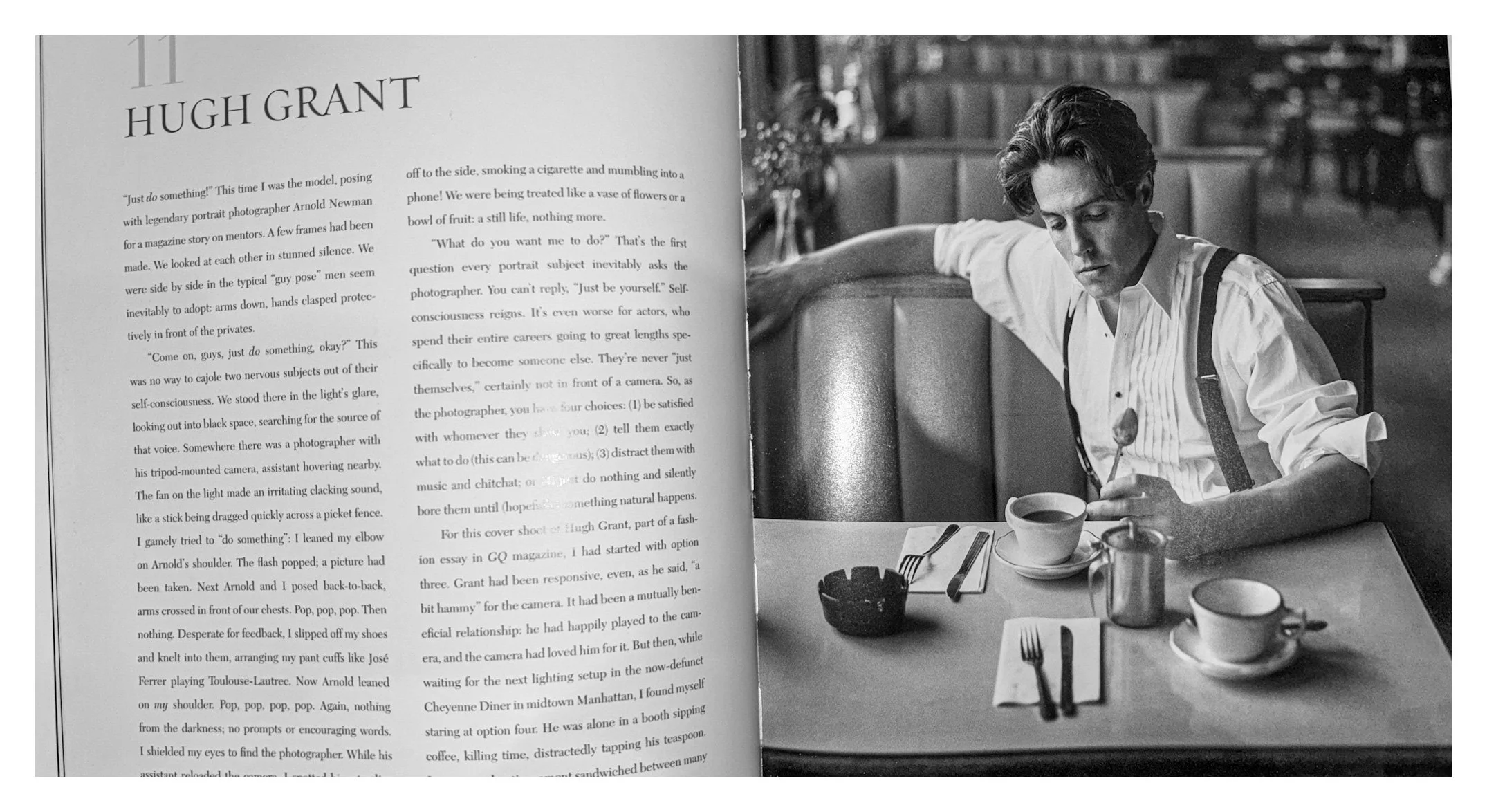
Every photographer keeps a picture they wish they had made. This one is a black and white diner portrait of a thoughtful man holding a teaspoon. Theo Marr takes apart its tone, blur and pose, and shows how to chase that look with the cameras you already own.
Metadata
Camera Model: Apple iPhone 17
Shutter Speed: 1/50 sec
Aperture: f/1.6
ISO: 32
Also recorded: 5.96mm main camera, 15 October 2026, 19:00, JPG, 4032 x 3024 original, shown here as a widescreen crop
Critique
This is not a street frame. It is a study: a photograph of a black and white portrait printed in Gregory Heisler's book 50 Portraits, with the chapter heading naming the sitter as the actor Hugh Grant. The printed portrait is the star, so I will take it apart first and then turn to your copy of it.
The portrait itself is a lesson in restraint. A young man in a white dress shirt with loosened cuffs and dark braces sits in a diner booth, one arm draped over the back of the seat, the other hand lifting a teaspoon over a cup. He is looking down at it, and he is not looking at us. That is why it reads as thoughtful. He is lost in his own head, and the cool comes from how unbothered he looks.
You named three things you admire, and they are the right three.
Tone. The scale of greys is rich and unhurried. The pleated shirt keeps its texture in the brightest area of the frame, the braces anchor it with a strong dark, and the leather of the booth carries soft specular sheen without burning out. It is a midtone-led picture with no crushed shadows, and that gives it the air of a quiet room.
Blur. The background dissolves into the repeating rhythm of the booths and the room beyond. You can tell where he is without being told, and nothing there competes with his face. The sharp plane sits on him, his hand and the table setting, and everything else falls away.
Pose. There is almost none. His body forms a loose diagonal from the draped arm through the shoulder to the spoon, and the cups, cutlery and napkins set up smaller diagonals on the table that echo it. The spoon is the point of tension, a small gesture that gives the eye somewhere to land and the sitter something to do. The setting does half the work.
The text on the facing page tells the story, and it is a useful one. The picture came from a pause between lighting setups, when the sitter, left alone in the booth, sat sipping coffee and tapping a spoon. In other words, the photographer waited for something natural to happen rather than directing it.
Now your copy. The portrait is sharp, with plenty of tonal detail preserved, and ISO 32 gives a very clean file. The weaknesses are about copying technique, not composition. The left-hand page is slightly rotated, so the lines of text slope upwards to the right. A pale streak of glare crosses the middle of the text column, which tells me the page was lit from overhead or from a window at the wrong angle. The page also curves towards the gutter, which softens the edge of the portrait nearest the spine. For a study, I would also crop to the portrait alone, since the text on the left competes with it.
Improvement
• Shoot a copy square on. Keep the phone parallel to the page and use the grid to align the edges, so the text lines run level.
• Avoid glare. Light the page from one side at about 45 degrees, or tilt the book a few degrees away from the source, so the sheen slides off the paper.
• Flatten the page. Weight the book open, or hold the pages down at the edges, to reduce the gutter curve.
• Crop to the portrait. For study purposes, the picture alone is cleaner than the spread.
• To chase the look yourself, start with the light. Use one large, soft, directional source, such as a window or an open doorway, and turn the sitter slightly towards it.
• Control the background. With the Leica D-Lux 8, zoom to 34mm at f/2.8, put the sitter about 1.5 to 2 metres from the camera and the background six metres or more behind them. The iPhone's f/1.6 sounds faster, but its tiny sensor gives weaker real blur than the number suggests.
• Give the sitter something to do. A cup, a spoon, a newspaper. Then wait, as the book's own lesson suggests, until they stop performing.
• Shoot in DNG and convert in Lightroom. Aim for rich midtones, a gentle contrast curve, shirt detail in the highlights, and shadows that are dark but not blocked.
• Practise with a patient friend in a quiet cafe booth. Ten frames at a table is enough for one session.
Growth and Data
Eighteen images in eighteen consecutive days.
• Cameras: ten frames on the Leica D-Lux 8, five on the Ricoh GR III, two on the iPhone 17 and one on the Fujifilm X-Pro2.
• Aperture: eleven frames at f/2.8 or wider and seven between f/3.2 and f/13.
• ISO: the range is now 32 to 640. ISO 200 is no longer half of your frames. The ISO ceiling test above 640 is still owed.
• Crop: seventeen of eighteen frames are cropped. Eight are squares, five are 4:5, four are widescreen and one is uncropped.
• People: four of the last seven frames (Posts 12, 16, 17 and now this) are about people or portraiture. This is the first frame where you have studied another photographer's picture rather than making one.
• Pattern: your stated ambition, a portrait that comes close to this one, matches a shift already visible in your work, towards faces and eye contact.
Next steps
• Set a portrait practice routine: one sitter, one window, ten frames a week.
• Choose one background-distance test: the same sitter at 1 metre and 2 metres from the camera.
• Repeat the 1/50 sec test handheld, since it held up here.
• Push the ISO test beyond 640.
• Keep the daily habit going.
Photographers to Study
• Arnold Newman: the pioneer of the environmental portrait, who placed sitters in settings that told their story, and Heisler's own mentor.
• Gregory Heisler: a New York portraitist known for more than seventy TIME magazine covers, and the author of the book you are studying.
• Jane Bown: the Observer's black and white portraitist, who worked quickly, unobtrusively and in available light, and stayed out of her sitters' way.
• Platon: a portraitist of leaders and the powerless, famous for his wide-lens close-ups and for the habit of learning about a person before judging them.
• Philippe Halsman: a portraitist with 101 Life covers, who asked sitters to jump so they would drop their guard, and a good counter-example to the quiet, waiting approach.
Books to Read
• 50 Portraits: Stories and Techniques from a Photographer's Photographer, Gregory Heisler
• Arnold Newman: Breaking Ground, Arnold Newman
• Exposures, Jane Bown
• The Defenders: Heroes of the Global Fight for Human Rights, Platon
• Philippe Halsman's Jump Book, Philippe Halsman
Videos to Watch
• Gregory Heisler: 50 Portraits, lecture (LensVid): https://lensvid.com/inspiration/gregory-heisler-50-portraits/
• Portrait Master Gregory Heisler on How to Relate to Subjects (PDN, Vimeo): https://vimeo.com/77528010
• Arnold Newman interview and Heisler's tribute: https://www.johnpaulcaponigro.com/blog/15387/photographer-arnold-newman-interview-heislers-in-memoriam/
• Looking for Light: Jane Bown (video promo for the 2014 film): https://www.youtube.com/watch?v=jgH6OlZsihM
• Platon on Meet the Leader (World Economic Forum interview): https://weforum.org/stories/2025/04/platon-the-photographer-of-power-and-the-powerless