

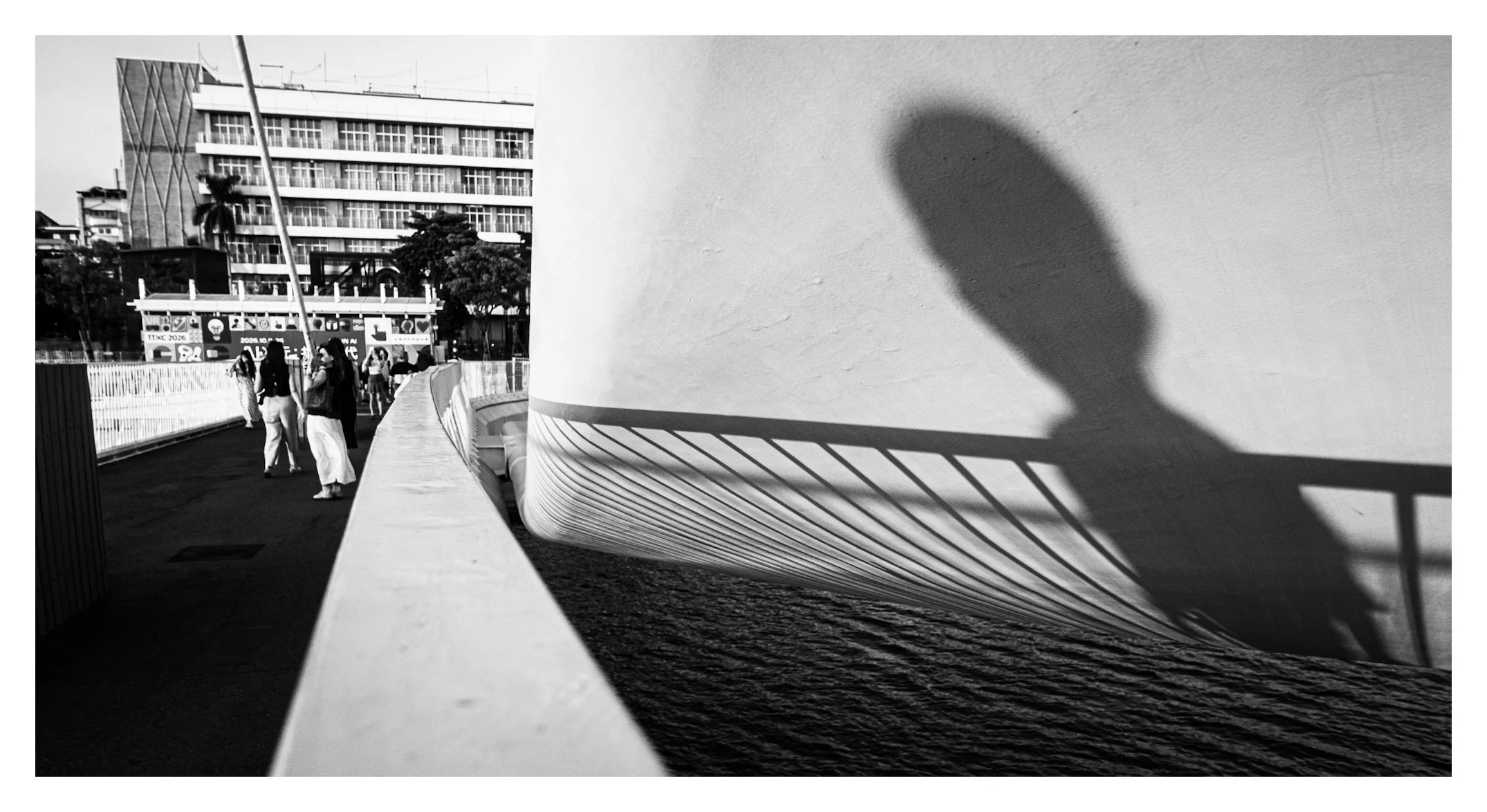
A long late-afternoon shadow stretches across the curved white form of Kaohsiung's Great Harbor Bridge while strangers drift away along the deck. Theo Marr looks at how a wide lens and low sun make a silhouette the main event, and where the clutter creeps in.
Metadata
Camera Model: Leica D-Lux 8
Shutter Speed: 1/250 sec
Aperture: f/3.5
ISO: 200
Also recorded: 11mm on the DC Vario-Summilux 10.9-34mm f/1.7-2.8 lens (about 24mm in full-frame terms), 19 October 2026, 17:15, DNG, 4736 x 3552 original, widescreen crop, monochrome
Critique
This is a picture where the light is the subject. At a quarter past five on Kaohsiung's Great Harbor Bridge, the low sun throws a long, soft-edged shadow, a head on a narrow neck, across the curved white form of the bridge. I read that form as the streamlined viewing platform at the centre of the span. The shadow of a railing cuts across it, and below, the ribbed underside sweeps down towards dark, rippled harbour water. On the left, a low white parapet runs away like a ramp towards a small group of walkers on the deck.
A note on the lens. The EXIF says 11mm, which sounds extremely wide, but it is misleading. The D-Lux 8 has a Four Thirds-sized sensor, the same size as Micro Four Thirds, so its focal lengths have to be multiplied by about 2.2 to compare them with a full-frame camera. 11mm is therefore roughly 24mm in full-frame terms: a wide lens, but nowhere near as extreme as the number suggests. It is the same view as a classic 24mm street lens.
The strengths are clear.
The shadow. It is the real star: a bold, dark, slightly comic shape, large and unmistakable against the pale wall. It gives the picture an immediate hook, and the railing shadow crossing it adds a second layer of graphic pattern. It was not made by you, which makes it a gift from the moment, and you recognised it.
The geometry. The parapet is a strong diagonal that leads the eye into the distance. The curved, ribbed underside is a lovely sweep of repeated lines that tapers like a sail, in keeping with a bridge designed around the image of a shell and a dolphin. The wall, the shadow, the curve and the water make four clear zones.
The wide angle. At about 24mm in full-frame terms, the lens exaggerates the perspective, pushing the parapet towards you and making the white wall loom. It places you right inside the scene, which is the right choice for a picture about being in the light. Because the real lens is only 11mm, depth of field is generous and the whole scene holds together.
The tones. The black-and-white conversion has real depth: the clean white wall, the near-black water with a lively ripple texture, and soft gradation across the curved surface. The sun was low enough to give long, soft shadows, and you used it.
The sense of place. The small figures walking away give the picture scale and a touch of human interest, without competing with the shadow.
The weaknesses are about clutter and handling the shadow.
The left side is busy. The building, the trees, an event banner with legible text and the group of walkers all fight for attention. The picture is strongest on the right and weakest where the eye goes first, the left.
A pole passes through a person. A thin diagonal cable or mast runs down from the top edge and meets the head of the woman in white trousers. It is a classic merge, and it takes attention from the figures.
The people are bunched. At that distance the walkers overlap into one clump, so none of them reads as an individual.
The shadow is a found shape, and it is not quite resolved. It reads as a head on a narrow neck, but the railing shadow cuts across it and the source is out of frame, so it could be a person, a lamp or a post. That mystery gives the picture some charm, but without a shoulder or an arm the shape stays slightly cryptic. Because the shadow is not yours, you could not shape it, and the only control you had was where you stood and when you pressed the shutter.
The darks are heavy. The water and the left-hand pavement drop into deep shadow with little detail, and the top edge of the parapet is very bright.
Improvement
• Work with the shadow you were given. You cannot move someone else's shadow, so move yourself. A step to one side would change where the railing shadow crosses the neck and could keep the head clean and whole.
• Wait for the shape to change. If the source is a passer-by, the shadow will shift every few seconds. A few frames across a minute would give you a choice of shapes, perhaps one with a shoulder or an arm.
• Clean up the left. Lower the camera or step sideways so the banner falls behind the parapet or the trees.
• Separate the walkers. Wait for one figure to step clear of the group, ideally just inside the pool of light.
• Avoid the pole through the head. A small step to the left or right would clear it.
• Hold the highlights. Burn the top of the parapet and the white wall a little, and lift the shadows in the water so the ripples keep their texture.
• Try f/5.6 to f/8. There is plenty of light at this time of day, and a smaller aperture would sharpen the far end of the bridge.
• Try a tighter focal length. With a zoom that runs to 34mm (75mm in full-frame terms), a longer setting would let you isolate the shadow and the railing pattern from the busy left side.
• Plan a return. The bridge is white and curved, so low light and long shadows suit it, and it is a swing bridge that rotates on a schedule. Come back at different times of day, and at sunset, to see how the shadows change.
Growth and Data
Twenty-two images in twenty-two consecutive days.
• Cameras: fourteen frames on the Leica D-Lux 8, five on the Ricoh GR III, two on the iPhone 17 and one on the Fujifilm X-Pro2.
• Aperture: twelve frames at f/2.8 or wider and ten between f/3.2 and f/14. f/3.5 is a sensible middle value.
• Shutter: from 1/8 to 1/2000 sec. 1/250 sec has now appeared in two frames in a row.
• ISO: always between 32 and 640. ISO 200 now accounts for exactly half of your frames. The ISO ceiling test above 640 is still owed.
• Crop: twenty of twenty-two frames are cropped. Nine are squares, five are 4:5, six are widescreen and two are uncropped.
• Focal length: 11mm for the second frame in a row, the widest end of the lens. Remember that this is about 24mm in full-frame terms, so compare your D-Lux 8 frames with the Ricoh GR III, which is also a 24mm equivalent, rather than with other cameras' 11mm.
• Light: this is a low-sun, late-afternoon frame. Your recent best frames all seem to cluster around early evening.
• Edges and clutter: busy backgrounds and merges are still the recurring weakness.
Next steps
• Photograph the same place at the same time over several evenings and compare the shadow.
• Check where thin lines meet heads, and check every corner, before the shutter.
• Wait for people to separate, or choose one and include them deliberately.
• Try the same scene at the 34mm end of the zoom and compare it with the wide frame.
• Test the ISO ceiling above 640.
• Keep the daily habit going.
Photographers to Study
• Ralph Gibson: known for graphic compositions with strong black-and-white contrast, and for pushing unwanted material into the shadows.
• Roy DeCarava: a master of the dark, tonal black-and-white print, and the first Black photographer to receive a Guggenheim Fellowship.
• Sergio Larraín: a Chilean Magnum photographer whose unmanipulated, experimental street pictures work with light and the unexpected.
• Louis Faurer: a New York street photographer who used high contrast, deep shadows and reflections in a film noir manner.
• Ruth Bernhard: made abstract shapes and sculptural forms from light and shadow, working with discipline and patience.
Books to Read
• The Somnambulist, Ralph Gibson
• The Sweet Flypaper of Life, Roy DeCarava and Langston Hughes
• Sergio Larrain: Vagabond Photographer, Sergio Larraín (Thames and Hudson; Aperture edition titled Sergio Larrain)
• Louis Faurer, Steidl with the Fondation Henri Cartier-Bresson (2016)
• The Eternal Body, Ruth Bernhard
Videos to Watch
• Ralph Gibson in the Leica Hall of Fame (the page describes a video portrait on YouTube and a talk with Ted Forbes): https://lfi-online.de/en/stories/ralph-gibson-ralph-gibson-in-the-leica-hall-of-fame-14787.html
• Conversations with Roy DeCarava (1984 documentary, 28 minutes, with a timestamped guide): https://alexhaley.com/2019/01/06/conversations-with-roy-decarava-a-film-by-carroll-parrot-blue/
• Sergio Larraín, The Eternal Moment (documentary, Pragda; also on HBO Max in some regions): https://pragda.docuseek2.com/pr-sergio
• David Hurn on Sergio Larraín (short video, embedded in an article): https://offlinejournal.substack.com/p/10-larrain-and-wenders
• Ruth Bernhard (profile page with a video section): https://all-about-photo.com/photographers/photographer/1361/ruth-bernhard
Manufacturer Note
For Leica Camera Taiwan and Leica Camera Japan: fourteen of the twenty-two frames in this daily series were made on the D-Lux 8, including this late-afternoon shadow study at 11mm (24mm equivalent), 1/250 sec, f/3.5 and ISO 200. A compact with a Four Thirds-sized sensor that holds clean white highlights and deep, textured blacks in the same DNG frame, and gives a wide, natural perspective in raking light, is the story I would like to tell with Leica. I would welcome a conversation about a partnership.