

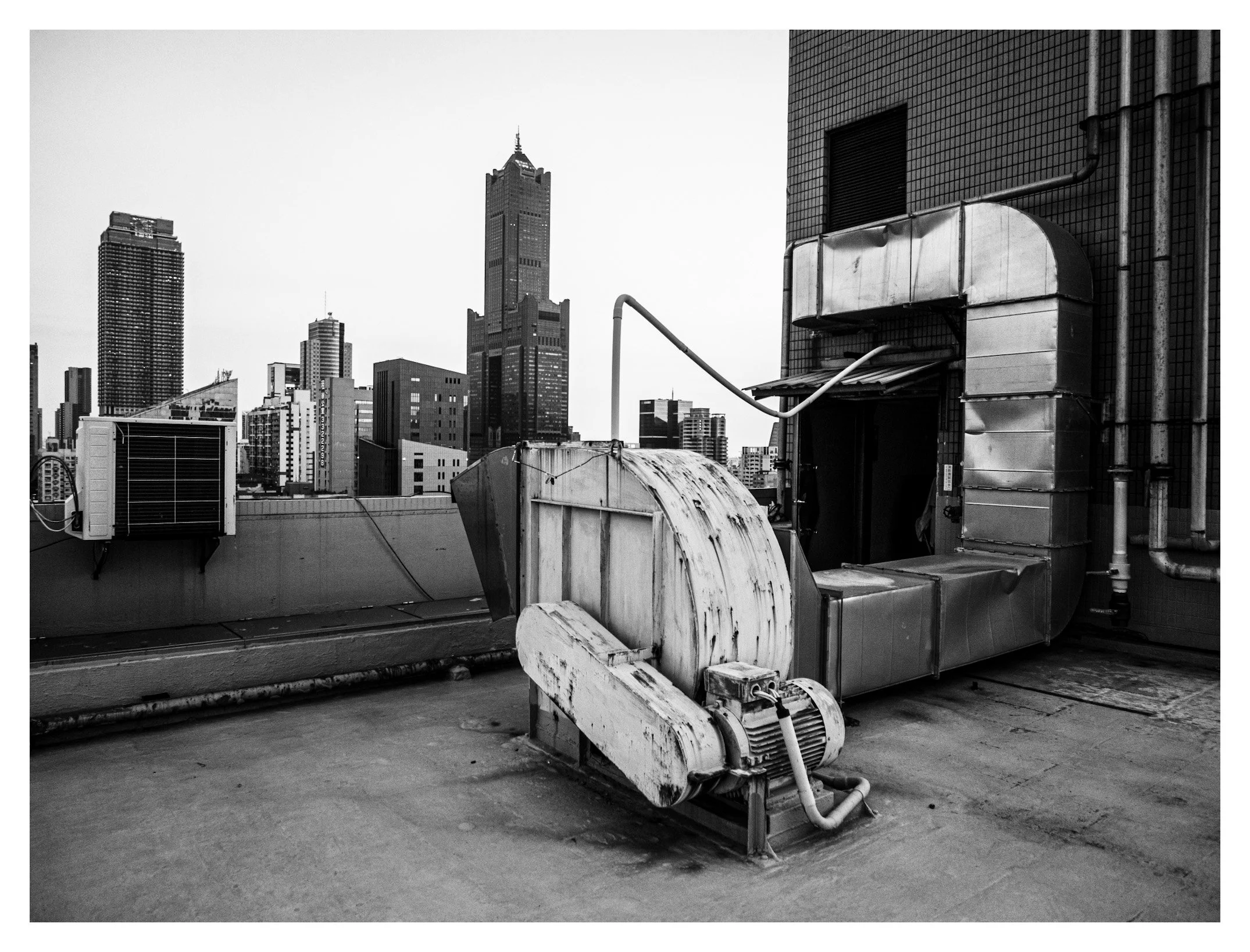
A battered blower and a dented steel duct take centre stage on a rooftop, with the city skyline as backdrop. Theo Marr explores how an 11mm lens turns plant equipment into portraiture, where the tones and the sky let it down, and what a smaller aperture would add.
Metadata
Camera Model: Leica D-Lux 8
Shutter Speed: 1/250 sec
Aperture: f/1.7
ISO: 320
Also recorded: 11mm on the DC Vario-Summilux 10.9-34mm f/1.7-2.8 lens, 18 October 2026, 17:34, DNG, 4736 x 3552, uncropped, monochrome
Critique
This is a portrait of a machine. On a flat rooftop at dusk, a large centrifugal blower sits in the foreground, its scrolled casing covered in chipped white paint and dark streaks, a belt guard sweeping down to the motor. Behind it, a dented galvanised duct climbs the tiled wall of the building, beside a row of downpipes, and a white plastic pipe arcs across the gap. At the left, an air-conditioning unit and a skyline of towers fill the distance, dominated by one with a distinctive stepped crown that looks like Kaohsiung's 85 Sky Tower.
The strengths are clear.
The subject. The blower is a wonderful object: a heavy, scarred, curving form with real character. The peeling paint and rust streaks catch the soft light and give the surface a skin, and the motor, with its ribbed casing and white conduit, gives it a face.
The wide angle. At 11mm you stood close enough to make the blower loom over the roof, with the city small and far behind. That gives the picture scale and depth: floor, machine, then skyline.
The shapes. The curves of the blower casing, the duct bend and the white pipe play against the grid of the tiles, the downpipes and the towers. It is a conversation between round and straight.
The light. At 17:34 on an overcast evening the light is soft and even, so the tones run smoothly from the pale casing to the dark doorway, with no harsh shadows.
The decision to leave the frame uncropped is a good one. After a run of heavy crops, this is a composition that was built in the camera.
The weaknesses are about tone, edges and settings.
The tower sits on the blower. The foot of the tower lines up with the top of the blower casing, so it looks as though one rests on the other. A step to the left or right would have separated them. The thin white pipe standing beside the tower's base echoes it, which is either a nice rhyme or a distraction.
The sky is blank. The upper third is a pale, near-white grey with almost no tone, so the top of the frame feels empty and the skyline loses some weight.
The tones are heavy on the right. The tiled wall and the doorway in the plant room fall into deep shadow, with the doorway almost solid black. It makes a strong counterweight, but it may be hiding detail.
The foreground is a large area of flat concrete. It gives the blower room, but the bottom third of the frame carries little interest beyond the texture and the stains.
f/1.7 is the widest opening the lens offers, and there was no need to use it. Depth of field at 11mm is already enormous, so the only effect is likely to be slightly softer corners.
Improvement
• Move to separate the tower from the blower. A step to one side would give the tower clear sky behind it.
• Use f/4 at about 1/50 sec. At 11mm that is safe to hold, and it would sharpen the corners at no cost to depth of field.
• Give the sky some tone. A graduated darkening in the conversion would hold the top of the frame and lead the eye down to the blower.
• Open the shadows a little. Check that the dark doorway and the tiled wall keep some detail.
• Shoot from lower. A lower camera would make the blower loom further and reduce the empty concrete.
• Check the edges. The left edge has cables and fragments of buildings, and the right edge is cut by the downpipes.
• Make it a series. Look for more equipment on more roofs. The portrait of a machine works because it has a face.
• Revisit at different times. A rooftop in raking evening light or at night, with the towers lit, would be a different picture.
Growth and Data
Twenty-one images in twenty-one consecutive days.
• Cameras: thirteen frames on the Leica D-Lux 8, five on the Ricoh GR III, two on the iPhone 17 and one on the Fujifilm X-Pro2.
• Aperture: twelve frames at f/2.8 or wider and nine between f/3.2 and f/14. f/1.7 is the widest aperture you have used on the D-Lux 8.
• Shutter: from 1/8 to 1/2000 sec.
• ISO: always between 32 and 640. ISO 200 now accounts for ten of twenty-one frames, fewer than half. The ISO ceiling test above 640 is still owed.
• Crop: nineteen of twenty-one frames are cropped. Nine are squares, five are 4:5, five are widescreen and two are uncropped. This is your second uncropped frame.
• Focal length: 11mm is the widest end of the lens, as in Post 16.
• Subject: this is your first frame of equipment treated as a portrait.
• Edges: small intrusions at the frame edges are still a recurring weakness.
Next steps
• Keep composing in the camera, and treat the crop as a last step.
• Use f/4 to f/5.6 for static subjects at wide angles.
• Check where background shapes meet foreground shapes before the shutter.
• Push the ISO test beyond 640.
• Keep the daily habit going.
Photographers to Study
• David Plowden: photographed America's steel mills, bridges, grain elevators and small towns with a poet's eye, always one step ahead of the wrecking ball.
• Vera Lutter: turns whole rooms into camera obscuras to make large, strange, reversed pictures of factories, shipyards and airports.
• Frank Gohlke: photographed grain elevators on the Great Plains and explored how big structures sit in empty space.
• W. Eugene Smith: spent a year photographing Pittsburgh and its steel mills, a project in which the city itself became the portrait subject.
• Kazuo Kitai: a Japanese photographer who documented the dock workers of Kobe, protest movements and everyday life.
Books to Read
• Industrial Landscape, David Plowden
• Vera Lutter, Hatje Cantz (2012)
• Measure of Emptiness: Grain Elevators in the American Landscape, Frank Gohlke
• Dream Street: W. Eugene Smith's Pittsburgh Project, edited by Sam Stephenson
• Somehow Familiar Places, Kazuo Kitai
Videos to Watch
• David Plowden: Light, Shadow and Form (1999 documentary, linked on the artist's media page): https://davidplowden.com/media
• Disappearing America: Dick Gordon interviews David Plowden (audio, same page): https://davidplowden.com/media
• Vera Lutter, Museum in the Artist's Camera Obscura (LACMA short film): https://www.gagosian.com/news/2020/05/07/vera-lutter-museum-in-the-artists-camera-obscura-lacma-video/
• Frank Gohlke talks about photographing grain elevators (Minnesota Public Radio, audio): https://archive.mpr.org/stories/1992/11/10/frank-gohlke-talks-about-photographing-grain-elevators
• W. Eugene Smith: Photography Made Difficult (PBS American Masters): https://www.pbs.org/wnet/americanmasters/w-eugene-smith-about-w-eugene-smith/707/
Manufacturer Note
For Leica Camera Taiwan and Leica Camera Japan: thirteen of the twenty-one frames in this daily series were made on the D-Lux 8, including this black and white rooftop study at 11mm, 1/250 sec and f/1.7. A compact that gives a wide, undistorted view of a big machine, holds clean tonal detail from pale casing to dark doorway, and records it in the DNG at ISO 320 is the story I would like to tell with Leica. I would welcome a conversation about a partnership.