

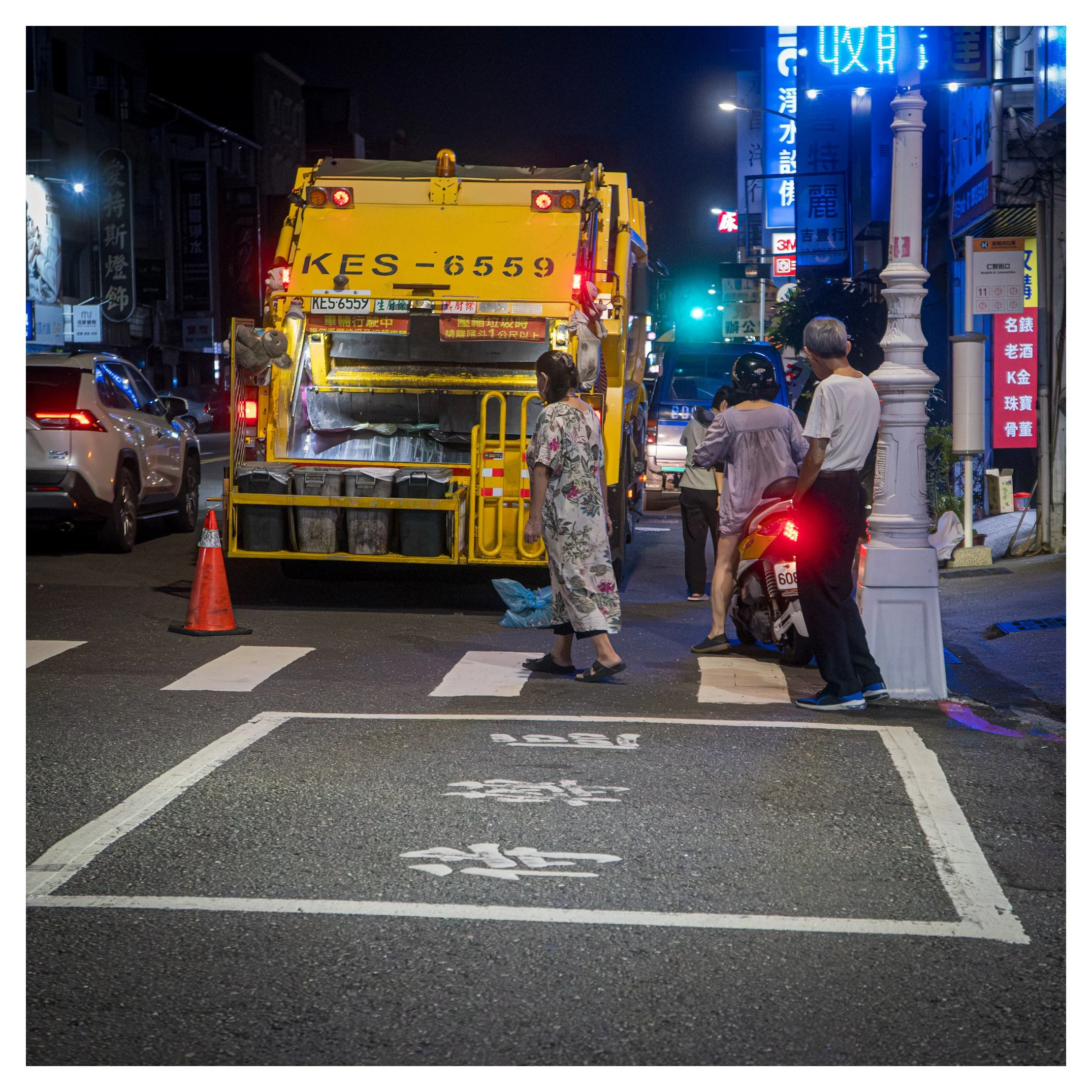
A yellow rubbish truck under blue neon, and the three frames that did not make it. Theo Marr looks at one sharp picture out of four, what ISO 6400 cost, and why a year of daily photographs includes plenty of nights when the camera gets it wrong.
Metadata
Camera Model: Leica D-Lux 8
Shutter Speed: 1/160 sec
Aperture: f/2.8
ISO: 6400
Also recorded: 28mm on the DC Vario-Summilux 10.9-34mm f/1.7-2.8 lens (about 62mm in full-frame terms), 20 October 2026, 21:32, DNG, 4736 x 3552 original, cropped to a 3532 x 3532 square
Critique
Tonight was the penultimate day of a 365-day project: a year of turning up with a camera whatever the circumstances, some of them grim. A daily project guarantees a picture. It does not guarantee a good one. Tonight is a fair example. You took exactly four frames and only one of them is in focus, so this is the picture that gets shown, and it should be judged as a good frame, not a great one.
It is an evening ritual caught at the right moment. A yellow rubbish truck stands at a street corner at half past nine at night, its tail lights glowing red and amber. A woman in a floral dress and sandals crosses in front of it, mid-stride, while a small group waits at a white lamp post on the right: a man in a white T-shirt leaning against the post, and a woman in lilac sitting on a scooter, her brake light glowing red. Behind them a wash of blue and red neon signage fills the street. In Taiwan the musical rubbish trucks call residents out to hand over their bags in person, five days a week in the late afternoon and evening, and for many older residents the collection is also a social occasion. The picture shows that well: nobody is hurrying.
A note on the lens. The EXIF says 28mm, but the D-Lux 8 has a Four Thirds-sized sensor, so that is about 62mm in full-frame terms: a short telephoto. It explains the look: the truck, the figures and the neon are stacked together in layers, and the street feels compressed rather than wide.
What works:
The colour. Yellow against blue is the strong contrast, with red as the accent: the tail lights, the traffic cone, the scooter's brake light and the red sign at the right. A small teal traffic light in the distance gives the palette a cool counterpoint. It looks like a film still.
The moment. The woman is caught mid-step with her weight on one foot, and her stride is in line with a zebra stripe on the crossing. The onlookers at the lamp post make a quiet group while she moves, so the picture has a clear contrast between stillness and motion.
The layers. At the longer focal length, the road markings, the figures, the truck and the signage stack neatly. The eye travels from the foreground box to the woman, to the truck, and out to the neon.
The detail. The truck's number is crisp, the hopper interior glows, and a plush toy tied to the truck's rail adds a touch of humour. It is sharp where it matters: the truck, the woman and her sandals.
The ISO test. This is the first frame above ISO 640, and you went straight to ISO 6400. At this display size the noise is well controlled and the colours hold. I would want to see the full-resolution file to judge the shadows, but the result is usable. It is not free, though: the black sky at the top left will show noise at 100%.
What does not work:
The road takes up about a third of the frame. The large painted box and the empty asphalt below it are a strong graphic shape, and the characters inside it are foreshortened and hard to read, so they look like decoration rather than information. The people live in the upper two-thirds, and the bottom third adds weight without adding interest.
The right side is a knot. The man merges with the lamp post, his shoulder touching it, and he overlaps the woman on the scooter, who in turn overlaps another person behind her. The white lamp post is bright and heavy, and it pulls the eye away from the truck.
The neon is clipped at the edges. The top of the blue sign at the upper right is cut by the frame, and the whole top-right corner is much brighter than the rest.
The left edge is cluttered. A white car's tail lights are cut by the frame, and a vertical shop sign adds more clutter.
The three frames that failed
The other three frames tonight were made on the Ricoh GR III, and they are the other half of the story. The subject was a small apricot dog riding in a stroller in a supermarket, in good light, with a lovely expression. You pressed the shutter at least three times and the camera recorded one frame. That frame is soft all over, with the dog's eye the closest thing to sharp and the stroller bars and the shelves behind no better. It is shown here as it came out of the camera.
[Insert the dog frame here, with the caption: Ricoh GR III, supermarket, 20 October 2026. Soft throughout. Not a keeper.]
Your verdict was that your phone would have done a better job, and for a moving dog at close range I think you are right. I cannot tell from the picture alone why it failed. It could be a missed focus at close range, it could be motion, or it could be a camera that waits for focus to lock before it fires, which would explain three presses and one frame. Whichever it was, it is a reminder that equipment fails, and that a photographer who shows only the pictures that worked gives a false idea of the craft.
Improvement
• Give the foreground a job. Wait for a scooter or a pedestrian to enter the painted box, or step forward so the box takes up less of the frame.
• Separate the man from the lamp post. Wait a moment for him to step away, or move a step to the left so he stands clear of it.
• Keep the neon edge whole. Step to the left or right, or crop, so the top of the blue sign is not cut by the frame.
• Calm the highlights. Pull the exposure down a little in the top-right corner so the lamp post and the signs keep some detail.
• Go wider for a faster lens. The lens is f/1.7 at its wide end and f/2.8 at 28mm, so a wider setting with a step closer would give you about half a stop more light, which is less noise at the same shutter speed.
• Reduce noise with care. Apply luminance noise reduction in the raw converter and keep a little grain.
• Check the plates. The truck's number is clear and the scooter's plate is partly visible. Consider whether to soften either before publishing.
• Know your camera's limits. Check the focus and release settings on any camera you take for moving subjects, check its minimum focus distance, and use zone or snap focus when a subject will not hold still.
• Return to the subject. The collection runs on a regular timetable, so you can come back to the same corner on several evenings and make a series.
Growth and Data
Twenty-three images in twenty-three consecutive days of this critique series, and tonight is day 364 of a 365-day project. You have turned up every day for a year, and tomorrow closes it.
• Cameras: fifteen frames on the Leica D-Lux 8, five on the Ricoh GR III, two on the iPhone 17 and one on the Fujifilm X-Pro2.
• Aperture: thirteen frames at f/2.8 or wider and ten between f/3.2 and f/14.
• Shutter: from 1/8 to 1/2000 sec.
• ISO: this is the first frame above 640, so the range is now 32 to 6400. The ceiling test is done, and ISO 200 still accounts for eleven of twenty-three frames.
• Crop: twenty-one of twenty-three frames are cropped. Ten are squares, five are 4:5, six are widescreen and two are uncropped.
• Focal length: 28mm is about 62mm in full-frame terms, longer than the 25mm (about 55mm) you used in Post 20.
• Time: 21:32 is the latest frame in the last seven posts, which have mostly been late afternoon or dusk.
• Keeper rate: of four frames tonight, one was in focus. That is the lowest rate of the series, and it comes from the equipment, not from effort.
• Edges and merges: busy edges and overlapping figures are still your recurring weakness.
Next steps
• Make day 365 a deliberate frame, not an obligation, and take the camera you trust.
• Export the shooting data for all 365 frames and look at the whole year at once: which focal lengths, apertures and ISO values you actually use, which cameras gave you keepers and which let you down, and which subjects keep returning.
• Choose twelve favourites and print them. A year of work only becomes a body of work when you edit it.
• Pick a project with a constraint for the next year, such as one corner, one time of day, one theme.
• Keep the habit, with less pressure.
Photographers to Study
• Weegee: the New York press photographer who worked at night with flash and often turned the camera away from the main event to the crowd gathered around it.
• Nick Turpin: photographed commuters on London night buses in ambient light for On the Night Bus, and runs a street photography channel on YouTube.
• Liam Wong: a Scottish photographer whose neon-lit Tokyo night series TO:KY:OO is built on colour, contrast and a cinematic eye.
• Siegfried Hansen: a Hamburg street photographer who finds graphic compositions in lines, shapes and colours, and adds a second layer of meaning to each frame.
• Jeff Mermelstein: a New York street photographer who works in colour and with serendipity. Leica sponsored his first book, Sidewalk.
Books to Read
• Naked City, Weegee (new edition from the International Center of Photography)
• On the Night Bus, Nick Turpin (Hoxton Mini Press)
• TO:KY:OO, Liam Wong
• Hold the Line, Siegfried Hansen (Kettler Verlag)
• Sidewalk, Jeff Mermelstein (Dewi Lewis, 1999)
Videos to Watch
• Street Photography with Nick Turpin (YouTube channel): https://www.youtube.com/channel/UC7KQzmf51UIB0sUyAq8gW6g
• Weegee the Famous (2009 documentary, with a link to watch the film): https://sidegallery.co.uk/collection/weegee-the-famous
• Liam Wong on the Top Artist Podcast (audio): https://podcast.mymodernmet.com/liam-wong/
• Of Shapes, Colours and Surfaces: Siegfried Hansen on street photography (interview, text): https://lfi-online.de/en/stories/siegfried-hansen-of-shapes-colours-and-surfaces-15089.html
• Jeff Mermelstein: The Curiosity of the World Deserves Witnesses (Leica blog, in German): https://leica-camera.com/de-DE/blog/jeff-mermelstein-the-curiosity-of-the-world-deserve-witnesses
Manufacturer Note
For Leica Camera Taiwan and Leica Camera Japan: fifteen of the twenty-three frames in this daily series were made on the D-Lux 8, including this night street scene at 28mm (about 62mm equivalent), 1/160 sec, f/2.8 and ISO 6400, on the penultimate day of a 365-day project. This blog shows the whole process, including the frames that fail, and the D-Lux 8 has so far been the camera that I rely on when a picture has to exist. I would welcome a conversation about a partnership.