

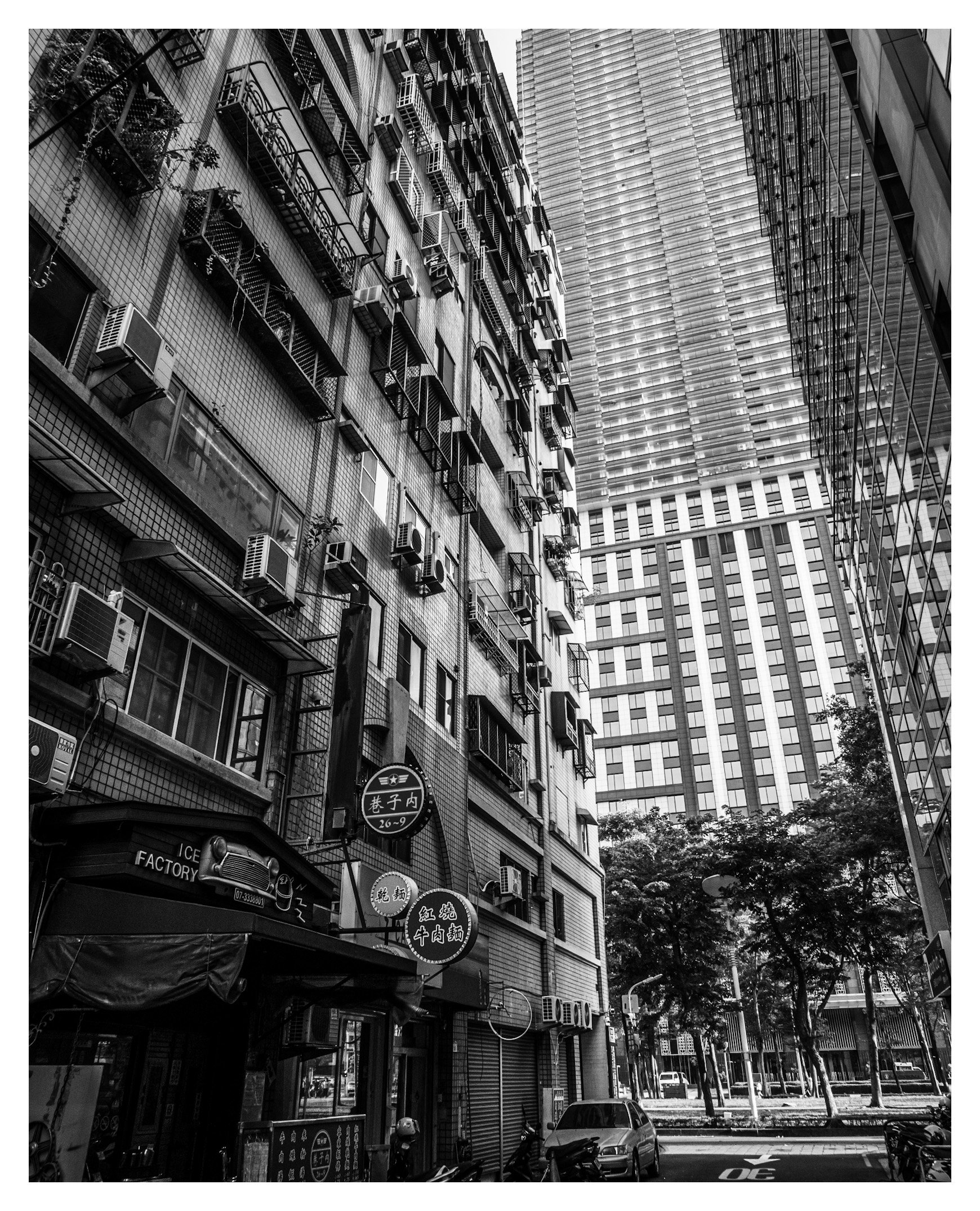
A tiled apartment block, a glass tower and a noodle shop in the shadow between them: the final frame of a 365-day project. Theo Marr looks at what makes the old and new Kaohsiung work together, where the picture falls short, and what to do with a year of daily photographs.
Metadata
Camera Model: Leica D-Lux 8
Shutter Speed: 1/250 sec
Aperture: f/3.2
ISO: 200
Also recorded: 11mm on the DC Vario-Summilux 10.9-34mm f/1.7-2.8 lens (about 24mm in full-frame terms), 21 October 2026, 16:33, DNG, 3552 x 4736 original (held vertically), cropped to 3552 x 4440 (4:5), converted to black and white
Critique
Day 365. You called this frame "Kaohsiung Old & New", and the title is exactly what the picture does. Looking up from street level in a narrow lane, an old tiled apartment block fills the left side of the frame: white-tiled walls, iron window grilles, plant boxes caged in mesh, and air conditioners stacked up the facade. In the middle a tall modern tower with horizontal banding rises out of the gap, and on the right a dark glass curtain wall leans in and appears to reflect the grilles of the old block. At the bottom left, a small noodle shop and a shopfront with a Mini Cooper grille on its sign sit under the weight of all that building. On the right, the lane opens onto trees and a park.
A note on the lens. The EXIF says 11mm, but the D-Lux 8 has a Four Thirds-sized sensor, so that is about 24mm in full-frame terms. A wide lens tilted upwards makes every vertical converge, and that is what gives the picture its canyon.
What works:
The idea. Old on the left, new on the right, and a street between them: it is a simple concept, and the frame makes the contrast without any trickery. The tile grid and the air conditioners give the old block a tactile, lived-in texture, and the banded tower and glass wall give the new city a smooth, repeating surface.
The converging lines. The old block leans in from the left, the glass wall from the right, and the tower stands up between them, so the eye is pushed up the diagonals towards the small patch of sky at the top. It works as a V-shaped canyon, and the picture has an exit.
The way in. The round signs at the bottom left are the entry point: "巷子內" (which means "inside the alley") with its star-and-wings emblem, then the signs for dry noodles and braised beef noodles. They are the only human-scale detail, and they tell you that people live and eat down here.
The exposure. At 1/250 sec, f/3.2 and ISO 200 you exposed for the shaded canyon, and the tones hold: detail in the tiles, a bright tower, and a trace of light on the glass.
The relief. The street opens at the bottom right to trees and a lamp post, which gives the heavy composition somewhere to breathe.
What does not work:
The bottom of the frame. The lower left is heavy and dark, the shop signs lose their text in the shadow, and the parked car, the scooters and the road marking at the bottom right are cluttered. The speed-limit "30" and its arrow are cut by the bottom edge. There are no people in the frame, so the old-and-new story has buildings but no one living between them.
The processing. At this size the structure and clarity look pushed hard. The tiles are crunchy, and there is a bright edge where the old block meets the sky. It suits the tiles, but the glass reflections on the right turn into pattern, and the deep shadows at the lower left are crushed.
The balance. The left of the frame is dense and dark and the right is lighter, and the dark glass at the upper right is heavy as well. The picture leans to the left.
The leaning verticals. The three buildings lean at three different angles. That is the nature of a wide lens pointed upwards, but the glass wall leans more than the tower and the old block, and the mix is a little uneasy. Either commit to the drama by tilting up more, or correct part of the lean.
Improvement
• Wait for a person. A single figure walking past the noodle shop, or a scooter rider in the lane, would give the picture its scale and its story.
• Clean up the bottom. Step back and lower the camera slightly so the road marking is complete, or crop so it is gone, and make sure the shop signs are not lost in the shadow.
• Ease the processing. Pull the clarity and structure back by about a fifth, protect the sky edge, and lift the deep shadows at the lower left.
• Balance the tones. Dodge the old block's lower floors and burn the dark glass at the upper right a little.
• Close down for the corners. At f/5.6 the far corners and the distant trees will sharpen, and 1/80 sec is still safe at this focal length with image stabilisation.
• Decide about the lean. Either tilt up further for a bolder canyon or apply partial vertical correction, but not something in between.
• Check the phone number. The business number on the Ice Factory sign is readable. It is a public sign, but consider whether to soften it before publishing.
Growth and Data
Twenty-four images in twenty-four consecutive days of this critique series, and today is day 365 of the project.
• Cameras: sixteen frames on the Leica D-Lux 8, five on the Ricoh GR III, two on the iPhone 17 and one on the Fujifilm X-Pro2.
• Aperture: thirteen frames at f/2.8 or wider and eleven between f/3.2 and f/14.
• Shutter: from 1/8 to 1/2000 sec.
• ISO: ISO 200 accounts for twelve of twenty-four frames, exactly half. Last night was ISO 6400 and today is ISO 200, so the two frames are five stops apart.
• Crop: twenty-two of twenty-four frames are cropped. Ten are squares, six are 4:5, six are widescreen and two are uncropped.
• Focal length: 11mm (about 24mm in full-frame terms) is now your most-used D-Lux 8 setting, in three of the last five D-Lux frames.
• Black and white: this is the third monochrome frame in the last four posts, after Posts 21 and 22.
• Orientation: this frame was shot vertically, and it works better for it.
• Recurring strength: geometry and graphic structure.
• Recurring weakness: cluttered edges, and in this frame the bottom of the picture.
The year
The honest summary of a year of daily photographs is not 365 good pictures. It is 365 pictures, many of them ordinary, a handful of them excellent, some of them misses, plus the unglamorous act of finishing. That is what a daily project proves.
Next steps
• Take tomorrow off. You have earned it, and a rest will tell you what you actually want to keep doing.
• Export the shooting data for all 365 frames and look at the whole year at once: which focal lengths, apertures and ISO values you used, which cameras gave you keepers and which let you down, and which subjects kept returning.
• Choose twelve favourites and print them. A year of work only becomes a body of work when you edit it.
• Pick a project with a constraint for next year, such as one corner, one time of day, one theme.
• Keep the habit in a lighter form: three days a week, or one good frame a week.
Photographers to Study
• Alvin Langdon Coburn: photographed New York from the pinnacles of its skyscrapers in 1912, and his bird's-eye views anticipated modernist architectural photography.
• Max Dupain: Australia's leading architectural photographer, who documented the construction of the Sydney Opera House and made his name with sharp angles and light.
• Todd Webb: walked the streets of New York with a heavy camera and tripod in the 1940s and 1950s, photographing people and buildings and finding the simple geometries of the city.
• Jason M. Peterson: a Chicago-based photographer who works only in black and white, and whose pictures of architecture and light draw on Harry Callahan.
• Yasuko Noguchi: an Osaka-born photographer whose black-and-white street pictures of Taiwan from 2017 to 2020 were published as a photobook by Vacuum Press.
Books to Read
• Alvin Langdon Coburn: Photographs 1900-1924 (Edition Stemmle, 1998)
• Max Dupain's Australia (Viking, 1986)
• I See a City: Todd Webb's New York (Thames and Hudson)
• Taiwan 2017-2020, Yasuko Noguchi (Vacuum Press)
• Zero, Kuan-Hsien Lin (2018, a Taiwanese photographer's high-contrast monochrome street pictures from 2015 to 2017)
Videos to Watch
• Through the Lens, Episode 7: Jason Peterson (a five-minute film on his black-and-white work): https://www.provideocoalition.com/through-the-lens-ep-07-jasonmpeterson/
• Honest Vision: A Portrait of Todd Webb (promotional version of the 1996 film, in a film archive): https://collection.oldfilm.org/Detail/occurrences/23721
• Far Away Eyes (2021 black-and-white film about a photographer wandering Taipei; festival page with synopsis): https://chicagofilmfestival.com/film/far-away-eyes
• New York from its Pinnacles, Alvin Langdon Coburn, 1912 (the work itself, at the Eastman Museum, not a video): https://collections.eastman.org/objects/10591/new-york-from-its-pinnacles
• Max Dupain: Modernist (State Library of NSW exhibition guide, PDF, not a video): https://www2.sl.nsw.gov.au/archive/events/exhibitions/2007/dupain/docs/maxdupain_modernist_guide.pdf
Manufacturer Note
For Leica Camera Taiwan and Leica Camera Japan: sixteen of the twenty-four frames in this daily series were made on the D-Lux 8, including the final frame of a 365-day project, made at 11mm (about 24mm equivalent), 1/250 sec, f/3.2 and ISO 200. Across two consecutive days the camera covered ISO 200 and ISO 6400 for me, in daylight and under neon. This blog shows the whole process, including the frames that fail, and I would welcome a conversation about a partnership.