

Day 44/365 The Glare of the Screen: Finding Soul in the Digital Street
The Critique
By Theo Marr
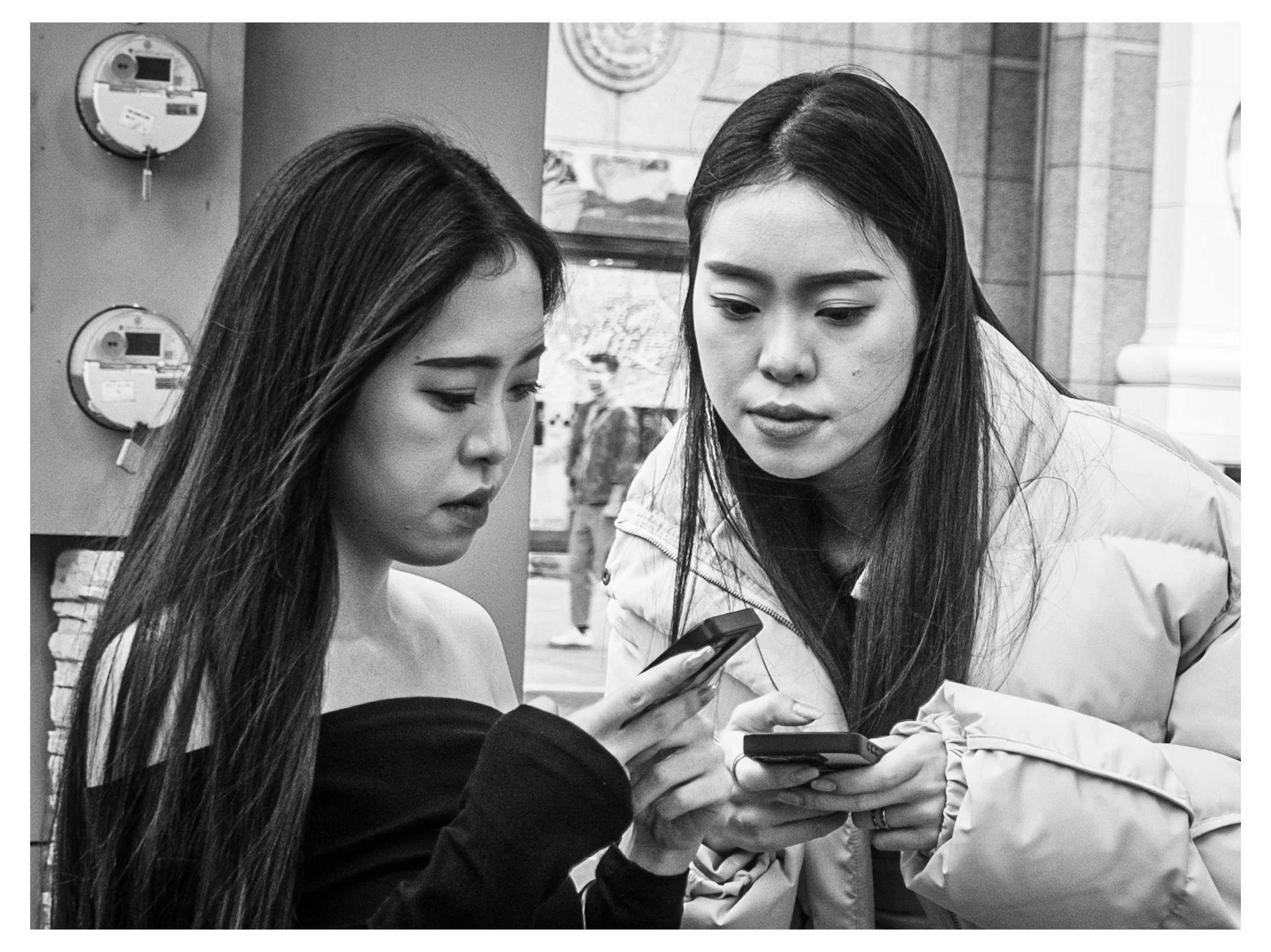
Let us step into the monochrome noise of the street. You have presented me with a moment that is arguably the defining visual signature of our era: the digital gaze. Two young women, physically proximate but mentally transported elsewhere by the devices in their hands.
The Strengths:
You have made a bold choice with your processing. The high-contrast black and white aesthetic immediately recalls the raw, gritty energy of the Japanese Provoke era. The tight framing forces the viewer into their intimate circle, creating a sense of voyeurism. The texture of the puffer jacket against the bare shoulder of the companion creates a lovely tactile contrast, and the expression on the right—furrowed, concerned—hints at a narrative beyond the frame.
The Areas for Growth:
However, the image suffers from a certain "clutter of reality" that has not yet been organized into art.
1. Background Distraction: The utility meters on the left wall are distinct circles that compete visually with the faces of your subjects. In street photography, if a background element is as sharp as the subject, it must contribute to the story. Here, it merely exists.
2. The "Dead" Space: The interaction here is static. We are looking at people looking at screens. This is a common trap in modern street photography. The screen absorbs the subject's energy, leaving little for the camera to catch.
3. Tonal Balance: The highlights on the right subject's face are pushing the limit. In high-contrast work, you want "crunchy" blacks, but you must protect the skin tones to retain emotional nuance.
Actionable Advice:
Next time, wait for the break. When photographing people on phones, the "moment" is rarely the scrolling. It is the second they look up, show a reaction to what they've read, or share the screen with a friend. You captured the sharing (on the left), but missed the reaction. Patience is your lens's sharpest element.
The Data of Vision: How to Audit Your Art
You asked how to become better by compiling data. Most photographers obsess over technical metadata (ISO, Aperture). To grow as an artist, you must track creative metadata.
I recommend you create a "Contact Sheet Diary" (a spreadsheet or physical notebook) and log the following for every "5-star" image you take:
• The "Why": Write one sentence on why you took the shot before you saw the result. (e.g., "The light on her hair," "The juxtaposition of old and new").
• The Distance: Estimate your physical distance from the subject (e.g., "1 meter," "across the street").
• The Mood: Was the street chaotic or quiet? (Keywords like "Alienation," "Claustrophobia," or "Energy" are useful here) .
• The Hit Rate: How many frames did you take of this specific scene?
The Analysis:
Review this quarterly. You might discover that your best work happens at 1.5 meters when you are feeling alienated, but your worst work happens when you are "hunting" from a distance. This data prevents you from lying to yourself about your style.
The Curriculum: Your Next Steps
Based on your inclination toward high-contrast, grainy black and white imagery, I have selected a specific curriculum for you from your library and the wider art world.
1. The Master of Grit: Daido Moriyama
Your image leans heavily into the "are, bure, boke" (grainy, blurry, out-of-focus) aesthetic. You must study Daido Moriyama to understand how to control this chaos.
• Read: Farewell Photography or A Hunter. Look at how he frames the mundane to make it look like a memory or a hallucination.
• Watch: "Daido Moriyama: The Past is Always New" (Tate Modern). This short piece explains his snapshot aesthetic.
2. The Local Context: Chien-Chi Chang
Since you are shooting in Taiwan, you must study the work of Magnum photographer Chien-Chi Chang. He is a master of "alienation"—a keyword that fits your image perfectly.
• Read: The Chain. While the subject matter (mental asylum) is heavier than your street work, observe his composition. He organizes chaotic groups of people into a frame that feels suffocating yet balanced.
• Watch: "Chien-Chi Chang: Magnum Photos". Observe how he talks about immersion and the distance between subject and photographer.
• Watch here (Note: This link creates a thematic bridge to his documentary style).
3. The Philosophy of Energy: Garry Winogrand
Your image is tight, but it feels slightly stationary. Winogrand was the master of capturing "energy" and "chaos" within the frame. He believed a photograph is a battleground between form and content.
• Read: The Man in the Crowd.
• Watch: "Garry Winogrand at Rice University (1977)". This is essential viewing. He dismantles the idea of "storytelling" and focuses purely on the visual problem of the frame.
4. The Modern Barrier: Michael Wolf
You are photographing people engaged with technology. Michael Wolf’s work on the "claustrophobia" of modern life is your best contemporary reference.
• Read: Tokyo Compression. He photographs commuters pressed against glass. The window is the barrier, much like the smartphone screen in your image. Study how he uses the barrier to create tension.
• Watch: "Michael Wolf on Tokyo Compression".
• Watch here (Interview and visual essay).