

Day 43/365 Unlocking the Gaze: Texture, Tone, and the Art of the Street Portrait
The Critique
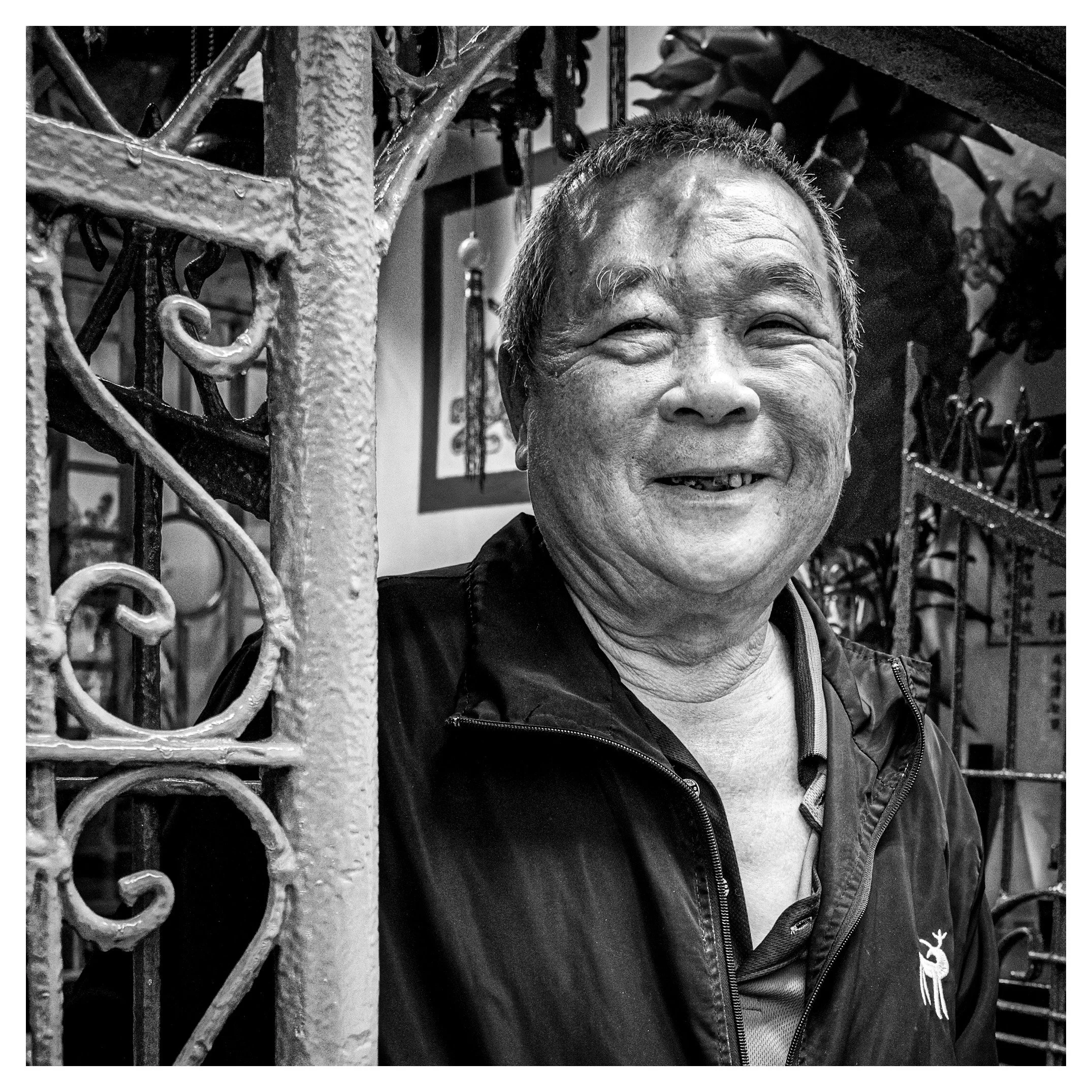
This is an image that breathes. It has a pulse. As a critic, I am often presented with technically perfect but emotionally sterile images; this is the opposite. You have captured a moment of genuine human warmth. The subject’s smile—gap-toothed and crinkling at the eyes—is an anchor that holds the viewer fast.
What is working:
• Texture: The choice of black and white is excellent here. It accentuates the weathering on the man's skin and the peeling paint of the iron gate. The tactile quality of the image is its strongest asset.
• Framing: You have attempted a "frame within a frame" composition using the ornate ironwork on the left. This is a classic device to lead the eye and add depth.
• Connection: The subject is comfortable with you. That level of intimacy is difficult to forge on the street and is the mark of a photographer who knows how to interact, not just observe.
How to improve:
• Separation: The primary issue here is the "figure-to-ground" relationship. The background is busy; the dark shapes behind the man’s head merge with his hair, flattening the image. In the future, a slightly wider aperture (lower f-stop) or a step to the right would have blurred that background distraction, making the subject pop.
• Breathing Room: The crop is tight—perhaps too tight. The iron gate on the left is beautiful, but it competes with the man rather than complementing him. Giving the composition a few more millimeters of space on the edges would allow the viewer's eye to travel more comfortably between the gate and the face.
• Highlight Control: The patch of sunlight on the forehead is nearly "blown out" (pure white). In high-contrast black and white, we must be careful to preserve detail in the highlights to avoid drawing the eye away from the subject's eyes.
The "Data" of Vision: How to Get Better
You asked how to improve over time by compiling data. This is a brilliant question that moves you from a "shooter" to a "student."
Most photographers look at their metadata only to check exposure. I want you to create a "Keeper's Audit."
1. The Hit-Rate Analysis: Every month, tag your top 5 images. Export their metadata into a spreadsheet. Look for patterns in your Focal Length. Are you consistently shooting your best work at 35mm or 50mm? If you find 80% of your best shots are at 35mm, force yourself to shoot only 35mm for a month to master that field of view.
2. The Aperture Sweet Spot: Analyze the aperture of your "misses"—specifically the ones that felt cluttered. You might find you are habitually shooting at f/8 or f/11, which keeps backgrounds too sharp in chaotic street environments. This data will empirically prove to you when you need to open up to f/2.8 or f/4.
3. The Failure Log: Don't just delete bad photos. Keep a folder of "Almosts"—photos like this one where the expression is perfect but the background is messy. Reviewing this folder is often more educational than reviewing your portfolio.
The Syllabus: Recommendations
To refine your eye, you must feed it the work of masters who grappled with these exact challenges. Based on your style and location, here is your curriculum.
1. The Photographer to Study: Fan Ho
You are shooting in Taiwan, a place of intense light and shadow. You must study Fan Ho. He was a master of using natural geometry (like your iron gate) to frame subjects, but he did so with a rigorous attention to lighting that separated the subject from the chaos of the street.
• Why him: He mastered the "frame within a frame" technique you are exploring here.
• Video: Fan Ho | The Art of Light, Shadow, and Humanism
2. The Books to Read
• "Portrait of Hong Kong" by Fan Ho
This book is essential for understanding classic composition and lighting in a dense Asian urban environment. It will teach you how to use shadow to hide the background clutter I mentioned above.
• "The Chain" by Chien-Chi Chang
Since you are based in Taiwan, you should look at Magnum photographer Chien-Chi Chang. His work often deals with alienation and environmental portraiture. While darker in tone than your image, his ability to place a subject in a complex environment without losing them is a masterclass.
• "Diane Arbus: An Aperture Monograph"
Your image is square and psychological, reminiscent of Arbus. She was known for her "freak" show portraits, but her genius was in the square format and the intense, often uncomfortable connection with the subject.
• Video: Masters of Photography: Diane Arbus (1972 Documentary)
3. Video on Technique
To fix the composition issues (tight framing and background separation), I recommend watching Phil Penman’s approach to street composition. He simplifies the complex.
• Video: 5 Tips for Street Photography Composition with Phil Penman