

Day 48/365 The Elegant Juxtaposition of Curve and Plane: An Architectural Study
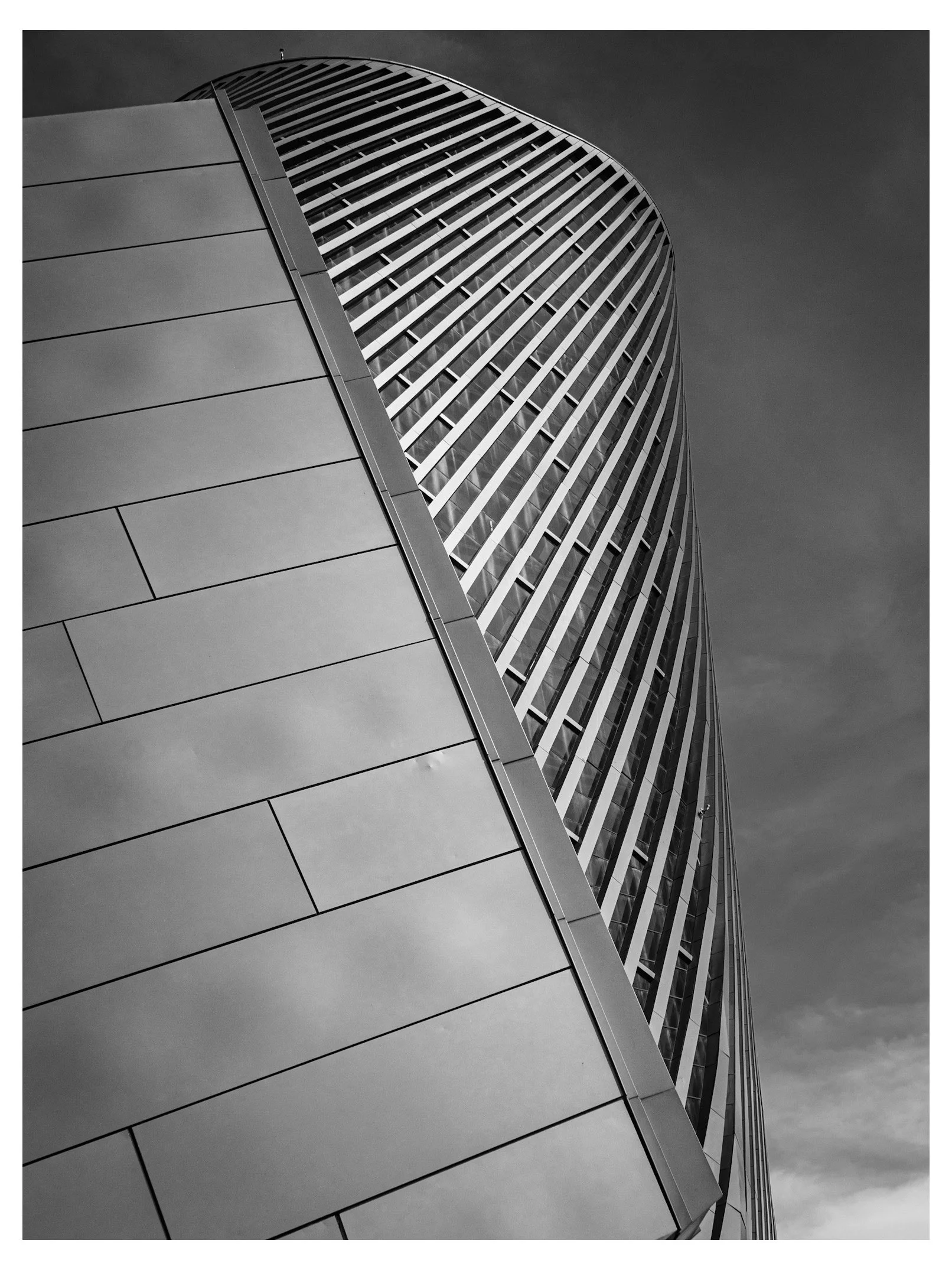
Critique: Cruise Ship Terminal, Kaohsiung
My dear photographer, Theo Marr here. Thank you for sharing this striking architectural study from Kaohsiung. This image—presumably of the city's cruise ship terminal—is a compelling demonstration of abstract form and texture, masterfully rendered in black and white.
What Works
• Powerful Abstraction: By focusing tightly on the convergence of two distinct building materials, you have transformed an architectural subject into a purely graphic and textural abstraction. The diagonal split created by the juxtaposition of the large, flat, rectangular panels on the left and the tightly-spiraling, striated curve on the right is exceptionally strong.
• Effective Use of Lines and Curves: The spiraling lines of the curved facade act as leading lines, drawing the viewer's eye into the depth and height of the structure. This tension between the dynamic curve and the static, blocky planes on the left is the intellectual core of the image. The natural, meandering quality of curved lines is often considered highly effective, as they guide the eye through the entire image.
• Monochrome Impact: The black and white conversion enhances the textures of the two surfaces and emphasizes the strong tonal contrast. The subtle gradation of the sky against the bright metallic surfaces adds a welcome layer of atmosphere.
Advice for Improvement
• Refining the Composition: While the composition is strong, the vertical orientation, while appropriate for the tall structure, feels slightly constrained at the top. Consider giving the building a bit more "breathing room" above to fully convey its scale against the sky. Alternatively, you could shift your position to either include more of the ground plane for an anchor or move closer to fully abstract the forms, cropping out the identifiable sky to focus solely on the intersection of the surfaces.
• Managing the Edge: The sliver of dark vertical line where the two sections of the building meet is highly important. Ensure this edge is perfectly vertical or diagonal to maintain the geometric precision the image relies on. In post-processing, you could subtly enhance the contrast along this sharp dividing line to make the juxtaposition even more definitive.
• Integrating the Environment: The provided image is a wonderful study of form, but a next-level architectural image often includes a contextual element. If the intention is not pure abstraction, a tiny, strategically placed element—perhaps a person, a boat, or even a subtle architectural detail from the surroundings—could provide scale and a narrative to the composition.
Compiling Your Photographer's Data: The Geometric Eye
Your current image demonstrates a keen interest in architectural geometry, leading lines, and the dramatic potential of monochrome. This data suggests you should focus your study on photographers and techniques that emphasize these elements.
Photographers to Research
To deepen your understanding of architectural form and geometry, I recommend the following masters:
• Hélène Binet: Known for her evocative, monochromatic works that emphasize depth, texture, and the play of light on architectural forms. Her work on structures like Zaha Hadid's Vitra Fire Station is particularly instructive.
• Fan Ho: An influential street photographer who often used curved lines in alleys and arches, alongside strong shadows, to lead the viewer's eye and capture an "urban flow" and architectural elegance.
• Ezra Stoller: The classic pioneer of mid-20th-century architectural photography. Study his work for precision, ability to highlight architectural intent, and meticulous framing.
Books to Study
Your journey into black and white architectural work would benefit from these texts:
• Steven Brooke's Architectural Photography and Composition: This comprehensive guide covers the history, practice, and techniques of architectural photography and composition.
• From Basics To Fine Art - Black and White Photography - Architecture and Beyond by Julia Anna Gospodarou and Joel Tjintjelaar: This in-depth book focuses on fine art processing, black and white theory, and specifically addresses architectural fine art photography.
• The Magic of Black and White: An accessible resource that will teach you how to "see" in monochrome, focusing on capturing mood, atmosphere, and using elements like texture, contrast, and lines.
Videos to Watch
Visual learning is essential for composition. Use these resources to see these concepts in action:
• 10 Compositions for ARCHITECTURE and URBAN Photography by Gregor Snell: This video covers tips that directly relate to your style, such as using one-point perspective, leading lines, and filling the frame.
• Link: https://www.youtube.com/watch?v=qyJ2Yuj_pkM
• A Simple Trick to Better Street Composition by Framelines: While focused on street photography, this discussion on Geometry in photography will be invaluable for strengthening your abstract and architectural framing.
• Link: https://www.youtube.com/watch?v=GC65wkfB3Ls
• Shooting Cities: Urban architecture and street photography in Rotterdam by Nikon School: Watch different photographers capture various architectural perspectives, which will give you ideas on how to frame complex structures and use lines in a city environment.