

Day 47/365 The Anchor in the Stream: Finding Stillness in the Chaos of Transit
The Critique: Stillness and Speed
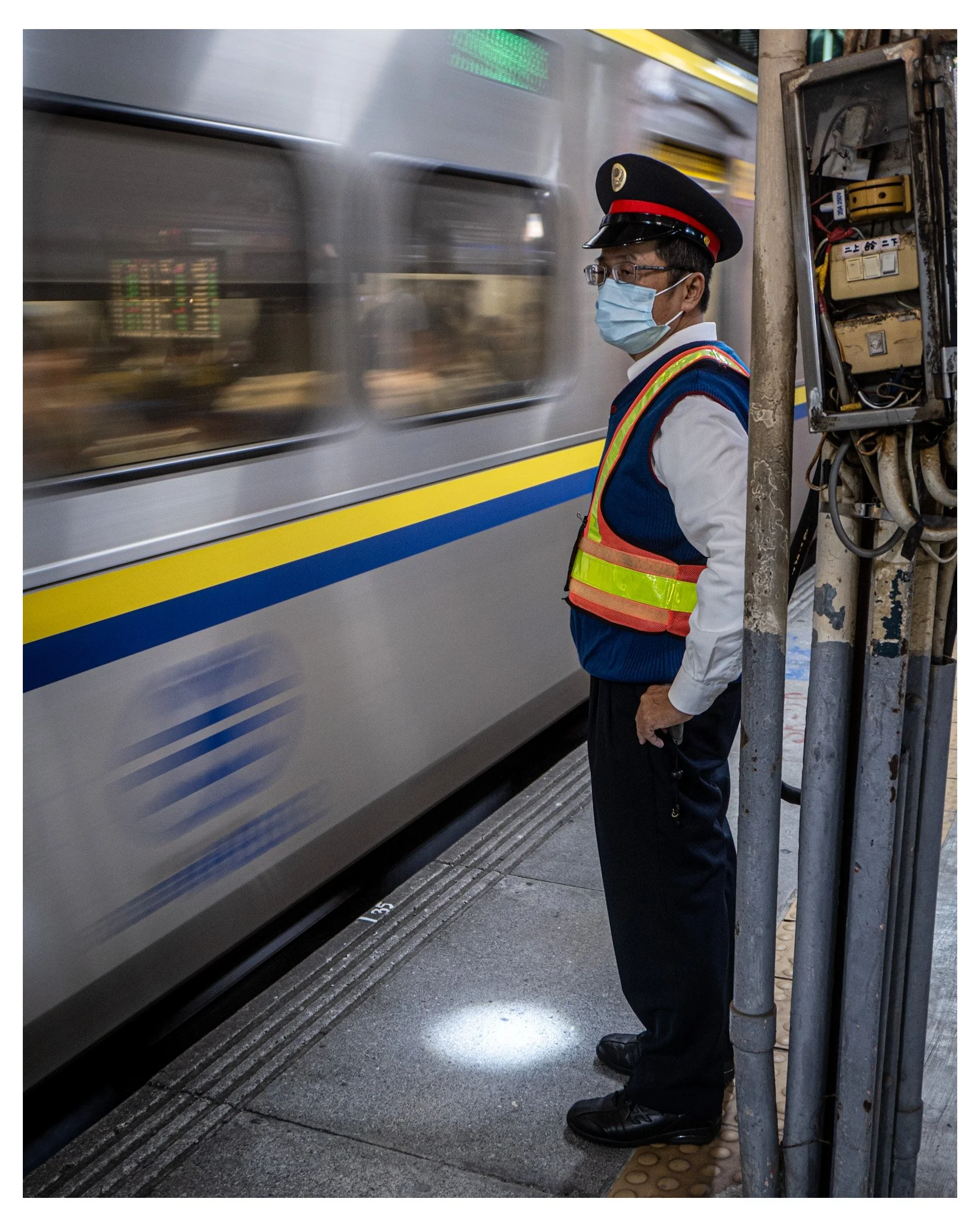
There is a wonderful tension in this image. You have successfully captured a classic photographic dichotomy: the immovable object against the irresistible force. The station guard—masked, uniformed, and rigid—serves as a visual anchor. He is the "sharp" reality in a world that is literally rushing past him.
The color blocking here is your strongest asset. The yellow stripe of the train perfectly mirrors the high-visibility vest of the official, creating a visual bridge between the two opposing forces. The cool, metallic tones of the train and platform provide a necessary stage for these bursts of color to sing.
However, the composition suffers from a common ailment in street photography: edge clutter. The right-hand third of the frame is dominated by the pipes and the open electrical box. While they add a touch of industrial grit, they are visually "heavy" and compete with the guard’s face for attention. The spotlight on the floor is another element that draws the eye down, away from the subject’s gaze.
Advice for next time: Work the scene by shifting your feet. A step to the left, panning slightly right, might have placed the guard against the moving train entirely, removing the static clutter of the electrical box. This would have isolated him further, emphasizing his solitude against the blur of the machine.
The Long Game: Compiling Your Artistic Data
You asked how to become better by "compiling data." Most photographers think this means looking at shutter speeds or ISO. As an artist, you must dig deeper. You need to compile the data of your intent.
I recommend you start a "Visual Audit" of your library every six months. Do not use a spreadsheet for this; use a physical notebook or a dedicated collection in your software. Track the following three metrics:
The Missed Shot Ratio: Tag images where you missed the moment. Then, analyze why. Was it technical (too slow to focus)? Was it fear (hesitation to raise the camera)? Was it positioning? This data reveals your friction points.
The Focal Length of Success: You likely have a favorite lens, but does it produce your best work? You might find that you shoot 80% of the time at 35mm, but your 5-star images are all at 50mm. This data tells you where your eye is most honest.
The Emotional tag: Start tagging your images not just by location (e.g., "Station"), but by emotion (e.g., "Alienation," "Joy," "Chaos"). Over time, you will see which emotions you are most skilled at capturing. This is how you find your voice.
The Syllabus: Resources for the Transit Photographer
To refine your eye for this specific genre—the solitude of the transit space—I have selected three masters for you to study. I noticed your library already contains Bruce Davidson, which is excellent, but we will push further into the abstract.
1. Alexey Titarenko (The Master of Time)
While your image uses motion blur to show speed, Titarenko uses it to show the passage of time and the erasure of individuality. His series City of Shadows transforms crowds into ghostly rivers. He is essential study for learning how long exposures can turn a mundane street scene into a poetic tragedy.
Book: The City is a Novel (This is a must-add to your collection).
Video: [Alexey Titarenko: Art of Photography] - This breakdown explains his philosophy of the "city as a tool" to express inner conditions.
2. Bruce Davidson (The Master of Atmosphere)
I see you own Subway. I want you to revisit it. Look specifically at how Davidson uses color in the gritty, graffiti-laden cars of 1980s New York. Unlike your image, which is cool and clinical, Davidson’s work is hot, dangerous, and intimate. Study his use of flash to freeze subjects against the dark backgrounds, a counter-technique to your natural light motion blur.
Book: Subway (Already in your library).
Video: [Bruce Davidson on Subway (Tate)] - Hear him describe the "voyage of discovery" underground.
3. Saul Leiter (The Master of Obstruction)
Your image has elements of obstruction (the pipes), but Saul Leiter made obstruction an art form. He often shot through steamy windows, between gaps in elevated train tracks, or past umbrellas. He teaches us that what you hide is as important as what you show. His work will help you handle that "clutter" on the right side of your frame—teaching you to either eliminate it or use it as a deliberate framing device.
Book: Early Color.
Video: [In No Great Hurry (Trailer)] - A beautiful glimpse into his philosophy of "unimportance" and finding beauty in the mundane.