

Day 50/365 The Collision of Eras: Deconstructing Kaohsiung’s Urban Layers
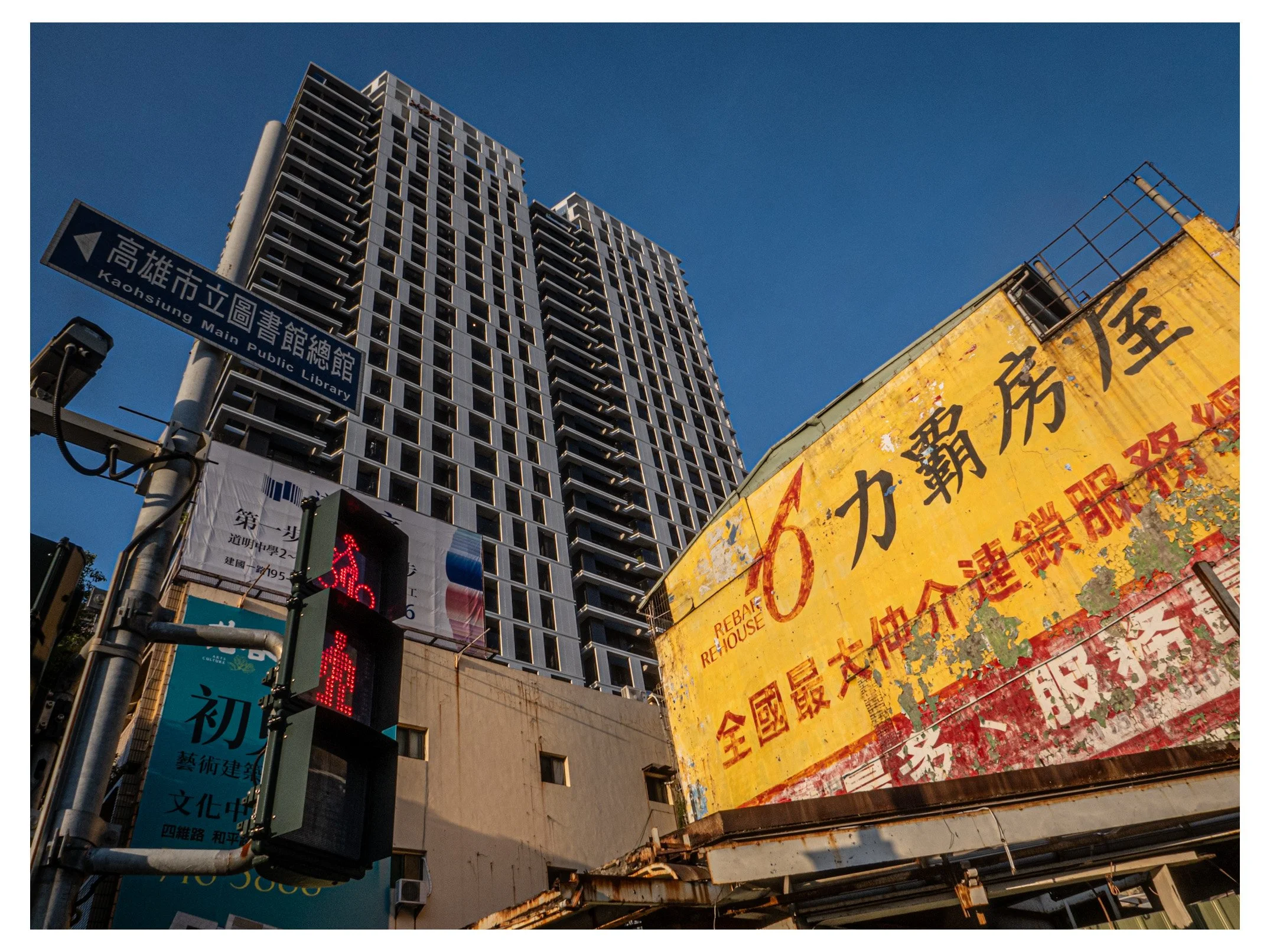
The Critique: Vertical Tensions
As I look at this image, I am immediately struck by the unapologetic dialogue between two distinct eras of Kaohsiung. You have captured a "vertical palimpsest"—a layering of history where the weathered, tactile past (the yellow sign) fights for space against the sterile, grid-like future (the high-rise).
What Works:
• Color Contrast: The interplay between the warm, decaying yellow of the "Rebar Rehouse" sign and the deep, polarized blue of the sky is classic complementary color theory in action. It creates a visual vibration that holds the viewer's eye.
• Juxtaposition: The organic peeling paint of the advertisement offers a fantastic textural counterpoint to the rigid, mathematical geometry of the library building in the background. This is the story of modern Asia in a single frame.
• The "Golden Hour" Hit: You have utilized the late afternoon light well. It skims across the yellow sign, emphasizing its texture and age.
Areas for Refinement:
• Visual Clutter: The left side of the frame is fighting for attention. The street sign ("Kaohsiung Main Public Library") and the traffic light create a "tangent" with the building behind them. In photography, when two objects overlap slightly but not deliberately, it flattens the depth. A step to the right might have separated the traffic light from the building, giving the red hand more breathing room against the sky.
• The "Anchor" Issue: The bottom edge feels slightly unresolved. The corrugated roof of the shed cuts in abruptly. I would advise either including more of the street level to ground the viewer or cropping tighter to make this purely about the abstract collision of the sign and the tower.
The Data-Driven Photographer: Your Metadata Journal
You asked how to improve over time by compiling data. Most photographers look at their EXIF data (ISO, shutter speed, aperture), but true growth comes from tracking subjective data.
I recommend you create a simple spreadsheet (or "Metadata Journal") for your best 50 images this year. Track these three columns:
1. The "Why": Write down the intent before you clicked the shutter. Was it the light? The geometry? A specific color? Comparing your intent with the final result is the fastest way to sharpen your vision.
2. The "Hit Rate" by Focal Length: Analyze your favorite images. Are 80% of them shot at 35mm? Or 85mm? If you find you are consistently succeeding at 35mm, force yourself to shoot only 85mm for a month to stretch your capabilities.
3. Light Quality: Categorize your shots by light type: Hard/Direct, Diffused/Cloudy, or Artificial. You might find your "voice" exists almost entirely in high-contrast hard light (like the image above). Knowing this allows you to double down on your strength or consciously practice your weakness.
The Curriculum: Resources for Study
To refine your eye for this kind of urban complexity, I have curated a specific list of masters, books, and viewings for you.
1. The Photographer to Study: Alex Webb
Your image attempts to layer multiple elements (sign, building, light, sky). No one does this better than Alex Webb. He is the master of "complex frames"—filling every inch of the photograph with information without it feeling chaotic.
• Why him: He works in intense color and deep shadow, often in tropical or warm climates similar to Taiwan's.
• Book Recommendation: The Suffering of Light by Alex Webb. This is arguably the most important color photography book of the last 30 years. It teaches you how to organize chaos.
• Watch: The Impossible Street Photography of Alex Webb. A breakdown of how he layers distinct subjects into one frame.
2. The Philosopher of the Banal: William Eggleston
Your focus on the "Rebar Rehouse" sign—a mundane, commercial object—reminds me of Eggleston. He treated tricycles, ceilings, and freezers with the same reverence as grand landscapes.
• Why him: He teaches us that color is the subject. The yellow of your sign is not just an adjective; it is the noun.
• Book Recommendation: William Eggleston's Guide. This book single-handedly legitimized color photography in the art world.
• Watch: William Eggleston: The Color Revolution. A look at how he used the dye-transfer process to achieve colors that felt hyper-real.
3. The Local Master: Shen Chao-Liang
Since you are shooting in Taiwan, you must study Shen Chao-Liang. His work on "stage trucks" (the cabaret trucks that fold out) captures the surreal color and energy of Taiwanese street culture.
• Why him: He bridges the gap between documentary and fine art, often using night photography and long exposures to capture the "cultural landscape" of Taiwan.
• Book Recommendation: STAGE by Shen Chao-Liang.
• Watch: Photographer Shen Chao-liang Sneaks in the Light. A profile on his process and his view of Taiwanese visual culture.
4. The Architect of Density: Michael Wolf
For your interest in the high-rise background, look at Michael Wolf. His "Architecture of Density" series removes the sky and ground, turning buildings into infinite, suffocating, yet beautiful patterns.
• Book Recommendation: Tokyo Compression. While focused on the subway, it deals with the same themes of claustrophobia and modern urban life