

Day 51/365 The Shadow and the Spectator: A Lesson in Urban Juxtaposition
The Critique: The Meta-Narrative of the Street
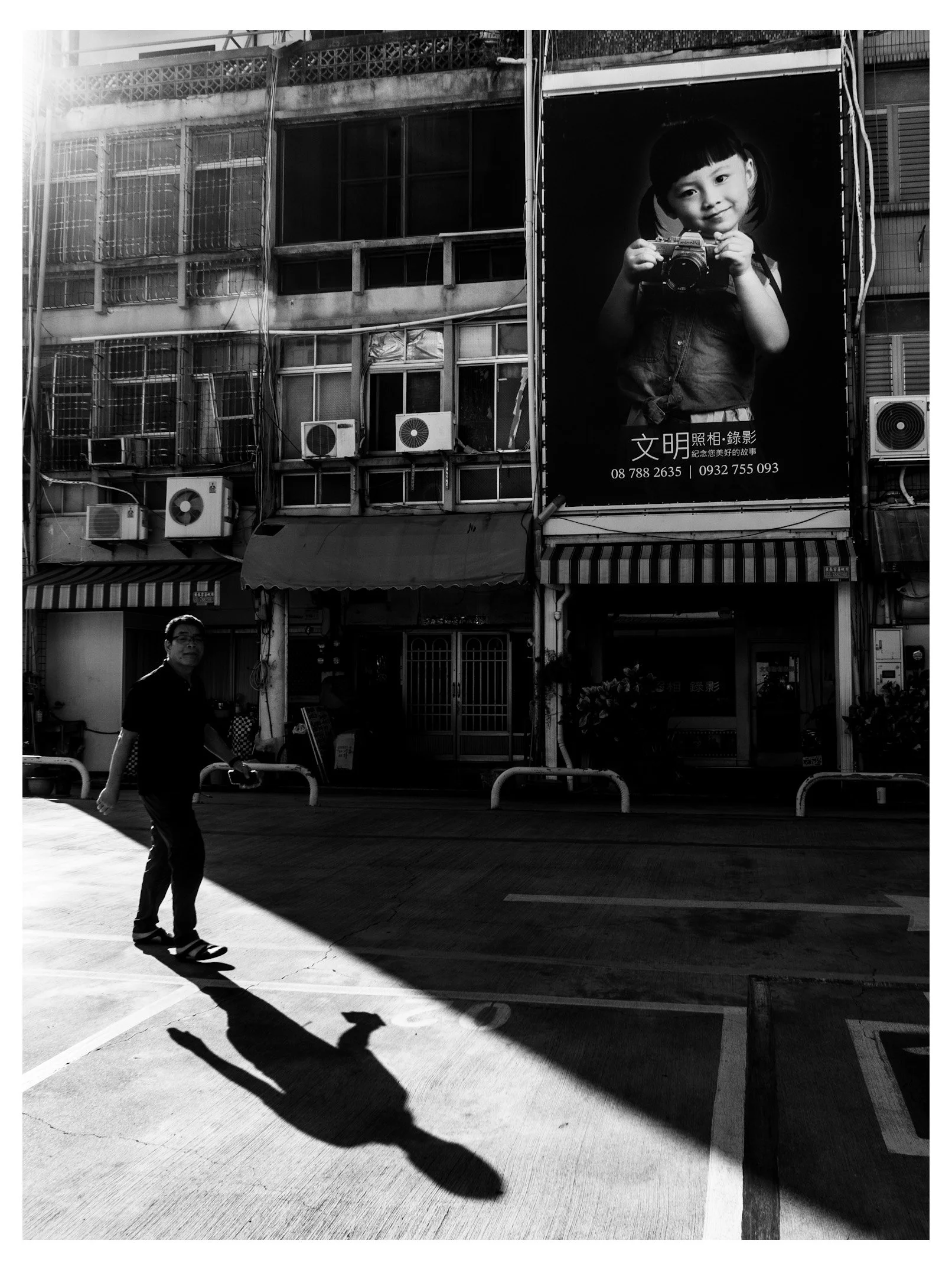
This image is far more ambitious than the previous rail study. You have moved from documenting a subject to interpreting a scene. The high-contrast black and white aesthetic (chiaroscuro) suits the gritty texture of the Taiwanese street architecture perfectly.
1. The "Meta" Juxtaposition:
The strongest element here is the intellectual wit. You have a massive billboard of a child holding a camera—a giant, unblinking eye watching the street—towering over a pedestrian who seems unaware he is being "watched." This creates a meta-narrative: a photograph of a photograph, commenting on the act of observation itself. This is sophisticated seeing.
2. The Geometry of Light:
The long, raking shadow of the pedestrian is excellent. It creates a diagonal vector that leads the eye into the frame. The shadow is almost more substantial than the man himself, which adds a layer of mystery and anonymity often found in film noir.
3. Separation and Chaos:
The background is incredibly busy—air conditioning units, grilles, and signage. This is the reality of the urban landscape, but it threatens to swallow your subject. The man’s dark shirt blends slightly into the dark awning behind him.
• Advice: In a high-contrast scene like this, patience is your best filter. If you had waited for a subject wearing white, or perhaps a cyclist, they would have "popped" against the dark background. Alternatively, waiting for the subject to step fully into the patch of sunlight (bottom left) would have illuminated him against the darker asphalt, creating instant separation.
4. The Stride:
You caught the subject mid-stride, which is good, but the "decisive moment" was arguably a fraction of a second later. His legs are scissoring, but his shadow is merging slightly with his body.
• Advice: Burst mode is your friend here. We want the "triangle" of the legs to be clearly defined in both the figure and the shadow to maximize the graphic impact.
The Long Game: Tracking Light and Metaphor
To evolve from taking "lucky shots" to making consistent art, you must track the intent behind your images in your database.
Add these columns to your tracking spreadsheet:
• The "Punctum": Roland Barthes’ term for the detail that "pricks" or bruises the viewer. In this photo, is it the girl's eyes? The shadow? Track what drew you to the scene.
• Juxtaposition Type: Label your images: "Irony" (like this one), "Color Match" (like the train), "Geometry," or "Texture." You will soon see which intellectual devices you favor.
• Shadow Length: Track the time of day. You will likely find your best B&W work happens before 9:00 AM or after 4:00 PM when shadows elongate and abstract the world.
The Syllabus: Masters of Shadow and Wit
Based on the visual language of this image—high contrast, urban grit, and visual wit—I have selected these resources from the canon and your library.
1. The Master of Shadow: Fan Ho
Your image screams Fan Ho. He was the master of using the high-contrast sunlight of Hong Kong to turn streets into theatrical stages. He often used long shadows to lead the eye, exactly as you attempted here.
• Book: Portrait of Hong Kong. Study how he simplifies busy backgrounds by crushing the blacks, hiding the "noise" of the city in shadow to highlight the subject.
• Watch: Fan Ho: The Master of Light and Shadow
2. The High-Contrast Dreamer: Trent Parke
For the deep blacks and blinding whites, look to Trent Parke. His work pushes the dynamic range to the breaking point, turning ordinary street scenes into apocalyptic or dreamlike visions.
• Book: Minutes to Midnight. Look at how he uses light not just to illuminate, but to obliterate unnecessary details.
• Watch: Trent Parke: Minutes to Midnight (Magnum Photos)
3. The Wit of the Street: Elliott Erwitt (or Vivian Maier)
Since your image relies on the humor of the billboard watching the man, you should study photographers who prioritize wit. Vivian Maier often photographed people interacting with advertisements or shop windows, creating similar "layered" meanings.
• Book: Vivian Maier: Street Photographer. Note her use of reflections and frames-within-frames.
• Watch: Finding Vivian Maier (Trailer)
4. The Gritty Texture: Daido Moriyama
Your background is full of chaotic texture—wires, vents, metal. Moriyama embraces this "are-bure-boke" (grainy, blurry, out-of-focus) aesthetic. He teaches us that the messiness of the city is its soul.
• Book: Provoke era works or Hawaii. Focus on how he frames tight, claustrophobic alleyways to create tension.