

Day 53/365 Stillness in the Stream: Mastering the Long Exposure
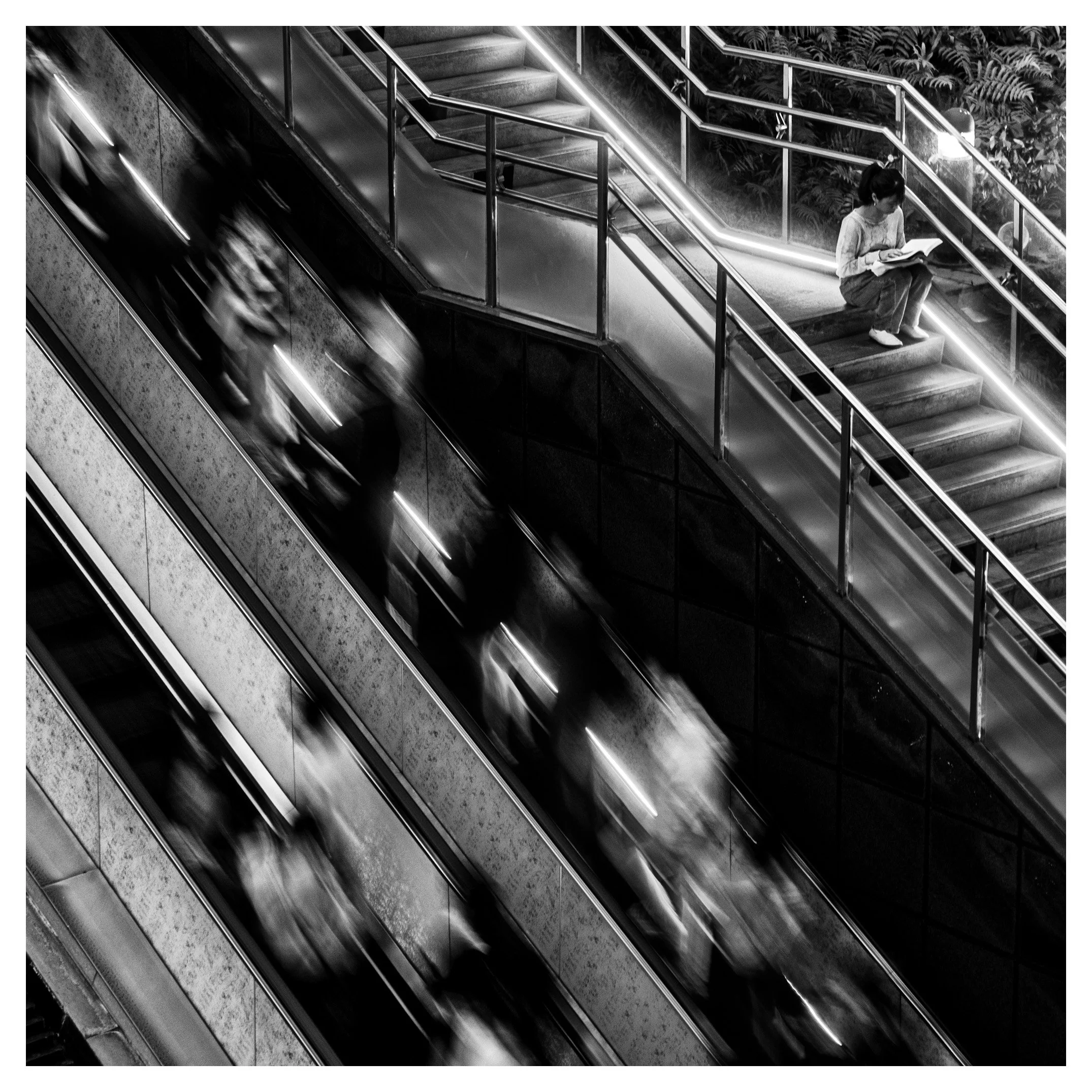
The Critique: A River of Ghosts
My dear photographer, you have captured something here that many spend years chasing: a clear, narrative counterpoint.
This image relies on a classic but difficult technique—long exposure in a high-traffic environment. The diagonal composition is strong, cutting the frame with the ruthless efficiency of the escalator itself. But the soul of this image is the solitary figure reading on the right. They are the anchor. Without them, this is just a technical exercise in motion blur; with them, it becomes a story about reading as an act of resistance against the rush of modern life.
Advice for Improvement:
• Shadow Management: Your blacks are incredibly deep—reminiscent of the Provoke era Japanese photographers. However, be careful not to crush them into a void. I would suggest lifting the shadows slightly in the lower quadrants to reveal just a hint of texture in the stone. It will ground the image.
• Timing the "Ghosting": The blur on the left is fantastic, but the figures are almost too abstract. Experiment with a slightly faster shutter speed (perhaps 1/4 or 1/8 of a second rather than 1/2 or 1 second) to retain just enough definition to see the "humanity" in the blur. We want ghosts, not just smoke.
• Framing the Anchor: Your reader is dangerously close to the edge of the frame. In the future, try to give your main subject a little more "breathing room" within the composition. If the eye falls off the edge, the tension is broken.
Becoming a Scientist of Your Own Art
You asked how to become better by compiling data. This is a brilliant question. Most photographers rely on "feeling," but the masters rely on consistency. Since you clearly enjoy databases (I see your reading list!), you should apply that same rigor to your shooting.
The "Keeper" Protocol:
Don't just store your images; interrogate them. Every month, pull your top 10 "Keepers" (successful images) and log the following data points into a spreadsheet:
1. Shutter Speed: Was it 1/15s? 1/60s? You will likely find a "sweet spot" for motion blur that fits your personal aesthetic.
2. Aperture: Are you consistently shooting wide open (f/2.8) or closed down (f/8)? This dictates your visual depth.
3. Light Condition: "Overcast," "Hard Noon," "Golden Hour," "Artificial/Neon."
4. The "Why": Write one sentence on why it worked. (e.g., "The contrast between the static subject and moving background.")
Over a year, this data will reveal your unconscious style. You might discover, "I produce my best work at f/8 in overcast light." Once you know your formula, you can stop hoping for good photos and start engineering them.
Recommendations for Study
Based on this image and your interest in high-contrast monochrome, I have selected specific works for you to study.
1. The Photographer to Research: Alexey Titarenko
You cannot attempt long-exposure crowd photography without bowing to Titarenko. His series City of Shadows, shot in St. Petersburg during the collapse of the Soviet Union, uses long exposure to turn commuting crowds into terrifying, ghostly rivers.
• Why him? He masters the exact technique you are using here but pushes it to a metaphorical extreme.
2. The Book to Read
• "Portrait of Hong Kong" by Fan Ho
• Context: I see this is already on your list (Row 54). It is essential. Fan Ho was the master of finding the "stage" within the city. He didn't just find light; he waited for actors to walk into it. Study how he uses staircases and shafts of light to isolate figures.
• "Minutes to Midnight" by Trent Parke
• Context: Also on your list (Row 60). Parke is a magician of light. He pushes contrast to the breaking point. Study this book to learn how to expose for the highlights and let the shadows fall into pure black—a technique that will help you refine the "crushed blacks" in your current image.
3. Videos to Watch
Visual learning is critical for understanding the "rhythm" of these photographers.
• Trent Parke: The Camera is God
Parke discusses how he shoots moving subjects and his obsession with light.
• Fan Ho: The Art of Photography
A breakdown of how Fan Ho composed his "theatrical" street scenes.
• Alexey Titarenko: City of Shadows
A look at the technique behind the "shadow crowds." This is the most directly relevant to your escalator image.
Keep shooting, keep analyzing, and remember: The camera sees what the eye cannot—time itself.
Theo Marr