

Day 52/365 San Duo’s Glass Canvas: Deconstructing the Urban Reflection
The Critique: San Duo MRT Exit
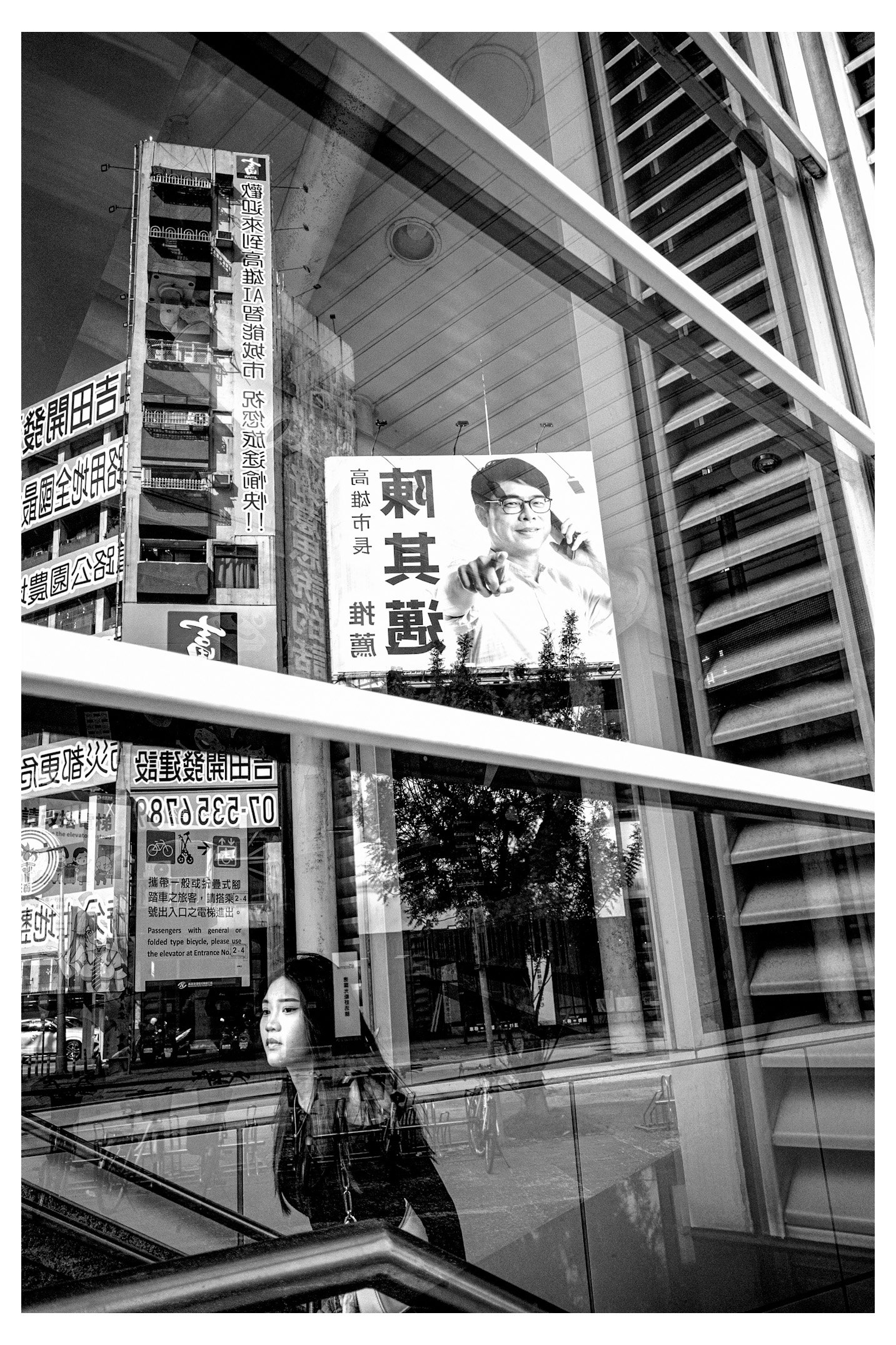
This image is a sophisticated exercise in layering—a "visual sandwich" that compresses the interior world of the subway commuter with the exterior bustle of Kaohsiung. You have successfully utilized the glass of the San Duo MRT exit not as a barrier, but as a canvas that merges two realities.
The strength of this photograph lies in its juxtaposition. The political billboard, featuring a man pointing authoritatively, looms over the young woman's face. Her expression is passive and introspective, creating a narrative tension between the "loud" public sphere and the "quiet" private moment. The high-contrast black and white editing reinforces the gritty, street-photography aesthetic, reminiscent of the Japanese Provoke era.
However, the image suffers from a common ailment in reflection photography: highlight competition. The structural beams of the MRT station are catching intense light, creating bright, diagonal slashes that cut through the frame. While they add dynamic geometry, they also compete with the woman’s face for the viewer's attention.
Advice for Improvement:
• Micro-positioning: In reflection shots, moving your camera just an inch to the left or right can drastically shift where the "ghost" layers fall. A slight step to the right might have placed the woman's face in a darker patch of the reflection, separating her features from the bright architecture.
• Burn and Dodge: In post-processing, use a localized "burn" tool to lower the exposure on the white billboard background and the bright structural beams. Conversely, slightly "dodge" (brighten) the woman’s eyes to make her the undeniable anchor of the photo.
• Wait for the "Eye Contact": The image is voyeuristic, which is fine, but if the woman had looked directly at the man pointing (or at you), the triangulated tension would have been electric.
The Methodology: Becoming a Better Photographer Through Data
You are already sitting on a goldmine of data with your books_database file. Most photographers passively consume art; you have the opportunity to actively analyze it. To improve over time, you must treat your consumption of photography as a dataset.
Don't just list books; track your "Visual DNA." Add a column to your database for "Key Lesson Learned" or "Visual Signature." For example, next to The Chain by Chien-Chi Chang, you might note "Alienation through repetition". Next to Tokyo Compression, note "Glass as a texture, not just a window".
Review this data quarterly. Are you buying books mostly about "Isolation"? "Geometry"? "Political unrest"? Your purchasing habits reveal your subconscious interests. Once you identify that you are obsessed with, say, urban alienation, you can stop taking random photos of flowers and focus entirely on that theme. Data turns a hobby into a body of work.
Recommendations
To refine your eye for reflections and layered narratives, I recommend studying the following masters. I have selected books specifically from your database to ensure they align with your existing library.
1. The Photographer: Lee Friedlander
Friedlander is the undisputed master of the "self-portrait in reflection." He uses shop windows, side-view mirrors, and glass doors to fragment the world. Unlike your image, which seeks to merge two layers, Friedlander often creates chaos that somehow feels organized. He teaches us that the photographer is always part of the picture.
2. The Book: Tokyo Compression by Michael Wolf
Since you are shooting in the MRT, this book is essential. Wolf photographed commuters pressed against the windows of the Tokyo subway. He focuses on the humidity, the skin against glass, and the claustrophobia of transit. It will teach you how to use glass not just for reflections, but as a tactile surface that traps the subject.
3. The Book: Subway by Bruce Davidson
Listed in your database simply as "(Bruce Davidson New Yo...)", this body of work is the holy grail of transit photography. Davidson used flash to cut through the grime of the 1980s NYC subway. Study this for how he manages to isolate subjects in chaotic, dark environments—a direct lesson for your San Duo underground shots.
4. The Videos
Visual learning is critical for understanding the "flow" of street photography.
• Lee Friedlander's Layered Chaos
This analysis breaks down how Friedlander uses "obstructions" (like the beams in your photo) intentionally rather than accidentally.
Watch: Lee Friedlander - Part 1 - What is he up to?
• Daido Moriyama's High Contrast Street Style
Your black and white processing reminds me of Moriyama. This video explores his "Are, Bure, Boke" (grainy, blurry, out-of-focus) philosophy, which might encourage you to be even bolder with your grit.
Watch: The Shocking Truth About Daido Moriyama's Style
• Alex Webb's Complex Frames
Webb is a master of layering multiple subjects without them overlapping messily. While he shoots in color, the principles of spatial separation apply perfectly to your B&W reflection work.