

Day 56/365 The Tactile Moment: Deconstructing Intimacy in Street Photography
The Critique: Visual Vernacular and the Anchor of Touch
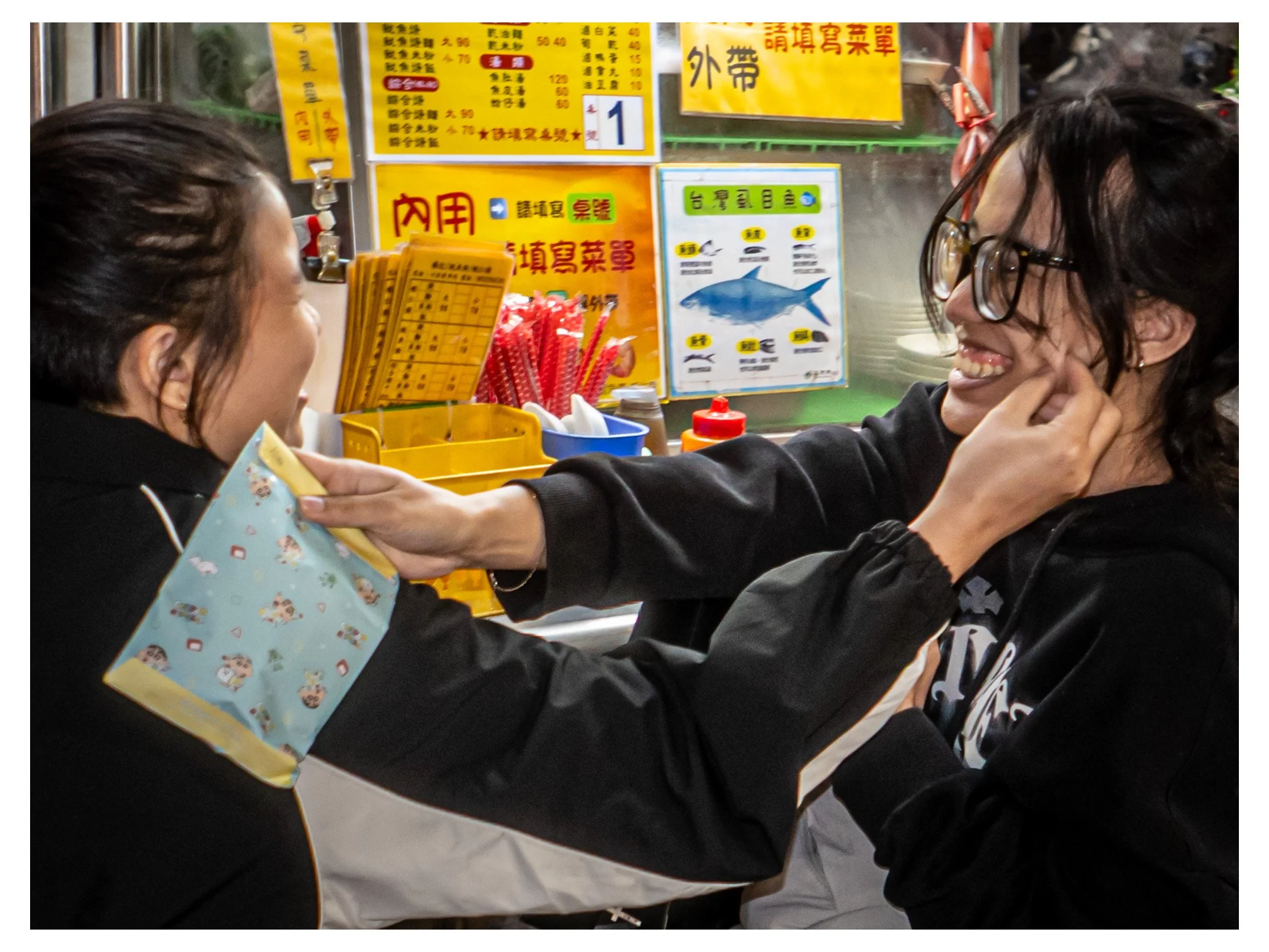
In the image you have submitted, we are presented with a rupture in the ordinary flow of street life. The photograph succeeds primarily on the strength of its central gesture: the cheek pinch. In a genre often dominated by distance and voyeurism, this image offers us tactile proof of connection. The subject on the right is not merely smiling; they are reacting to a physical stimulus, creating an expression of genuine, unguarded joy that is difficult to manufacture.
However, from a critical perspective, the composition wrestles with the chaos of its setting. You are working in a visually dense environment—likely a Taiwanese night market or eatery, indicated by the yellow signage. The arm of the figure on the left cuts across the frame, creating a heavy visual block that obscures the connection rather than leading our eye into it. The cropping feels somewhat claustrophobic, cutting off the context that could give this interaction more "air" to breathe.
To improve this kind of image, you must become hyper-aware of your edges. In the milliseconds before the shutter clicks, ask yourself: Is the gesture clear? Is the arm a leading line or a barrier? A half-step to your right would have opened up the angle, revealing the profile of the pincher and creating a triangular composition between the two faces and the hand.
The Data-Driven Eye: Compiling Your Archive
You asked how to improve over time by compiling data. This is a sophisticated question that separates the hobbyist from the serious practitioner. Photography is not just about taking new photos; it is about analyzing the DNA of your past work.
I recommend you begin a metadata audit of your catalog every quarter. Do not simply look at your favorites; look at your failures. Create a simple dataset tracking three specific metrics:
1. Focal Length vs. Keeper Rate: You may find that 80% of your successful images are shot at 35mm, yet you spend 50% of your time shooting at 50mm. This data tells you where your natural vision lives.
2. Proximity Index: Rate your images on a scale of 1-5 based on physical distance to the subject. If your highest-rated images are all close-range (like the one above), you know your strength lies in intimacy, not architectural geometry.
3. The "Why" Tag: In your metadata software, add a custom tag for the emotion that triggered the shutter: "Humor," "Anger," "Light," "Chaos." Over a year, you will see a pattern emerge revealing your subconscious artistic intent.
Curated Curriculum: Masters of the Candid
Based on the raw energy and human connection in your image, I have selected a specific curriculum for you. These recommendations leverage the books_database you provided, ensuring you look toward established masters who navigated these same visual problems.
1. The Aesthetic of Intimacy: Nan Goldin
Your image shares a spiritual DNA with Nan Goldin’s work—specifically the "snapshot" aesthetic that prioritizes emotional truth over technical perfection. Goldin’s seminal work, The Ballad of Sexual Dependency, is essential reading for you. Note how she uses flash not to illuminate a scene, but to expose the psychological rawness of her subjects. She does not shy away from the people she loves; she gets closer.
• Book to Study: The Ballad of Sexual Dependency (ISBN: 0893812366)
• Watch: Nan Goldin: The Ballad of Sexual Dependency (Interview & Analysis)
https://www.youtube.com/watch?v=RlC3ym4-YaQ
2. The Chaos of Color: Martin Parr
The yellow signs and chaotic background in your photo remind me of the saturation found in Martin Parr’s work. Parr is a master of managing clutter and using it to tell a story about consumption and leisure. In The Last Resort, he uses flash in daylight to make subjects "pop" from chaotic backgrounds—a technique that could help you separate your subjects from the busy text in your own work.
• Book to Study: The Last Resort (ISBN: 0906361596)
• Watch: Martin Parr’s Advice to Young Photographers
https://www.youtube.com/watch?v=6Bs49pTOLDo
3. The Taiwanese Context: Chien-Chi Chang
Since you are shooting in Taiwan, you must study Chien-Chi Chang. While his work The Chain is formal and stark, his broader Magnum work captures the alienation and deep bonds of Taiwanese culture. Study how he integrates cultural symbols (like the wedding scenarios in Double Happiness) without letting them overpower the human element.
• Book to Study: The Chain (ISBN: 0954207955)
• Watch: Chien-Chi Chang: Magnum Photos Profile
https://www.youtube.com/watch?v=jZ5e6q7q8kM (Search for "Magnum Photos Chien-Chi Chang" if this specific link is unavailable in your region, as Magnum archives rotate frequently).
4. The Energy of the Street: Garry Winogrand
Your image has a kinetic energy—it feels like it’s moving. Winogrand was the master of this. He often tilted the horizon (the "Dutch angle") not for effect, but to fit as much life into the frame as possible. His book Public Relations shows people at parties and events, interacting in tight clusters. Study how he manages to frame three or four people interacting without the limbs becoming distracting—a direct lesson for your "arm obstruction" issue.
• Book to Study: Public Relations (or The Man in the Crowd)
• Watch: Garry Winogrand: All Things are Photographable (Trailer/Clips)