

Day 57/365 The Electric Altar: Documenting the Silent Grids of the City
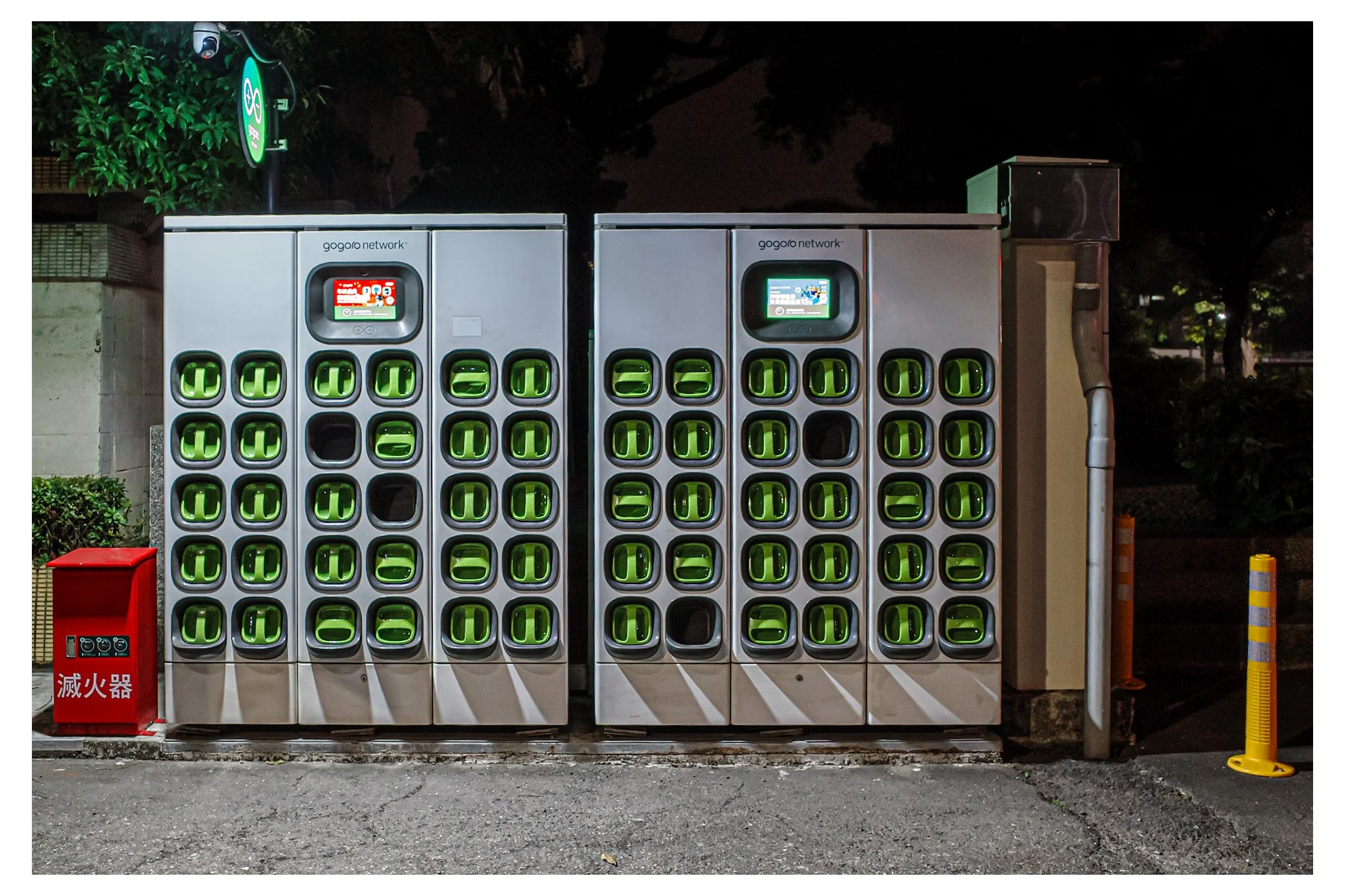
The Critique: Neon and Geometry
This new version is a significant improvement in intentionality. You have successfully embraced the "deadpan" aesthetic I mentioned earlier. By stepping back and including the pavement, the bollards, and the dark void of the trees above, you have contextualized the machine. It no longer feels like a tight crop; it feels like a portrait of an object in its habitat.
The composition now has a wonderful "stage-like" quality. The Gogoro station sits center stage, flanked by the red fire extinguisher on the left and the yellow bollard on the right. These primary colors (Red, Green, Yellow) create a triad that is visually satisfying and very "pop art." The darkness above acts as a heavy curtain, pressing down on the scene and emphasizing the artificial light of the station.
Advice for improvement:
While the wider shot is better, pay attention to the "verticals." The lines of the machine still lean slightly, converging towards the top. This is a common issue with wide-angle lenses when tilting the camera up. In post-production (or in-camera with a tilt-shift lens), correcting these vertical lines to be perfectly parallel would elevate this from a "snapshot of a machine" to a "typological study." It would make the image feel more architectural and rigorous.
The Methodology: Becoming a Better Photographer Through Data
You asked how to compile data to improve. Most photographers track technical metadata (ISO, Shutter Speed). An artist tracks intent.
I recommend you create a "Field Journal" (a simple spreadsheet or notebook) with the following columns for every significant shoot:
1. The Light Condition: (e.g., "Mercury Vapor Streetlight," "Blue Hour," "Neon Haze").
2. The Subject Class: (e.g., "Infrastructure," "Portrait," "Typography").
3. The Intent: What was I trying to say? (e.g., "Alienation," "Convenience," "Future-Noir").
4. The Variance: Look at the image a month later. Did the result match the intent?
If you track this for 6 months, you will see patterns. You might realize, "I consistently shoot better images under fluorescent light," or "My best work happens when I photograph industrial machinery." This is how you find your style—not by guessing, but by analyzing your own data.
The Curriculum: Resources for the Urban Documentarian
Based on your inclination toward the colorful, industrial nightscapes of Taiwan, I have selected the following resources for you.
1. The Photographer to Study: Shen Chao-Liang
You cannot document the night colors of Taiwan without studying Shen Chao-Liang. His work appears in your Books_Database file, specifically his series STAGE. He photographs the mobile stage trucks of Taiwan—colorful, transforming structures that look like Transformers unfolding in the night.
• Why study him? He takes something "low culture" (stage trucks) and treats it with "high art" rigor and large-format precision. He matches your interest in glowing, colorful structures in the dark.
2. The Book to Read: Uncommon Places by Stephen Shore
Also found in your database, this is the bible of color documentary photography. Shore drove across America photographing parking lots, hotel breakfasts, and intersections.
• Why read it? Shore teaches us that "boring" subjects are only boring if the composition is lazy. He organizes chaos into perfect order.
3. The Videos to Watch
I have curated three videos that break down the philosophy of the "deadpan" and the "industrial sublime."
• Shen Chao-Liang on his process: This interview gives you insight into how a Taiwanese master approaches his long-term projects like STAGE.
• Watch: Shen Chao-liang Sneaks in the Light and Shadows
• Andreas Gursky - The Making of Worlds: Gursky is the master of the "Grid." He photographs supermarkets and apartment blocks, turning them into massive abstract patterns. This will help you see your battery stations as abstract art.
• Watch: Andreas Gursky - The Making of Worlds
• Stephen Shore - Uncommon Places: A look at how Shore transitioned from snapshots to the large-format discipline that defined his career.