

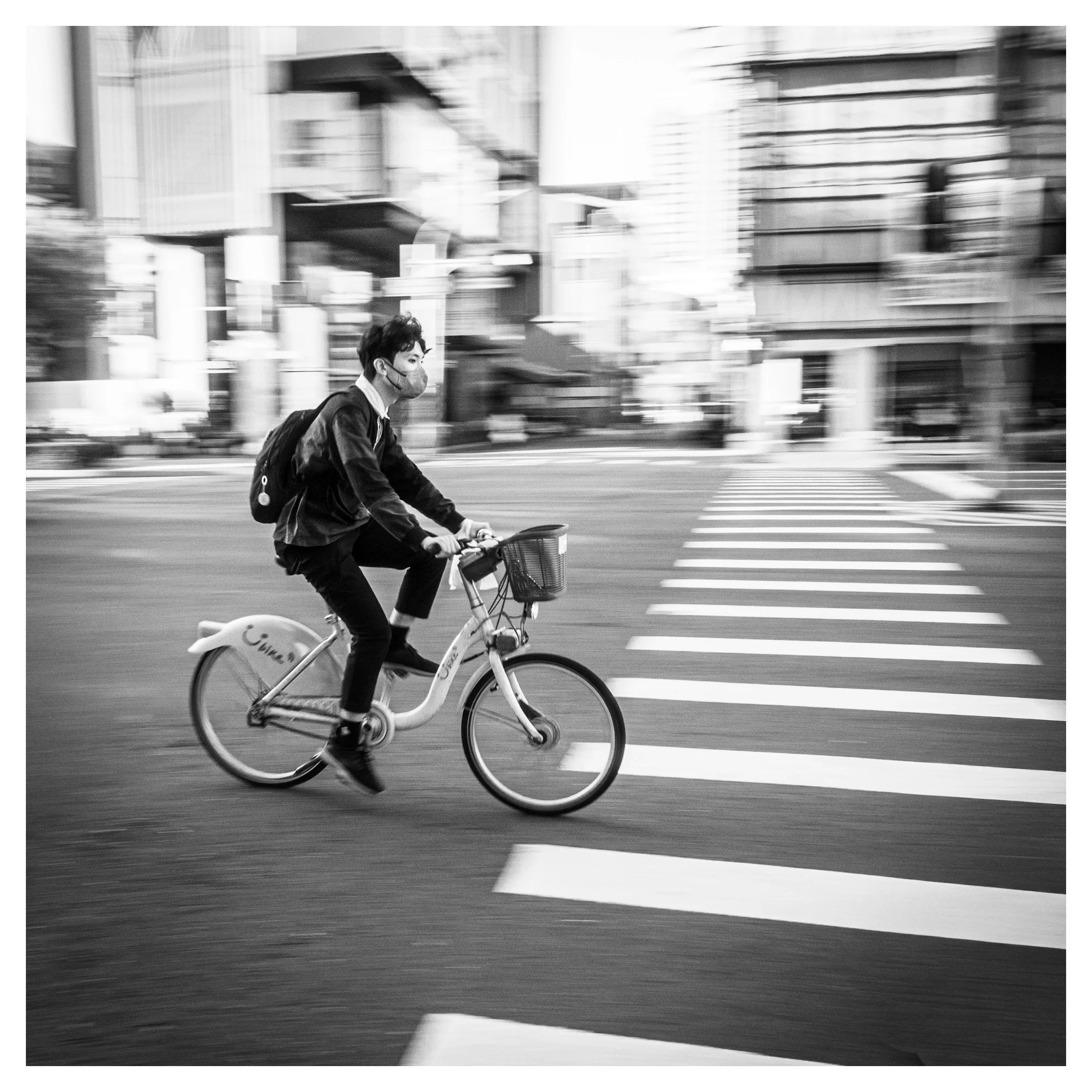
You’ll learn why intentional blur is a powerful narrative tool and how shooting in full manual allows you to conquer complex backlighting that would otherwise leave your subject in the dark.
Camera Model: LEICA D-Lux 8
Shutter Speed: 1/30 sec
Aperture: f/11
ISO: 400
The Critique: Technical Defiance for Emotional Impact
This image is a masterclass in using manual exposure to achieve a specific creative vision. By choosing full manual control, you successfully navigated a difficult lighting scenario where the light source was behind and to the left of the cyclist. Had you relied on the camera's meter, the bright street and backlighting would have caused the subject to be underexposed; instead, you’ve maintained essential detail in the rider's form while achieving the intended aesthetic.
The choice of 1/30 sec at f/11 was a deliberate and necessary calculation. In the bright Kaohsiung light, stopping down to f/11 was the only way to facilitate a shutter speed slow enough to generate that kinetic "smear" of the environment. This technique echoes the "Are, Bure, Boke" (grainy, blurry, out-of-focus) philosophy of the Japanese Provoke movement, where the mood of the image is paramount. The contrast between the sharp focus on the cyclist's face and the rhythmic blur of the crosswalk creates a powerful sense of isolation and momentum.
Advice for Improvement
• Compositional Breathing Room: The crop is quite aggressive, bringing the image down from 16.8 MP to 3.1 MP. While it highlights the rider, giving the subject more "negative space" to ride into would amplify the sense of journey and speed.
• Managing Diffraction: While f/11 was necessary for the shutter speed here, compact sensors can lose a bit of fine detail to diffraction at such small apertures. To keep your desired 1/30 sec "emotion" while using a more optimal aperture like f/5.6 or f/8, consider using a Neutral Density (ND) filter to block excess light.
Path to Mastery: Building Your Database
To evolve as an artist, you must analyze the gap between your intent and your camera's suggestions. By compiling a database of your manual overrides, you will develop an intuitive sense of "Kaohsiung light." Tracking successful shots and noting technical choices—such as those found in your current records of masters like Fan Ho and Chien-Chi Chang—will help internalize these values.
Recommended Research
• Photographers to Study:
• Chien-Chi Chang: Look at his series The Chain or Jet Lag for masterful depictions of alienation and urban motion in a Taiwanese context.
• Fan Ho: Study his Portrait of Hong Kong for his legendary use of geometric shadows and 1950s street compositions.
• Daido Moriyama: To see how blur and high contrast can be used as a primary narrative language.
• Books to Read:
• The Decisive Moment by Henri Cartier-Bresson: For the ultimate study in timing and geometry.
• A Farewell to Photography by Daido Moriyama: For embracing the beauty of technical "imperfection".
• The Americans by Robert Frank: To understand the "outsider" perspective on cultural landscapes.
• Videos to Watch:
• Fan Ho: Visual Poetry: An exploration of street composition and light.
• The Art of the Panning Shot: Technical tips for perfecting the motion blur you captured here.
• Mastering Manual Exposure: Understanding how to override meters in tricky lighting.