

Image Metadata
Camera Model: Leica D-Lux 8
Shutter Speed: 1/125s
Aperture: f/3.5
ISO: 200
The Critique: Theodore Marr’s Analysis
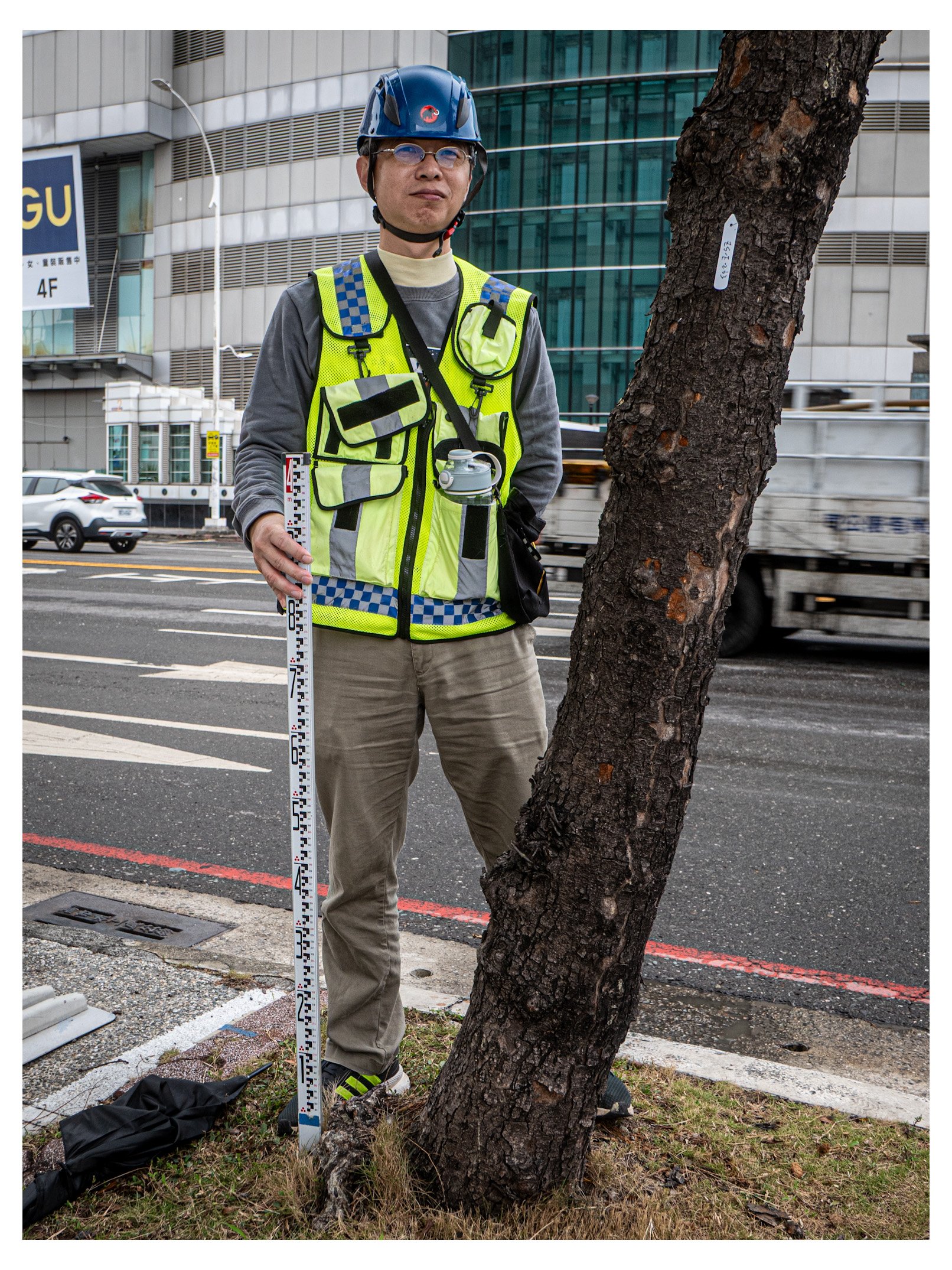
This second iteration is a significant step forward in your storytelling. By widening the frame to include the subject’s feet and the base of the tree, you have moved from a simple portrait to a true documentary piece. The inclusion of the "survey plot" on the ground provides the necessary context for his work. The surveyor’s posture is stable and dignified, creating a strong vertical line that parallels both the tree and the urban architecture in the background.
The color version works well here because of the high-visibility safety vest; the vibrant yellow acts as a "natural" focal point that separates the subject from the muted tones of the asphalt and the grey building. The direct but humble expression on his face, combined with the way he holds the leveling staff, communicates a quiet mastery of his craft.
Advice for Improvement
• Mind the Edges: On the left side of the frame, the black umbrella is partially cut off. In a clean documentary shot, it is often better to either include the entire object or remove it from the frame entirely to avoid distracting the viewer's eye away from the center.
• Perspective and Horizon: The red curb line in the background is slightly tilted. In architectural and urban photography, ensuring your horizontal lines are level provides a sense of stability and professional polish.
• Depth of Field: At f/3.5, the background is soft, but still quite busy. If you want the surveyor to pop even more, consider stepping back and zooming in to 75mm (equivalent), which would compress the background further and create a creamier bokeh.
Path to Mastery: Compiling Your Data
To evolve as an artist, your growth should be driven by an analysis of your own technical data.
1. Consistency Audit: Compare the metadata of this shot with your previous one. Using consistent settings like ISO 200 helps you understand how your sensor handles different lighting conditions.
2. Thematic Keywording: Use software to tag these images with descriptive metadata such as "Taiwan Labor," "Urban Forestry," and "D-Lux 8". This turns a random collection of files into a structured archive that you can search and analyze over time.
3. Focal Point Analysis: Look at where you are placing your subject. Are you always centering them? Try using a 3x3 grid in your viewfinder to experiment with the Rule of Thirds, placing the surveyor on the left vertical line to allow the tree to "breathe" on the right.
Recommended Research
Photographers to Study
• Zhang Xinmin: One of the first to document migrant and urban workers in China; his work is essential for understanding social documentation in Asia.
• Lewis Hine: A historical master whose work on labor issues proved that photography could be a powerful tool for social change.
• Sebastião Salgado: Study his epic "Workers" project to see how to turn manual labor into heroic, monumental art.
Books to Read
• Photography as Activism: Images for Social Change by Michelle Bogre: A great guide for anyone wanting to use their camera to highlight community issues.
• Think Like a Street Photographer by Matt Stuart: Excellent for learning how to anticipate moments in busy urban environments.
Videos to Watch
• The Power of Environmental Portraits: This video explains how to balance a person with their surroundings to tell a deeper story. Watch on YouTube.
• Understanding Your Camera's Metadata: Learn how to use the hidden data in your photos to diagnose and fix technical mistakes. Watch on YouTube.