

Day 85/365 Neon Noir: Deconstructing the Taiwanese Night Market
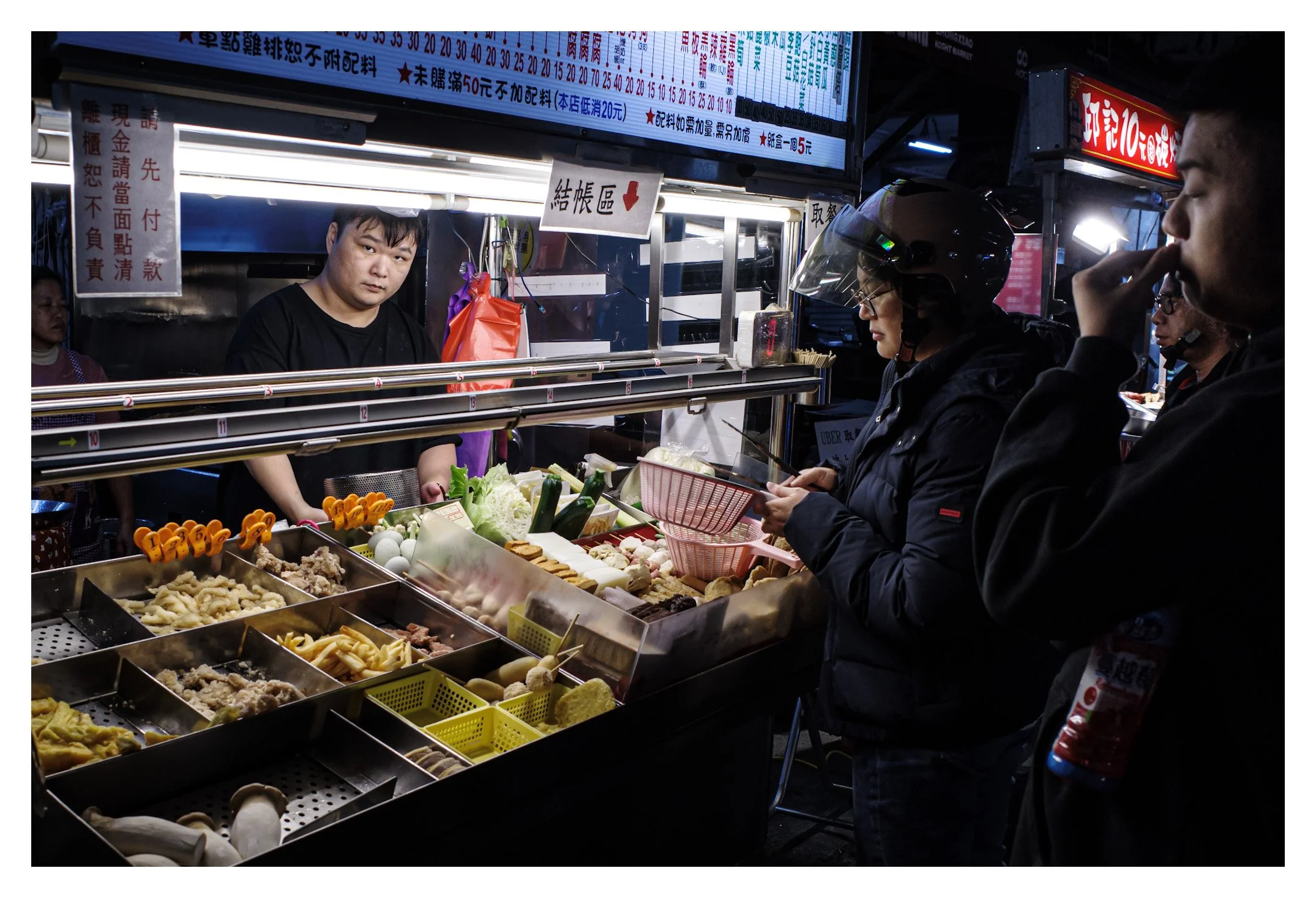
Image Metadata
Camera Model: Ricoh GRIII
Shutter Speed: 1/125
Aperture: f3.2
ISO: 640
The Critique
This image is a successful exercise in what I call "ordered chaos." You have stepped into the visual cacophony of a Taiwanese night market—a place where steam, neon, and humanity collide—and you have managed to extract a moment of stillness.
The Anchor of the Gaze
The strongest element here is undoubtedly the vendor’s direct eye contact. In a frame cluttered with menu signs, plastic baskets, and foreground figures, his gaze acts as a visual anchor. Without it, this image would simply be a document of a busy stall. With it, it becomes a confrontation. He is the calm center of the storm, looking back at you, the observer. This breaks the "fourth wall" of street photography in a way that feels intimate rather than intrusive.
Layering and Depth
You are utilizing a classic three-layer composition, a technique often mastered by the likes of Alex Webb.
• Foreground: The man on the right, eating or drinking, provides a dark frame that pushes the eye inward.
• Midground: The woman in the helmet interacts with the stall, adding narrative context—this is a transaction.
• Background: The vendor and the signage provide the setting and the emotional connection.
Color and Light
The Ricoh GRIII’s lens has rendered the mixed lighting beautifully. You have the harsh, cool fluorescent light illuminating the food (making it pop) and the vendor’s face, contrasting with the deep shadows of the periphery. The "cool" cast of the light works well here; it feels authentic to the harsh reality of street vending at night, rather than romanticized warmth.
Areas for Improvement
1. Managing the Edges
While the layering is strong, the foreground figure on the right occupies a significant portion of the frame (roughly 25%). His darkness acts as a negative space that feels slightly too heavy.
• The Fix: A half-step to your left would have kept him in the frame as a layer but reduced his dominance, revealing more of the interaction between the woman and the food.
2. Separation
The helmeted woman overlaps slightly with the food display in a way that muddies the shapes.
• The Fix: Waiting for a fraction of a second—perhaps when she reached out or turned her head—might have created a cleaner separation between her silhouette and the brightly lit stall.
Becoming a Better Photographer: The Data Approach
You asked how to improve over time. The answer lies in your own archives. You must treat your catalog not just as storage, but as a dataset.
Analyze Your "Keepers"
Filter your library for your 5-star images from the last year. Look at the metadata.
• Shutter Speed: You shot this at 1/125. Is this your sweet spot? If you find many of your blurred failures are at 1/60, you know your hand-holding limit.
• ISO: You are at ISO 640 here, which is quite clean. Do not be afraid to push this. The Ricoh GRIII sensor handles grain beautifully—embrace the grit.
• Focal Distance: Review how close you physically get. If your best shots are under 2 meters, force yourself to stay in that "danger zone."
Create "Contact Sheets"
Don't just look at the final edit. Look at the sequence of 10 photos you took before and after the winner. Did you stop shooting too soon? Did you miss a better gesture because you were checking the screen? This analysis is where growth happens.
Recommendations for Study
To refine your eye for complex, layered night scenes, I recommend the following resources. I have selected books from your own database that you should revisit, and added external artists who master this aesthetic.
Photographers to Research
• Greg Girard: No one captures the mood of Asian nightlife, neon, and the "vanishing" city better. His work on Hong Kong and Vancouver nights is essential study for color grading and mood.
• Alex Webb: For his mastery of complex, multi-layered frames where every inch of the photograph is active. He turns chaos into geometry.
• Daido Moriyama: Since you own a Ricoh (a favorite of his), study him not for his composition, but for his attitude. His work is gritty, high-contrast, and fearless.
Books to Read (From your Library)
• "The Suffering of Light" by Alex Webb: This is the bible of color street photography. Study how he manages deep shadows and bright colors simultaneously.
• "Tokyo Compression" by Michael Wolf: Your image has a tightness to it. Wolf’s work explores the extreme density of urban life. It will teach you how to make "claustrophobia" a stylistic choice rather than an error.
• "Bystander: A History of Street Photography": Use this to understand the lineage you are part of. It’s a reference guide to the evolution of the candid gaze.
Videos to Watch
• Greg Girard: The Photographer who Captured Vanishing Cities.
• Daido Moriyama: The Shocking Truth About Daido Moriyama's Street Photography Style.
• Alex Webb: The Art of Complexity.
Would you like me to analyze the composition of another image to see if you are consistently applying these layering techniques?
How Alex Webb Turns Street Photography Chaos Into Art: Seeing Like a Photographer
I selected this video because Alex Webb is the master of the specific "layered" composition style you attempted in this photo; understanding his process will directly help you refine the foreground/background balance in your future night market shots.