

Day 84/365 The Reluctant Shutter: Finding Art in Fatigue
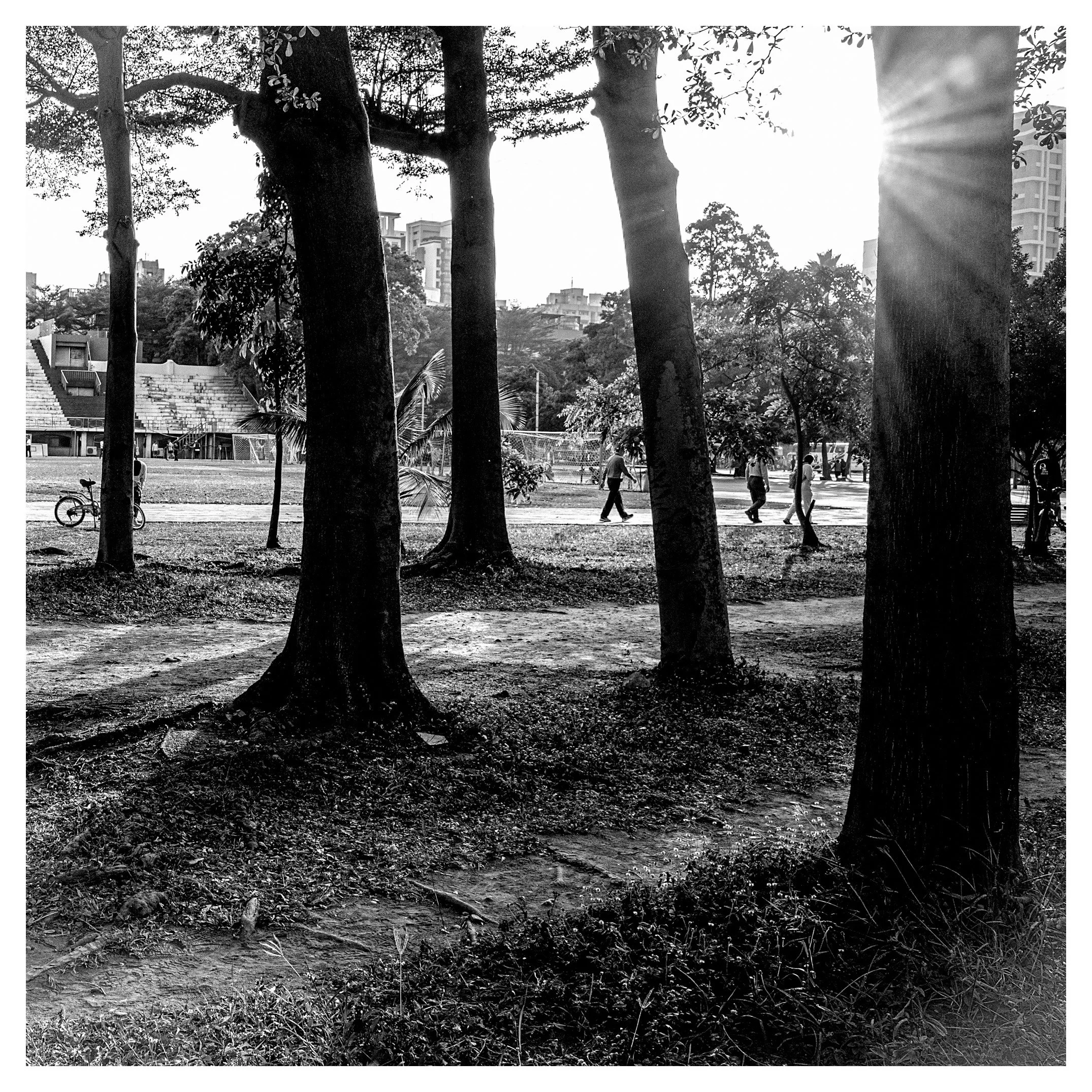
EXIF Data
Camera Model: Ricoh GRIII
Shutter Speed: 1/320
Aperture: f8
ISO: 500
Critique
There is a distinct honesty in the image that stems directly from your context. You mention a lack of motivation and the physical drag of a cold, yet you still stopped. That act alone—the stopping—is half the battle in photography.
Visually, you have leaned heavily on the high-contrast capabilities of the GRIII. The choice of f8 was technically sound, allowing for that sharp, defined sunstar bursting through the upper right canopy. The silhouettes of the trees are commanding, perhaps too much so; they act as heavy, dark bars that cage the scene. However, this weight effectively contrasts with the lightness of the background—the distant stadium seating and the small, ephemeral figures walking through the light.
The composition is busy. The bicycle on the far left, likely yours or a fellow commuter's, sits on the edge of the frame, creating a slight visual tension that pulls the eye away from the center. A purist might crop it, but in the context of "Day 84," it serves as a jagged reminder of the ride itself. The image is not a masterpiece of clean composition, but it is a successful exercise in seeing light amidst the mundane. You captured the drama of the backlighting, which turns an ordinary park scene into something theatrical.
Becoming a Better Photographer: The Data Approach
You asked how to improve by compiling data on your images. This is a scientific approach to an artistic pursuit, and it is highly effective for self-diagnosis. Do not just track technical settings; track your "Hit Rate" and "Intent."
Create a spreadsheet with columns for the following:
• Focal Length & Aperture: You may find you are technically sharpest at f8 but emotionally most resonant at f2.8.
• Light Quality: Hard Sun, Overcast, Night, Window Light.
• Mood/Energy: Rate your energy level (1-10) when taking the shot. You might discover, surprisingly, that your best work comes when you are tired and relying on instinct rather than overthinking—just like today.
• The "Keeper" Flag: Mark images as "Portfolio," "Blog," or "Trash."
Over six months, analyze this data. You might find that 80% of your "Portfolio" shots were taken in "Hard Sun" or that you rarely keep images shot below 1/125th of a second. This removes the guesswork from your growth.
Recommendations
To refine your eye for high-contrast black and white and the "daily grind" of observation, I recommend the following resources.
Photographers to Study
• Fan Ho: For his mastery of light, shadow, and geometry in urban settings. Your image attempts the kind of dramatic backlighting he perfected in Hong Kong.
• Trent Parke: His work often deals with harsh Australian light and deep blacks, turning the ordinary into the dreamlike.
• Daido Moriyama: For a grittier, grainier, and more chaotic approach to street photography that embraces the "stray dog" mentality of wandering the city.
Books to Read
• Minutes to Midnight by Trent Parke. This body of work is an essential study in high-contrast black and white storytelling.
• The Americans by Robert Frank. Since you are capturing moments on your daily commute, Frank's seminal work on his road trip across the USA will teach you about sequencing and the outsider's gaze.
Videos to Watch
• The Narrative Photography of Fan Ho: This video breaks down how Ho used light to carve out his compositions, much like you attempted with the sunburst. https://www.youtube.com/watch?v=YMhm5gBJZUY
• Trent Parke: Mastering Storytelling in Street Photography: An excellent look at how Parke pushes his film and composition to the extreme edges of dynamic range. https://www.youtube.com/watch?v=zom_efQccvc