

EXIF Data
• Camera Model: Leica D-Lux 8
• Shutter Speed: 1/125
• Aperture: f/2.8
• ISO: 1250
The Critique
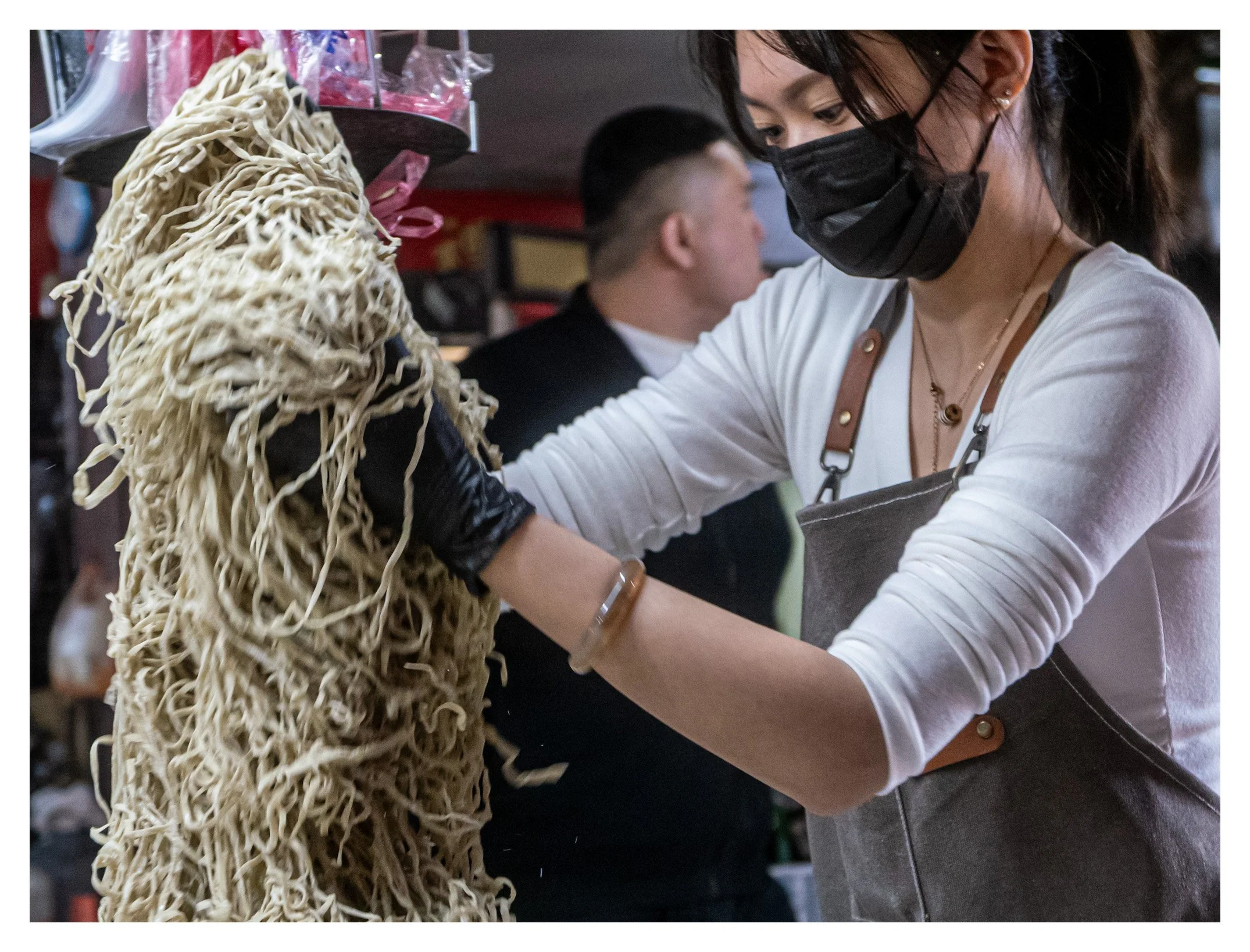
You have captured something visceral here. This is not just food; it is a curtain of texture that dominates the frame. By freezing the noodles in mid-air, you have turned a mundane culinary process into a sculptural event. The "Leica look" is present in the micro-contrast of the noodle strands, which appear almost like tangled wire or yarn, giving the image a heavy, industrial feel.
The Technicals:
Your choice of 1/125 shutter speed is on the artistic edge. It is fast enough to keep the mask and face relatively sharp, but slow enough to allow a slight "shimmer" in the moving noodles. This is a sophisticated creative choice; if it were frozen perfectly at 1/1000, the noodles might look plastic and artificial.
The ISO 1250 is aggressive for the D-Lux 8, which utilizes a Four Thirds sensor. While modern noise reduction is powerful, you can see the digital structure (grain) in the darker background. However, this grit fits the street aesthetic perfectly—it feels raw and unpolished, rather than clinically clean.
The Composition:
The cropping is tight and claustrophobic in a positive way. The subject's eyes are focused, and the mask adds a layer of anonymity that universalizes the labor. The image is about the act of making, not just the maker. However, the background is a bit muddy. The man in the black suit behind her creates a visual dead spot that pulls the eye away from the main texture.
Advice for Improvement
1. Managing the "Visual Hole"
The figure in the black suit behind your subject is a distraction because he creates a dark void without detail. Since you are using a compact camera with a smaller sensor, you cannot rely solely on "bokeh" (background blur) to obliterate distractions.
• The Fix: A small step to the right would have placed the subject against a cleaner background, or waiting five seconds for the background figure to move would have isolated the "sculpture" of the noodles.
2. Push the Contrast in Post
The lighting appears to be flat market fluorescence. In your editing software, try dodging the noodles (brightening them) and burning the background (darkening it). This will mimic the effect of a studio strobe light, making the noodles pop forward and pushing the background distractions into the shadows.
3. Become a Data Scientist of Your ISO
To improve over time, you need to understand the "breaking point" of your specific gear.
• The Experiment: Create a column in your tracking spreadsheet for "Perceived Noise." Rate your night shots from 1 to 10.
• The Goal: You might find that on the D-Lux 8, your personal limit for acceptable texture is ISO 1600. Knowing this limit prevents you from shooting at ISO 3200 and hoping for the best. It forces you to find better light.
Recommendations
To refine your eye for texture and high-contrast night photography, I recommend studying the following masters who excel at turning the chaotic into the graphic.
Photographers to Research:
• Michael Wolf: Specifically his work Tokyo Compression. He photographs commuters pressed against subway windows. Study how he fills the entire frame with texture (skin, condensation) to create a feeling of pressure, much like your wall of noodles.
• Fan Ho: Although known for 1950s Hong Kong, his understanding of light is timeless. He often used steam and smoke to simplify chaotic street scenes. Watch how he uses backlighting to turn figures into silhouettes.
• Daido Moriyama: A master of the "Provoke era," known for high contrast, grit, and blur. His work validates the use of high ISO noise as an artistic texture rather than a technical failure.
Books to Read:
• "Tokyo Compression" by Michael Wolf: Essential for learning how to make "tight" images feel expansive.
• "Portrait of Hong Kong" by Fan Ho: Study this for the use of shadow and classic composition.
• "Farewell Photography" by Daido Moriyama: For a dive into the blurry, out-of-focus, and grainy aesthetic that pushes photography toward the abstract.
Videos to Watch:
• Fan Ho - The Art of Photography
A breakdown of how Fan Ho used lighting to create drama in everyday street scenes, perfect for learning how to simplify your backgrounds.
• Artist Daido Moriyama – In Pictures | Tate
Daido Moriyama walks through Shinjuku and discusses his "snapshot" style. This is essential viewing to understand that "grit" and "grain" are artistic tools, not mistakes.
• Michael Wolf - Rush Hour Portraits of the Tokyo Subway
This short feature explores Wolf's "Tokyo Compression" series. Notice how he crops tightly on faces and hands, similar to how you cropped the noodles and hands in your image.