

Day 88/365 Reflections in Distortion: The Urban Mirror
EXIF Data
Camera Model: Leica D-Lux8
Shutter Speed: 1/125
Aperture: f/2.8
ISO: 320
Critique
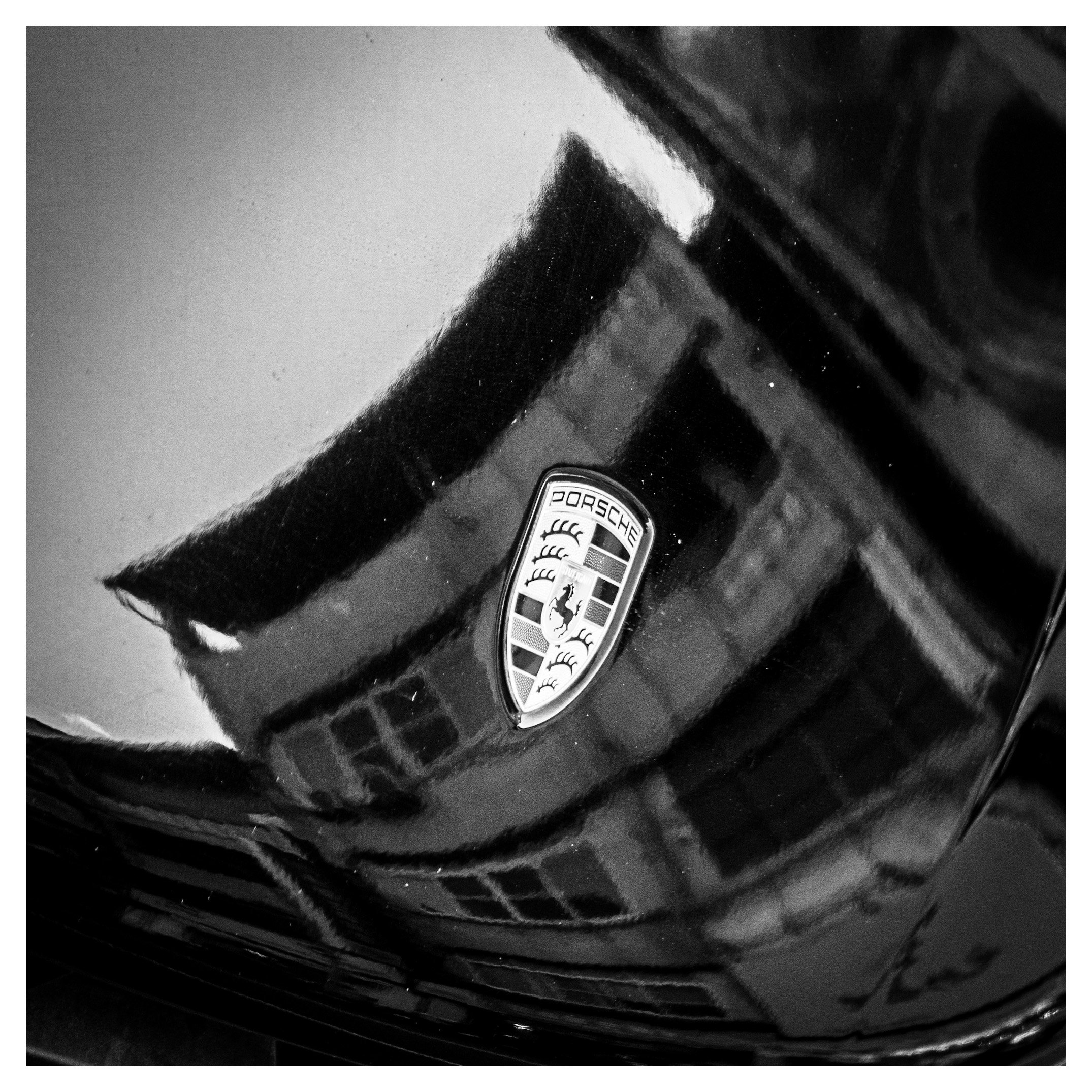
In this variation, the crop is significantly more confrontational. By placing the Porsche crest lower in the frame and centering it horizontally, you have removed the dynamic "escape" that the previous composition offered. The viewer's eye is pinned to the badge, unable to exit. This creates a gravitational pull that feels heavier, almost static, yet the surroundings are in chaotic motion.
The reflection is the true protagonist here. The curve of the car’s hood acts as a fisheye lens, bending the reflected architecture—likely a multi-story building—into a sweeping, aggressive arc. This distortion contrasts beautifully with the rigid, shield-like geometry of the emblem. The monochrome conversion is successful in highlighting the "orange peel" texture of the paint, adding a tactile, gritty quality that contradicts the smoothness usually associated with luxury vehicles.
However, the crop feels slightly indecisive at the bottom edge. You have cut close to the emblem, but left a sliver of darkness that doesn't quite ground the image. The reflection of the windows creates a "ladder" effect leading the eye down, but they crash abruptly into the bottom frame.
Improving the Image
• Mind the Edges: The bottom bezel of the image is heavy and visually murky. A crop that either included more of the bumper to provide a base, or cut tighter into the crest to eliminate the dead space at the bottom, would be stronger.
• Aperture and Depth: At f/2.8, your depth of field is shallow. While the badge is sharp, the reflected building is soft. Stopping down to f/5.6 or f/8 would have rendered the reflection with razor-sharp clarity, turning the hood into a true mirror and layering the two realities (the car and the building) on top of each other with equal visual weight.
• Verticality: The image is square, but the energy is vertical due to the reflected building. Experimenting with a portrait orientation might have allowed that curved reflection to "climb" further, emphasizing the looming nature of the architecture over the car.
The Data of Vision: Becoming a Better Photographer
To evolve, you must move beyond technical settings and analyze your success rate. I recommend tracking your "Keeper Ratio."
1. The Keeper Ratio: In your metadata management tool (like Lightroom or Capture One), tag every photo you actually publish or print with 5 stars. Now, look at the ratio of 5-star images to total shots taken per session. If you are taking 500 photos to get 1 good one, you are "spraying and praying." Aim to lower your total shot count while maintaining your number of keepers. This forces intention.
2. Subject Correlation: Tag your photos by subject matter (e.g., "Abstract," "Street," "Portrait"). Analyze which category has the highest Keeper Ratio. You might find you are statistically a better abstract photographer than a street photographer. Lean into what the data says is your natural strength.
3. Time of Day: Filter your best images by capture time. You might discover that 80% of your best work happens between 4 PM and 6 PM. If so, stop wasting your energy shooting at noon.
Recommendations
For this image, which balances urban grit with high-contrast composition, you need to look at photographers who found surrealism in the city streets.
Photographers to Study:
• Masahisa Fukase: A Japanese master known for his obsessive, dark, and deeply personal work. His high-contrast, grainy style fits the mood you are cultivating.
• Fan Ho: Although his work is often more scenic, his mastery of light, shadow, and geometric composition in Hong Kong is unparalleled. He turns urban chaos into organized patterns.
• Garry Winogrand: For his use of tilted horizons and aggressive framing. He captured the energy of the street, often with a sense of chaos that mirrors the reflections in your image.
• Josef Koudelka: His high-contrast, gritty panoramas and landscapes often feature heavy textures and isolation, relevant to the "island" feel of the emblem here.
Books to Read:
• "Ravens" by Masahisa Fukase: This is essential for understanding how to use darkness and abstraction to convey solitude and obsession.
• "Portrait of Hong Kong" by Fan Ho: Study this for the interplay of light and shadow. He turns the mundane into the theatrical.
• "The Decisive Moment" by Henri Cartier-Bresson: The "bible" of timing. While your subject is static, the reflection suggests a fleeting moment of alignment.
• "Gypsies" by Josef Koudelka: A masterclass in gritty, high-contrast black and white photography that emphasizes form and texture.
Video to Watch:
... Fan Ho - The Art of Photography ...
I selected this video because Fan Ho was a master of using shadow to crop images in camera. He would often use dark areas to hide distractions and force the viewer's eye to the light, a technique that directly applies to how you handle the reflections on the car hood.