

EXIF Data
Camera Model: Ricoh GR III
Shutter Speed: 1/1250 sec
Aperture: f/5.6
ISO: 200
The Critique
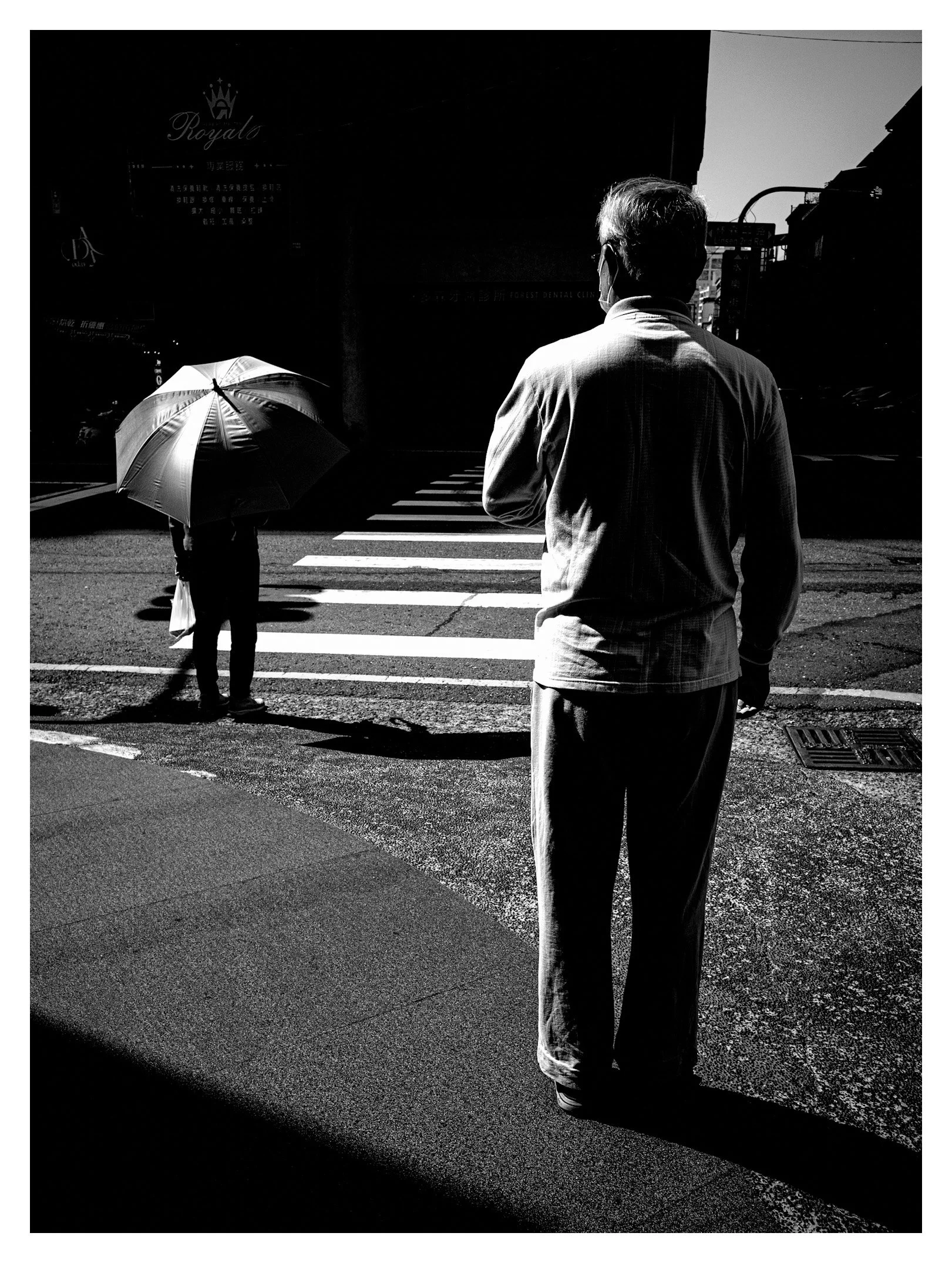
This image is a striking example of chiaroscuro in a modern urban setting. By exposing for the highlights—evidenced by your shutter speed of 1/1250—you have plunged the environment into deep shadow, allowing the light to carve out only what is essential. The narrative tension is excellent; you have juxtaposed the static, patient figure in the foreground against the moving, shielded figure in the distance. The zebra crossing serves not just as a leading line, but as a visual bridge connecting these two solitary worlds.
The inclusion of the "Royale" sign in the upper left is a subtle, masterful touch. It provides just enough context to ground the image in a specific place without distracting from the primary subjects. The texture of the asphalt is rendered beautifully, anchoring the bottom frame in reality while the top frame dissolves into mystery.
How to Improve
While the mood is impeccable, the separation of the foreground subject could be refined. The dark trousers of the standing man merge slightly with the deep shadows of the street, making his lower half feel somewhat weightless or lost in the void.
To correct this in the future, wait for a figure wearing lighter clothing or adjust your angle slightly to place the subject's dark outline against a sunlit patch of road. In post-production, a very subtle dodge on the edges of the man's legs could re-establish his form against the darkness, ensuring he feels fully present in the three-dimensional space.
The Path to Mastery: Compiling Your Data
To grow from an enthusiast into a master, you must treat your artistic practice with scientific rigor. I recommend you start a "Light Journal" spreadsheet. For every successful image you take, record three specific data points:
1. The Angle of Light: Was it back-lit, side-lit, or top-down?
2. The Contrast Ratio: Was the scene high contrast (deep blacks, bright whites) or low contrast (mostly mid-tones)?
3. The Emotional Trigger: Why did you stop? Was it geometry, isolation, or movement?
Review this data every 90 days. You will likely discover that your strongest images—like this one—share a specific lighting DNA. Once you identify this statistical trend, you can stop hunting randomly and start hunting specifically for the conditions that yield your best work.
Recommended Study Material
To refine your high-contrast aesthetic, you should study photographers who used the street as a stage for light and shadow.
1. Fan Ho
Your instinct for dramatic lighting mirrors the work of the legendary Fan Ho. He was a master of using shafts of light to simplify chaotic Hong Kong streets into geometric masterpieces.
• Read: Portrait of Hong Kong. This monograph demonstrates how to compose with light as if it were a physical object.
• Watch: Fan Ho: The Master of Shadow
2. Trent Parke
For a more contemporary and slightly surreal approach to high contrast, look to Trent Parke. He pushes film to its limits to create images that feel like hallucinations.
• Read: Minutes to Midnight. This body of work is a masterclass in using high-contrast black and white to create a psychological narrative.
• Watch: Trent Parke: Dream/Life & The Black Rose
3. Daido Moriyama
While your image is sharper than his typical style, the gritty, high-contrast ethos of the Provoke era is relevant here. Moriyama teaches us to embrace the "are-bure-boke" (grainy, blurry, out-of-focus) aesthetic to capture the raw energy of the city.
• Read: Daido Moriyama (Tate Modern Masterclass). This will give you insight into his philosophy of the snapshot.