

Day 92/365 The Illuminated Promise: Deconstructing the Political Landscape
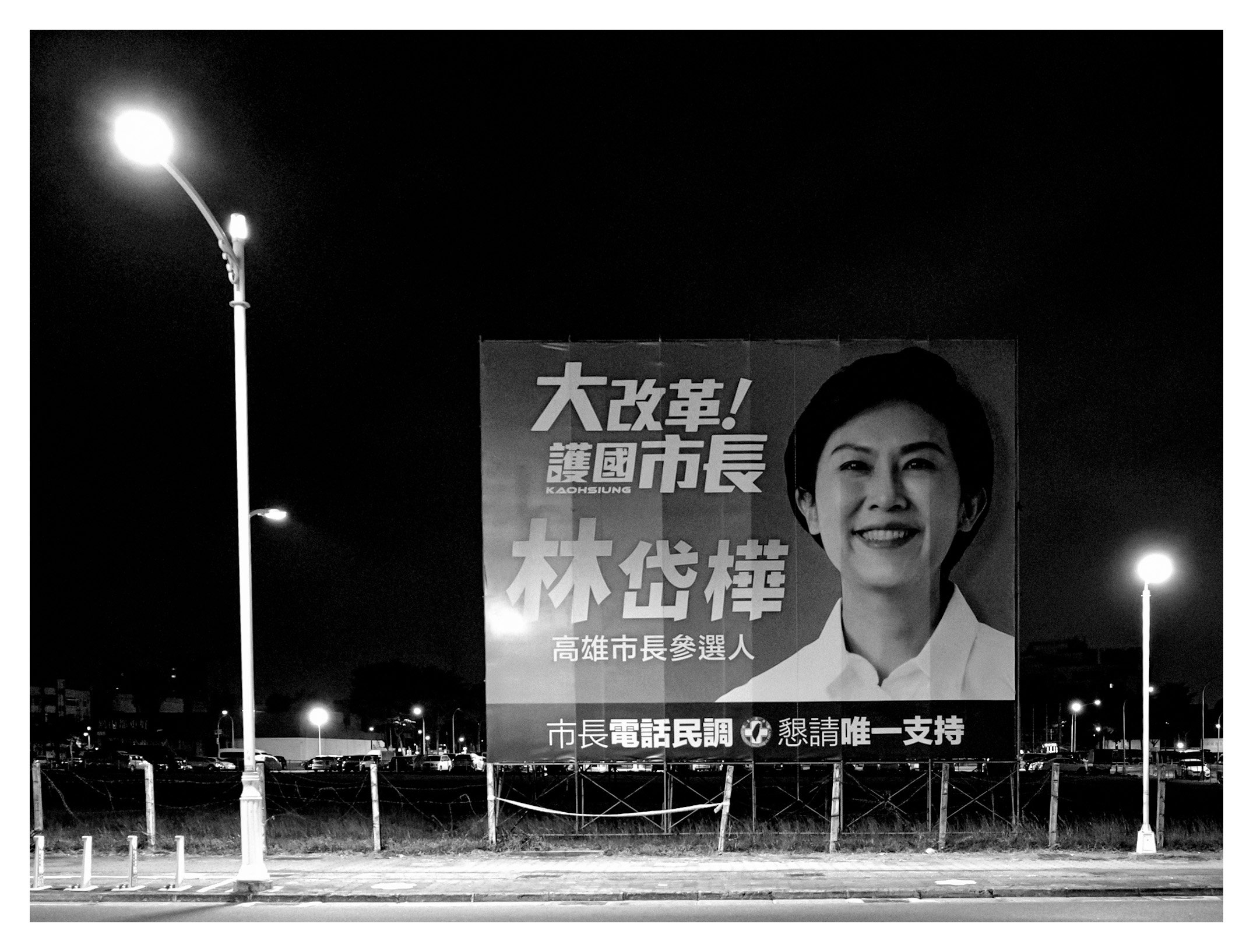
EXIF Metadata
• Camera Model: Ricoh GR III
• Shutter Speed: 1/60 sec
• Aperture: f/2.8
• ISO: 6400
The Critique
You have captured a stark, arresting moment of dissonance in Kaohsiung. The Ricoh GR III is a legendary street camera, famous for its high-contrast black and white "snapshot" aesthetic, and you have leaned into that heritage here.
The composition relies on a classic tension between the artificial sun of the streetlamp and the beaming face of the candidate, Lin Dai-hua. The text "Great Reform!" (大改革!) hangs in the void, promising change to an empty lot. The high-contrast processing serves you well; it emphasizes the texture of the barbed wire in the foreground—a subtle but biting visual metaphor that separates the viewer (the electorate) from the polished promise on the billboard.
The use of ISO 6400 is not a flaw here; it is a texture. It adds a grit that feels appropriate for a political critique. However, the image suffers from "soot and chalk" exposure. The streetlight is blown out, creating a "hole" in the image that draws the eye away from the subject without offering detail in return. The deep blacks are velvety, which is excellent, but we lose the context of the environment. Is this a construction site? A wasteland? A touch more shadow detail would ground the floating head in a specific reality.
How to Improve This Image
Control the Highlights: The streetlight is the brightest point in your frame, and at f/2.8 with these settings, it has lost all information. In high-contrast night scenes, expose for the highlights (underexpose the image slightly by -1 or -2 EV) to preserve the shape of the light source, then lift the shadows in post-production.
Mind the Edges: The white border frames the image like a gallery print, but the bottom edge cuts off the street markers abruptly. Ensure your crop feels intentional—either include the street curb as a leading line or crop it out entirely to focus on the floating nature of the billboard.
Becoming a Better Photographer: The Data Log
You asked how to improve over time. You cannot improve what you do not measure. To evolve from taking "snapshots" to making "photographs," you must compile data on your work.
Create a simple log (a spreadsheet) for every serious shoot. Record not just the settings, but the intent.
Columns to track:
1. Technical: Shutter, Aperture, ISO.
2. Environmental: Light source (Streetlamp, Neon, Moon).
3. The "Why": What feeling were you trying to capture? (e.g., "Isolation," "Hope," "Irony").
4. The Result: Did you achieve it? If not, why?
Over time, you will see patterns. You might realize you consistently underexpose in high-contrast scenes, or that your best emotional work happens when you are forced to use high ISOs like 6400. This self-analysis is the fastest route to mastery.
Recommendations
To refine your eye for the social landscape and high-contrast monochrome, I recommend the following resources.
Photographers to Research
• Shen Chao-Liang (沈昭良): A Taiwanese master. His series STAGE documents the mobile stage trucks of Taiwan. While his work is often in vibrant color, studying how he frames these artificial structures against the Taiwanese landscape is essential for you.
• Daido Moriyama: The Japanese master of the "Provoke" era. His work is often grainy, blurry, and out-of-focus. His high-contrast street photography will teach you how to embrace the grit of your Ricoh GR III.
• Robert Frank: His seminal work captured the isolation and irony of the American landscape. Your billboard photo shares a spiritual DNA with his view of public signage.
Books to Read
• The Americans by Robert Frank
• Stage by Shen Chao-Liang
• The Chain by Chien-Chi Chang (Another Magnum photographer from Taiwan—essential study for alienation).
Videos to Watch
• Daido Moriyama: "The Mighty Power" – A documentary look at how he prowls the streets. Watch here
• Shen Chao-Liang on the "Stage" Series – This helps understand the cultural context of capturing Taiwanese structures. Watch here