

Day 95/365 Liquid Gold & Grain: A Study in Low Light
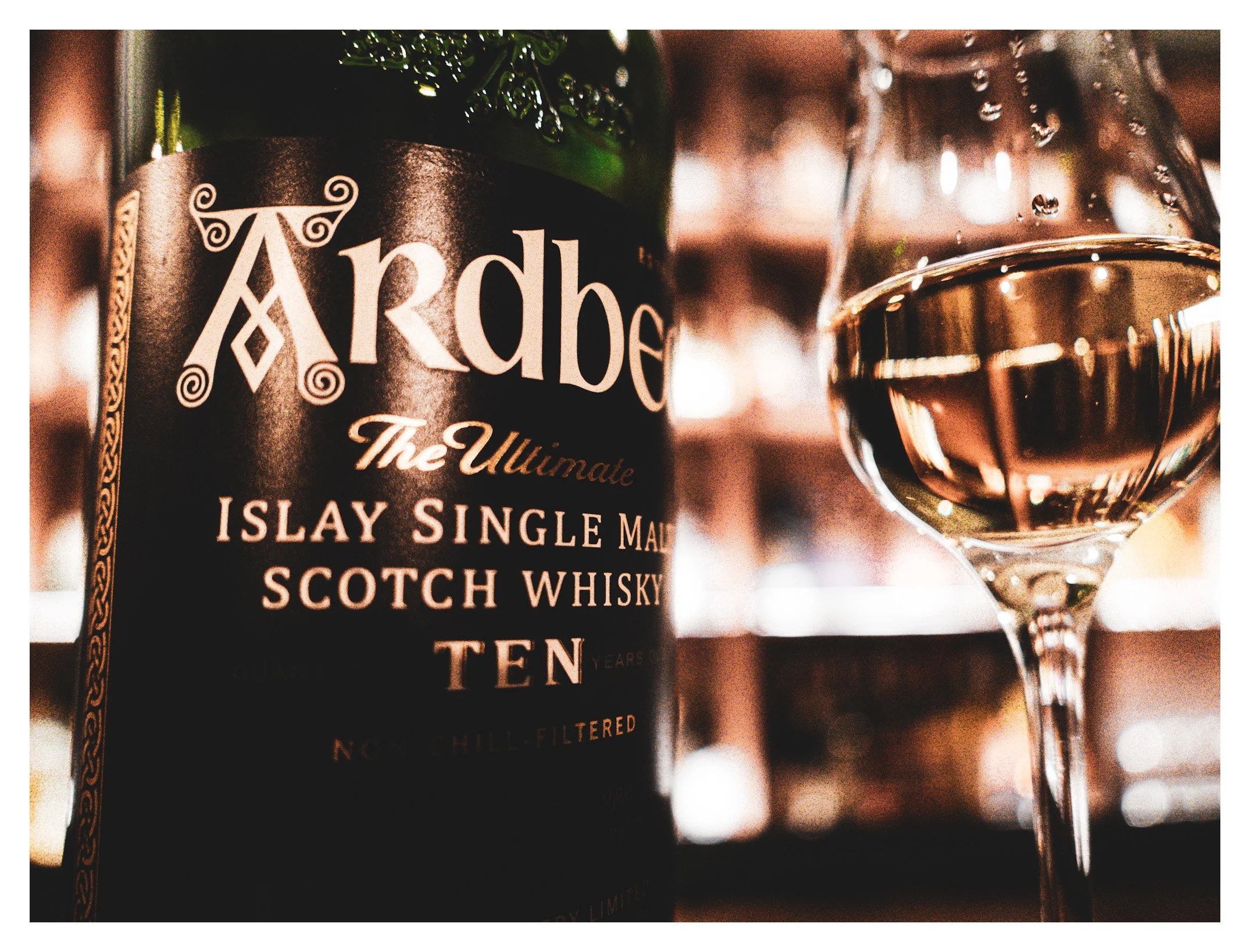
Leica D-Lux8 | 1/15s | f1.7 | ISO3200
The Critique
There is a distinct, resinous warmth to this image that immediately recalls the peaty notes of the subject itself. You have leaned into the atmosphere here, eschewing clinical perfection for a "felt" image. The shallow depth of field at f/1.7 successfully isolates the "Ardbeg" typography, lending it a monumental quality, while the glass recedes into a soft, golden bokeh.
However, we must address the technical gamble you took. At 1/15th of a second, you are dancing on the edge of motion blur. While the D-Lux8 is a capable compact, hand-holding at this speed softens the micro-contrast that a bottle label—with its intricate embossing and foil—deserves. The high ISO of 3200 introduces significant digital noise. In this specific context, it mimics film grain and complements the "gritty" whisky aesthetic, but in a different setting, it would simply look degraded. The glass, while beautifully lit, falls too quickly out of focus; a slightly stopped-down aperture (f/2.8 or f/4) would have retained the lettering's sharpness while rendering the glass more intelligibly.
Improving the Image
To elevate this shot from "atmospheric snapshot" to "intentional still life":
• Stabilize: Use a tripod or a "platypod" for table-top work. This allows you to drop the ISO to 200 or 400.
• The "Slices" of Focus: By stabilizing, you can slow the shutter to 1/2s or 1s. This frees you to stop down to f/5.6 or f/8, bringing the rim of the glass and the bottle into a shared plane of sharpness without losing the background blur entirely.
• Light Control: The highlights on the glass are somewhat scattered. A small bounce card (even a white menu or napkin) placed off-camera to the right would fill the shadows on the bottle's dark side, revealing the "Ten" years text more clearly.
Becoming a Better Photographer Through Data
You asked how to use data to improve. This is the secret weapon of the methodical artist. Do not just hoard terabytes of images; analyze your metadata to find your "sweet spots" and "fail zones."
Create a "Technical Audit" Spreadsheet:
Every month, select your 50 best images and 50 "failed" images (blurry, missed focus, bad exposure). Log the following:
• ISO Ceiling: At what ISO does your specific camera (Leica D-Lux8) lose color fidelity? You might find that ISO 1600 is acceptable for black and white but ISO 800 is your limit for color.
• Shutter Stability: Track your "hit rate" at slow shutter speeds. If 80% of your shots at 1/15s are soft, you must enforce a hard rule: "Below 1/30s, I use a tripod."
• Focal Length Bias: Group your favorites by focal length. If you notice 90% of your best work is at the 24mm or 35mm equivalent, stop forcing yourself to shoot telephoto and master your preferred wide angle.
Recommendations for Study
To refine your eye for light and composition, look outside the genre of product photography and toward masters of atmosphere and color.
Photographers to Research:
• Saul Leiter: For his mastery of shooting through glass, condensation, and obscured views. He turned "bad" weather and low light into poetry.
• Irving Penn: Specifically his still life work. He could make a frozen block of food or a piece of debris look like a classical sculpture. Study his use of "North Light."
• William Eggleston: Since you are working with color, study how he treats ordinary objects (a lightbulb, a drink on a plane tray) with democratic importance.
Books to Read:
From your library (and general canon), I highly recommend revisiting these texts to sharpen your visual literacy:
• "William Eggleston's Guide" by William Eggleston: Use this to study how color itself can be the subject of a photograph, rather than just the object you are shooting.
• "Suffering Light" by Alex Webb: While he is a street photographer, Webb is a master of complex frames. Study how he layers foreground and background elements—something you can apply to the relationship between your bottle and glass.
• "Uncommon Places" by Stephen Shore: Shore’s large-format work teaches immense discipline in composition. Every millimeter of the frame is considered.
Video for Study:
To bridge the gap between your current shot and a "studio" quality result using simple tools, I have selected a tutorial that focuses on "Old Master" lighting styles. This is highly relevant to the dark, moody aesthetic you are achieving with the whisky.
... Mastering 17th-Century Lighting in Still Life ...
I chose this video because Karl Taylor deconstructs how to create a "painterly" quality with light, which fits perfectly with the rich, amber tones of your Ardbeg bottle.