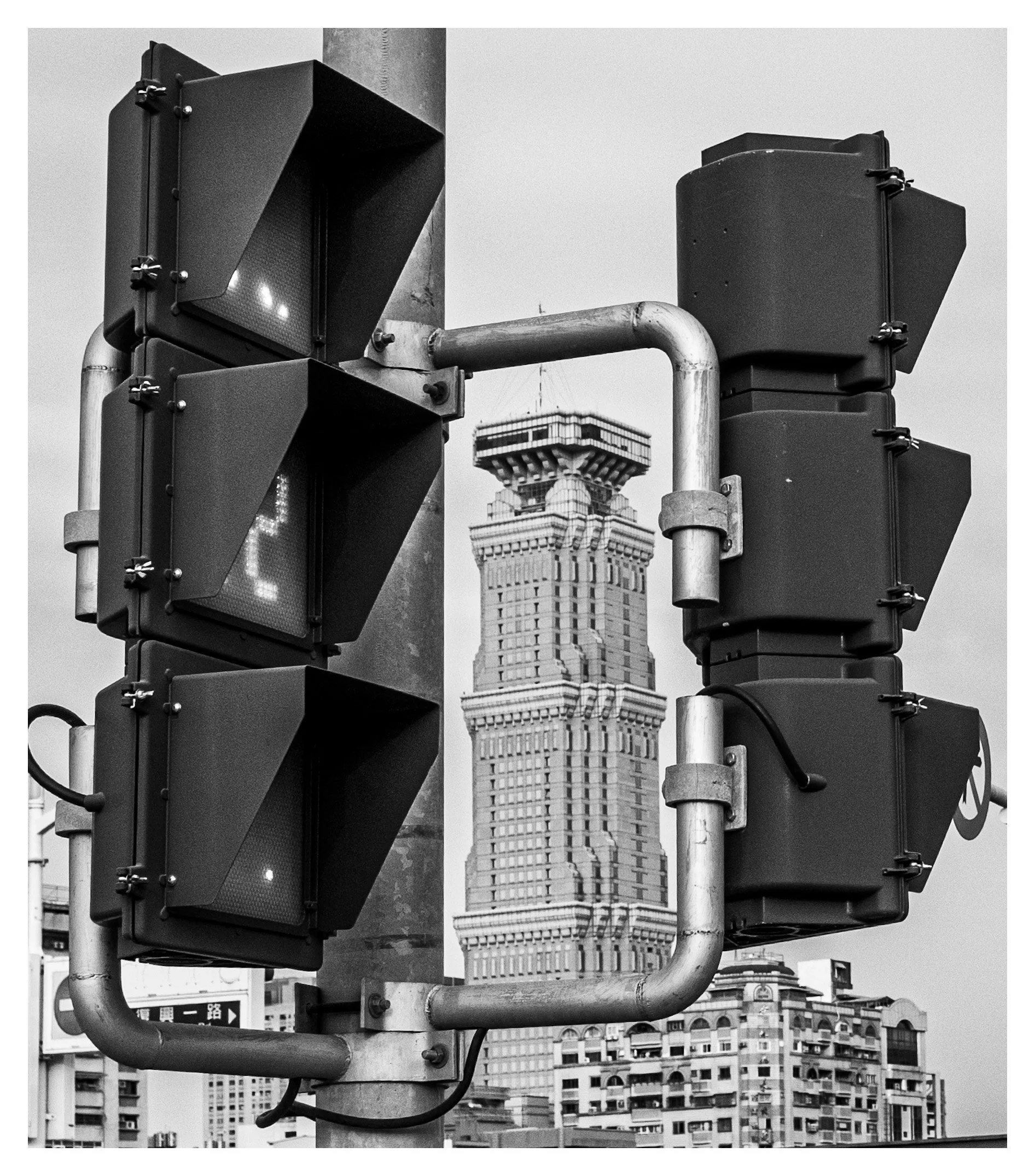
Day 94/365 Framing the Grand 50: Industrial Geometry in Kaohsiung
EXIF Data
• Camera Model: Ricoh GRIII
• Shutter Speed: 1/1000
• Aperture: f4
• ISO: 200
Critique by Theo Marr
There is a distinct architectural rigour to this photograph that commands immediate respect. You have turned your lens upon the Chang-Gu World Trade Center—the Grand 50 Tower—but you have eschewed the typical soaring vista. Instead, you have grounded this icon of Kaohsiung’s skyline in the gritty reality of the street.
The composition operates on a powerful juxtaposition. In the background, we have the intricate, pagoda-style crown of C.Y. Lee’s design, a symbol of traditional aesthetics meeting modern verticality. In the foreground, you have placed the brutal, functional geometry of the traffic signals. By utilizing these signals as a heavy, darkened frame, you create a "frame within a frame" structure that is intellectually engaged.
The choice of high-contrast black and white is correct here. It reduces the Grand 50 to its textures and tiers, allowing it to converse directly with the mechanical shapes of the lights. A countdown timer displaying "2" offers a fleeting, temporal counterpoint to the static permanence of the stone and glass behind it.
However, the image feels slightly crowded. Shooting at f4 with the GRIII’s 28mm equivalent lens compresses the layers, but the separation is minimal. The visual "weight" of the traffic light housing is immense; it occupies so much negative space that it threatens to bully the subject rather than merely frame it. The Grand 50 is a building of subtle details, and it is currently fighting for air against the heavy foreground shadows.
Advice on Improving This Image
1. Vertical Alignment and Symmetry
In architectural compositions, specifically when photographing a building with such distinct symmetry as the Grand 50, precision is paramount. The vertical lines seem to lean ever so slightly. When you introduce strong geometric frames like these traffic lights, even a one-degree tilt disrupts the viewer's sense of structural integrity. Correcting the keystoning in post-production is essential to restore the tower's authority.
2. Managing Dynamic Range
The sky is a flat, uniform grey. While this isolates the building, it lacks drama. A slight increase in contrast in the highlights, or the use of a red filter simulation, would separate the tower's intricate upper tiers from the sky more effectively, giving the "pagoda" top a more three-dimensional presence.
3. The Decisive Moment
You captured the timer at "2". A stronger narrative choice might have been to wait for a more significant interaction—perhaps a bird flying through the gap between the traffic light arm and the tower, or a cloud formation that mimics the tower's shape. The frame is static; it needs a spark of life to break the rigidity.
Long-Term Photographer Development: The Data of Vision
To evolve from taking pictures to making photographs, you must treat your work as data to be analyzed.
Compile a "Meta-Journal"
Create a simple database—much like the one you have for your book collection—where you track not just the technical metadata, but the intent and the result.
• Column 1: Intent. Why did I take this? (e.g., "Framing," "Texture," "Verticality").
• Column 2: Aperture Choice. You shot this at f4. Review your last 50 images. Do you default to f4? If so, you may be relying on the camera's sweet spot rather than making a conscious artistic decision about depth. Try shooting a series at f8 to see how deep focus changes the relationship between the traffic lights and the distant tower.
• Column 3: The "Keeper" Ratio. Track which subjects yield the highest percentage of successful images. If your architectural abstractions succeed 50% of the time, but your street portraits fail 90% of the time, you have identified exactly where your practice is required.
Recommendations for Study
To refine your eye for geometric framing and high-contrast street photography, look to the masters who treated the city as a stage.
Photographers to Research
• Lee Friedlander: The master of the "intrusive foreground." Friedlander famously used street signs and poles to bisect his compositions, much like you have done here. Study how he balances the visual weight of these intrusions so they don't overpower the subject.
• Fan Ho: Known for his work in Hong Kong, Ho was a master of using geometry and shadow to impose order on a chaotic city. His work is essential for learning how to photograph vertical cities.
• Daido Moriyama: Since you are working in high-contrast black and white, Moriyama is essential. His aggressive use of contrast and grain will teach you how to manage heavy blacks without losing texture.
Books to Read
• "Fan Ho: Portrait of Hong Kong": This is essential reading. Ho’s ability to find the "classic" composition within the modernizing city is unparalleled.
• "STAGE" by Shen Chao-Liang: As a photographer in Taiwan, you should study Shen. His work often deals with the surreal nature of structures within the landscape, which parallels your view of the Grand 50.
• "Tokyo Compression" by Michael Wolf: Study this for the sensation of density. Your image has a compressed, tight feel; Wolf took this concept to its extreme.
Videos to Watch
• The Narrative Photography of Fan Ho
This breakdown explains how Ho used geometry not just for shape, but to tell a story.
https://www.youtube.com/watch?v=YMhm5gBJZUY
• Everyday Beauty: Framing Life with Lee Friedlander
A look at how Friedlander uses the "clutter" of the street to frame his world—directly relevant to your traffic light composition.
https://www.youtube.com/watch?v=GbT13IKcs2o
• Daido Moriyama: The Space between the Illusory and the Real
Understanding the high-contrast aesthetic and the philosophy of the "snapshot."